How to Read a Crash Game Round: A Beginner’s Guide
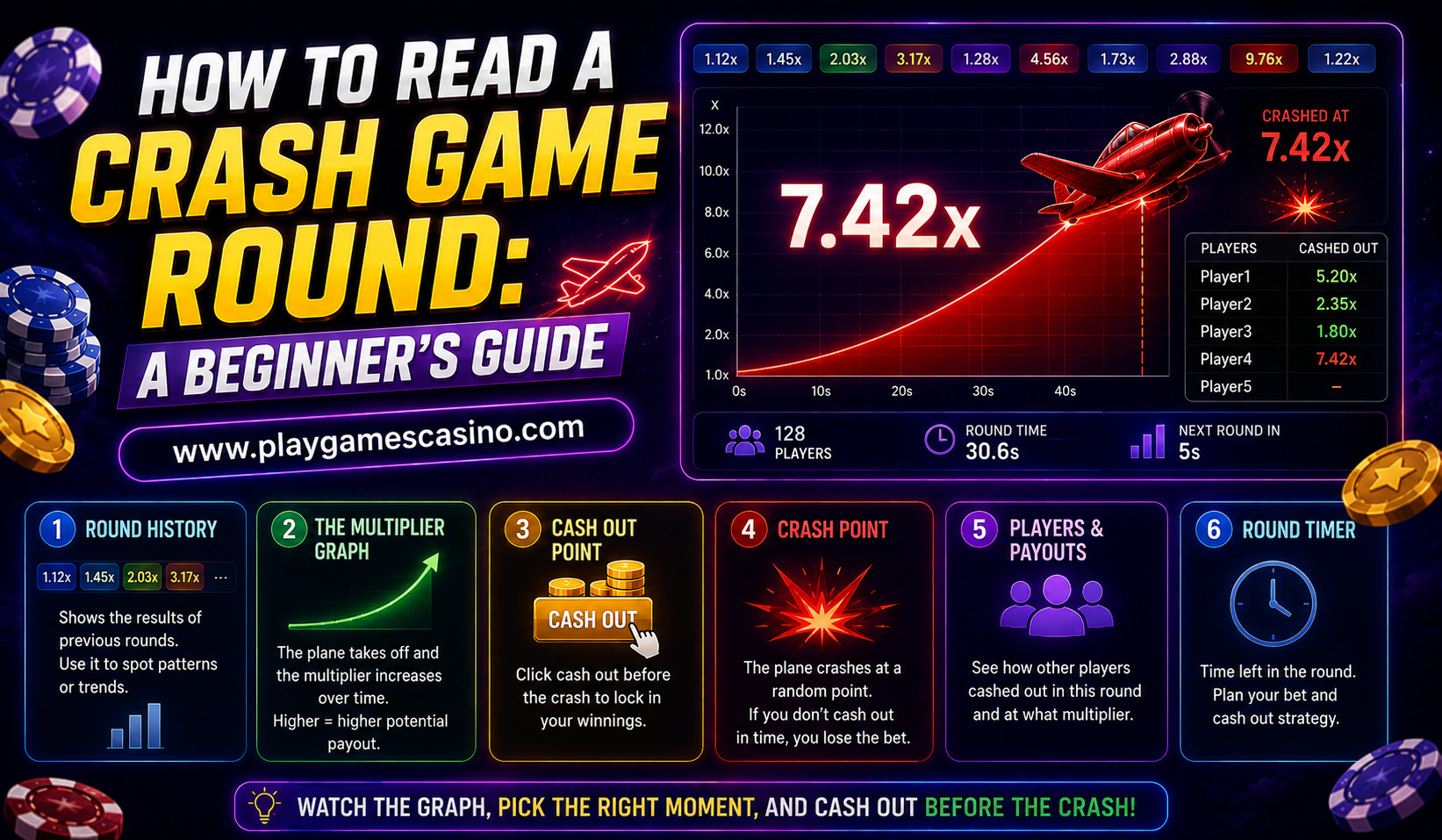
Crash games have become increasingly visible across the online gaming industry because they offer a simple format built around one rapidly changing number. A typical round begins with a multiplier near 1.00x, rises as the round continues and eventually stops at a randomly determined crash point. Before that happens, players can generally choose to cash out.
For someone seeing a crash game for the first time, the screen can appear more complicated than it really is. There may be a multiplier, betting controls, a cash-out button, previous results, player activity and additional settings. Understanding what each part means is the first step toward understanding how a round works.
This beginner’s guide explains how to read a crash game round, what the multiplier represents, how cash-out decisions work, why previous results should be interpreted carefully and which common assumptions can lead to confusion.
What Is a Crash Game Round?
A crash game round is a single cycle that begins when betting opens and ends when the multiplier reaches the game’s crash point.
At the start, players place their wagers according to the available betting limits. Once the round begins, the multiplier starts increasing. The player can then choose to cash out before the round ends.
Consider a hypothetical ₹100 wager. If a player cashes out at 1.50x, the gross return would correspond to ₹150 under a simple multiplier calculation. At 2.50x, the corresponding gross return would be ₹250. However, if the game crashes before the player’s cash-out is successfully completed, that active wager can be lost according to the game’s rules.
The important point for beginners is that the multiplier is not a countdown or a guaranteed progression toward a particular number. It simply shows the current payout multiplier while the round remains active.
Understanding the Crash Game Interface
Most crash-game interfaces share several basic elements, although their appearance differs between providers.
The multiplier is usually the largest number on the screen. It shows the current level of the round and normally increases continuously or in small increments.
The betting section displays the wager amount and controls used to participate. Once the round starts, the cash-out button becomes particularly important because it allows a player to exit before the crash.
Some games also display a history of recent crash results. Other interfaces show live betting activity, the number of players in a round or additional statistics.
A beginner should not assume that every number shown on the screen has predictive value. Some information is simply there to make the interface more interactive.
The Multiplier: The Most Important Number
The multiplier is the central feature of a crash game. It determines the gross payout associated with a successful cash-out.
For example, the following table shows how the multiplier relates to a hypothetical ₹100 wager:
| Cash-Out Multiplier | Example Wager | Gross Return |
| 1.20x | ₹100 | ₹120 |
| 1.50x | ₹100 | ₹150 |
| 2.00x | ₹100 | ₹200 |
| 3.00x | ₹100 | ₹300 |
| 5.00x | ₹100 | ₹500 |
These figures are simple illustrations rather than predictions of how frequently any multiplier will occur.
A higher multiplier represents a larger potential return, but it also requires the round to continue longer before the player exits. There is therefore a direct trade-off between potential payout and exposure to the crash.
Reading a Round Step by Step
The easiest way for a beginner to understand a crash game is to follow the round chronologically.
First, the betting phase opens. Players choose their wager and confirm their participation. Once betting closes, the round begins.
Next, the multiplier starts rising. At this point, a player with an active wager can generally choose to cash out. If they exit successfully, their payout is calculated using the multiplier at the time of the confirmed cash-out.
Finally, the crash occurs. The multiplier stops, the round ends and the game prepares for the next round.
The sequence can be summarized simply:
- Betting opens.
- Wagers are placed.
- The multiplier begins rising.
- Players can cash out.
- The round reaches its crash point.
- The next round begins after the applicable transition.
The exact timing and controls can differ from one game to another, so beginners should always read the rules of the specific title.
What Does Cashing Out Mean?
Cashing out means ending an active wager before the crash occurs in exchange for the multiplier currently displayed by the game, subject to its rules.
Suppose a player enters a round with ₹200 and cashes out successfully at 1.75x. The simple gross calculation would be ₹350. If the player waits for 2.50x but the round crashes at 2.20x, the desired cash-out level is never reached.
This is why cash-out decisions are central to crash games. The player has to decide whether the current multiplier is acceptable or whether to continue waiting.
There is no universally correct multiplier at which everyone should exit. A lower target does not guarantee an overall profit, and waiting for a higher target does not guarantee that the round will reach it.
What Happens When the Game Crashes?
The crash marks the end of the round. If a player has already completed a valid cash-out, the applicable payout is normally recorded according to the game’s rules. If the wager is still active when the crash happens, the wager may be lost.
The word “crash” can sound like a technical failure, but in this context it is simply the game’s term for the end of the multiplier sequence.
For example, if a round progresses through 1.10x, 1.40x, 1.90x and 2.30x before ending at 2.36x, the final number is the crash point. A player who successfully cashed out at 2.00x would have exited before the crash.
How to Read Previous Results
Many crash games show previous round results in a history bar. A beginner may see a sequence such as 1.12x, 1.48x, 3.20x, 1.05x and 7.10x and wonder whether it reveals what will happen next.
It does not provide a reliable prediction method.
If the game’s rounds are independently generated, previous outcomes do not force the next round to reach a particular multiplier. A run of low results does not mean that a high multiplier is guaranteed next.
This is an important distinction because historical results can be useful for understanding what has happened, but they cannot establish what must happen next.
Why High Multipliers Attract Attention
Large multipliers are visually striking. A round reaching 10x, 20x or higher can attract more attention than a round ending near 1.20x.
However, beginners should avoid interpreting the largest numbers as normal or expected targets. The possibility of a high multiplier does not mean that waiting for it is a reliable strategy.
The longer a player remains in a round, the more time there is for the crash to occur before the desired cash-out point. A high multiplier can therefore represent both a larger potential payout and greater exposure to the risk of losing the active wager.
Auto Cash-Out Explained
Some crash games offer an automatic cash-out option. Instead of manually pressing the button during a rapidly changing round, a player can enter a target multiplier in advance.
For example, a player might set an auto cash-out at 1.80x. If the round reaches that level before crashing and the game’s conditions are satisfied, the system attempts to cash out automatically.
This can make the interface easier to manage, but it does not predict the crash. Players should also understand the game’s exact rules for automatic cash-outs, including any technical or connectivity conditions.
What Does Auto-Bet Mean?
Some crash games also provide auto-bet features. These allow players to arrange wagers for multiple future rounds according to selected settings.
While this can reduce the need to manually enter every wager, it can also make it easier to participate in many rounds without actively reassessing each decision.
Beginners should therefore understand that automation changes how the controls operate, not the underlying uncertainty of the game.
Understanding RTP and Fairness
When reading information about a crash game, beginners may encounter RTP, or Return to Player. RTP is a theoretical long-term measurement describing the expected return structure of a game over a very large number of plays.
It should not be interpreted as a promise for an individual session.
Players may also encounter terms such as RNG, random-number generation and provably fair. Different games can use different technical systems. Some provide mechanisms for verifying certain results after a round, while others use independent testing and certification.
The key distinction is between verifying how a game operates and predicting its future outcomes. A transparent game can still produce unpredictable individual rounds.
A Simple Example of Reading a Round
Imagine a hypothetical game where a player enters with ₹500.
The round begins at 1.00x. The multiplier rises to 1.25x, then 1.60x and later reaches 2.10x. The player decides to cash out at 2.10x. Under a simple calculation, the gross return would be ₹1,050.
If another player waits for 3.00x and the round crashes at 2.75x, that player does not receive the 3.00x return because the target was never reached.
The example demonstrates the central idea: players are not predicting the final multiplier; they are deciding when to exit while the round is still active.
How Beginners Can Compare Crash Games
Not every crash game has identical rules or technical features. Before trying a particular title, beginners can compare several factors.
| Feature | Why It Matters |
| Game provider | Identifies the developer responsible for the title |
| RTP | Provides information about theoretical long-term return |
| Betting limits | Shows the permitted wager range |
| Cash-out options | Explains how players can exit a round |
| Auto features | Shows whether auto-bet or auto cash-out is available |
| Fairness information | Explains testing or result-verification methods |
These details are generally more useful than choosing a game simply because it displays the largest multiplier.
Conclusion
Learning how to read a crash game round is mainly about understanding the relationship between the multiplier, cash-out and crash point. The interface may contain several numbers and controls, but the central process is straightforward.
A round begins after wagers are placed, the multiplier rises, players decide whether to cash out and the round eventually ends at its crash point. A successful cash-out before the crash can produce a payout based on the applicable multiplier, while an active wager at the time of the crash can be lost according to the game’s rules.
Previous results should not be treated as a prediction tool, and high multipliers should not be viewed as guaranteed targets. Likewise, auto-bet and auto cash-out features can simplify controls but cannot remove the uncertainty associated with the game.
For beginners, the best starting point is education rather than prediction. Understanding the interface, reading the rules, checking the game’s published information and setting responsible limits can provide a clearer picture of how crash games operate.
Frequently Asked Questions
What is the multiplier in a crash game?
The multiplier shows the current payout level of an active round. If a player successfully cashes out at a particular multiplier, the wager is generally calculated using that multiplier under the game’s rules.
What does the crash point mean?
The crash point is the multiplier at which the round ends. Once the game reaches that point, players who have not successfully cashed out may lose their active wager.
Can beginners predict the crash point?
No reliable prediction can be made from previous results or the movement of the multiplier. The underlying outcome is generated according to the specific game’s mathematical system.
What happens if I cash out early?
If the cash-out is successfully completed before the crash, the payout is generally based on the multiplier at the time of the confirmed cash-out.
Is a high multiplier better?
A high multiplier provides a larger potential payout if reached and successfully cashed out, but it also involves waiting longer while the round remains at risk of crashing.