Crash Game Fairness: Understanding Random Number Generation
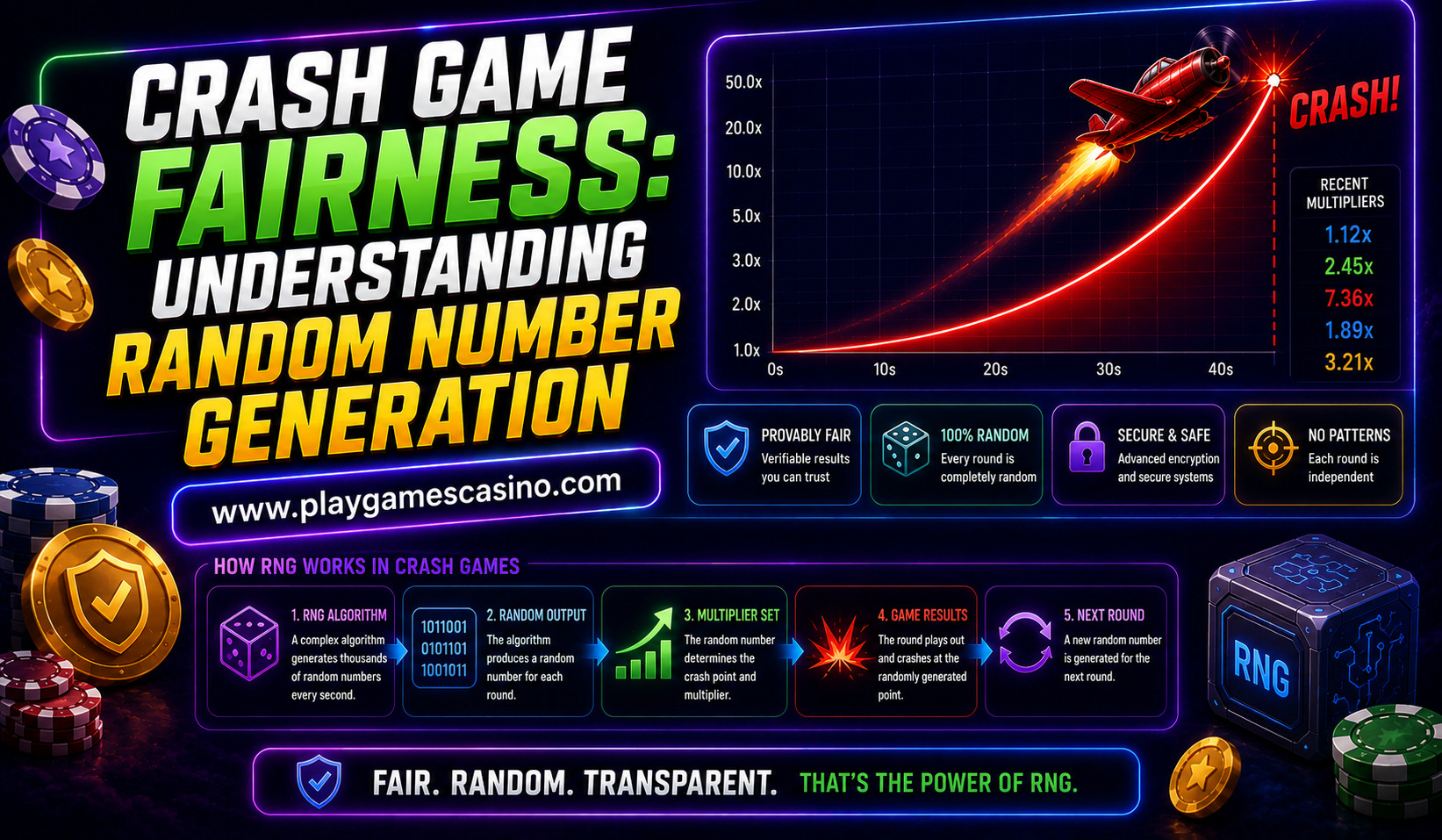
Crash games have become a familiar part of the online gambling landscape, combining a rising multiplier with a simple cash-out decision. A round begins, the multiplier increases and the game eventually ends at a crash point. Because the result can change dramatically from one round to another, questions about fairness and randomness naturally follow.
For beginners, the most important question is often straightforward: how does the game decide when to crash? The answer depends on the specific game’s technology. Many online games use random number generation, while some crash titles use cryptographic systems marketed as “provably fair.” Licensed operators may also rely on independent testing and certification to demonstrate that their games operate according to stated rules.
Understanding these systems does not make future crash points predictable. Instead, it helps players distinguish between randomness, verification and prediction. A fair system can still produce surprising results, including very short rounds and occasional extremely high multipliers.
What Does Fairness Mean in a Crash Game?
Fairness in an online crash game generally refers to whether the game produces results according to its published rules and mathematical design rather than being secretly manipulated to produce particular outcomes.
Fairness does not mean that every player wins equally or that a particular multiplier appears at regular intervals. It also does not mean that the game has no mathematical advantage for the operator.
Instead, fairness is connected to the integrity of the outcome-generation system. If a game claims to use a random process, that process should operate as described. If it uses a cryptographic verification system, the relevant information should allow results to be checked according to the provider’s stated method.
This distinction is important because a game can be random while still producing losing results for players. Randomness is about how outcomes are generated; profitability is a separate issue.
What Is Random Number Generation?
Random Number Generation, commonly abbreviated as RNG, refers to technology used to produce unpredictable numerical outcomes. In online gaming, RNG systems can determine the result of a game event according to a defined mathematical process.
A computer cannot simply “think” of a random number in the same way a person might choose one. Instead, software uses algorithms and, in some systems, additional sources of entropy to generate sequences intended to behave randomly.
In a crash game, an RNG or related mechanism can be used to determine the crash outcome. The visual multiplier then presents that outcome to the player through an animated interface.
The important point is that the animation and the underlying mathematical process are not necessarily the same thing. The aircraft, rocket, astronaut or other visual element is primarily a way of presenting the changing multiplier.
How RNG Can Influence a Crash Round
A simplified crash-game process can be understood in three broad stages. First, the game establishes the inputs required for the outcome. Second, a mathematical process produces the relevant result. Third, the game converts that result into a crash point and displays the multiplier.
The exact algorithm is different from one provider to another, so there is no universal formula that applies to every crash game.
A simplified example might look like this:
| Stage | What Happens |
| Input generation | The system collects the required random or cryptographic inputs |
| Outcome calculation | An algorithm processes those inputs |
| Crash point | The result is converted into a multiplier |
| Game display | The multiplier rises until the crash point is reached |
This table is a conceptual explanation rather than a description of one specific provider’s proprietary system.
Why Randomness Matters
Randomness prevents players from reliably knowing the outcome of an individual round in advance. Without an unpredictable outcome-generation process, players could potentially identify weaknesses and anticipate results.
For crash games, unpredictability is especially important because the entire experience is built around uncertainty. A player sees the multiplier rising but does not know exactly when the round will end.
This explains why one round might finish around 1.10x while another reaches 8x or much higher. Different outcomes can occur because the underlying process does not have to follow the pattern established by previous rounds.
A series such as 1.15x, 1.40x, 1.08x, 2.20x and 1.30x does not automatically mean that a high multiplier is next. If rounds are independently generated, previous outcomes do not force the next result.
What Is a Provably Fair Crash Game?
The phrase “provably fair” is commonly associated with online games that use cryptographic methods to allow players to verify certain game outcomes.
The concept generally involves information such as a server seed, client seed and nonce, although the exact implementation can vary. The provider may commit to information before a round and later reveal details that allow the result to be independently checked.
This creates an important difference between verification and prediction.
A player may be able to verify that a previous result was generated according to a particular algorithm. That does not mean the player can determine the next result before it occurs.
The purpose of provably fair technology is therefore transparency and verification, not giving players a mathematical advantage over the game.
RNG vs. Provably Fair Systems
RNG-based systems and provably fair systems can both be designed to produce unpredictable outcomes, but their approaches to transparency can differ.
Traditional online gaming environments may rely on certified RNG systems that are tested by independent organizations. Provably fair systems often provide players with cryptographic information that can be used to verify individual outcomes.
Neither term should automatically be interpreted as meaning “guaranteed to be profitable.”
| Feature | RNG-Based System | Provably Fair System |
|---|---|---|
| Main purpose | Generate unpredictable outcomes | Generate and allow verification of outcomes |
| Common technology | Random-number algorithms | Cryptographic inputs and algorithms |
| Player verification | May depend on certification or testing | Often allows individual result verification |
| Predict future results? | No reliable method | No reliable method |
| Guarantees profit? | No | No |
The exact implementation should always be checked in the individual game’s documentation.
Does Fairness Mean Every Multiplier Is Equally Likely?
No. This is one of the most common misunderstandings surrounding crash games.
A fair random system does not necessarily mean every possible multiplier has an identical probability. The mathematical distribution can be designed so that some outcomes are more common than others.
For example, a crash game may produce relatively frequent low multipliers while very high multipliers occur much less often. This can be part of the game’s mathematical design.
The fact that a 1.20x result appears more often than a 20x result does not automatically mean the system is unfair. The probability distribution and the game’s published RTP are more relevant when evaluating the mathematical structure.
Understanding RTP and House Edge
RTP, or Return to Player, is another important concept when discussing crash-game fairness. It describes the theoretical amount a game is designed to return to players over a very large number of wagers.
Suppose a hypothetical game has a 97% RTP. That does not mean a player who wagers ₹10,000 will receive exactly ₹9,700. Short-term results can vary significantly.
The remaining theoretical percentage is generally associated with the game’s mathematical edge. This is why a game can be fair in terms of its stated mechanics while still being designed to generate revenue for the operator over the long term.
Players should therefore avoid confusing fairness with favorable odds.
A fair game can still have a house edge.
Can Previous Results Reveal the Next Crash?
Historical results are often displayed prominently in crash-game interfaces. A player might see a long sequence of recent multipliers and attempt to identify a pattern.
However, previous outcomes should not be treated as a reliable forecasting system when rounds are independently generated.
For example, if five consecutive rounds end below 2x, it does not mean that the sixth round must reach 5x. Likewise, a 20x result does not make another high multiplier immediately more or less certain.
Three common misconceptions are worth remembering:
- A series of low multipliers does not make a high multiplier guaranteed next.
- A previous high result does not mean the next round must be low.
- A visible sequence does not automatically represent a predictable pattern.
This is essentially an application of the gambler’s fallacy: assuming that independent events must compensate for previous outcomes.
How Can Players Check Game Fairness?
Players interested in fairness should focus on documented information rather than claims made in informal communities or social media.
The first step is to identify the game’s developer and read the official rules. Information about RTP, game mechanics and the outcome-generation system can provide useful context.
Where available, players can also examine independent testing or certification information. For games using provably fair technology, the provider may offer a verification page or explanation of the cryptographic process.
Players should consider:
- Who developed the game?
- How does the provider explain the crash-generation process?
- Is RTP publicly disclosed?
- Is independent testing or certification documented?
- Does the game provide a method for verifying results?
These checks cannot guarantee a particular financial outcome, but they can help players understand the system they are using.
Why High Multipliers Should Be Treated Carefully
High multipliers are one of the most visually attractive parts of crash games. A round reaching 50x or 100x can create the impression that a major opportunity has appeared.
But a large multiplier should not be interpreted as evidence that the game is becoming more favorable. Its size simply reflects the outcome of that particular round.
The possibility of a high multiplier also does not mean that players can wait for one with certainty. The longer a player remains in a round, the greater the possibility that the crash may occur before the desired cash-out point.
This is why a high multiplier and a good decision are not necessarily the same thing.
The Role of Independent Testing
In regulated online gambling environments, independent testing can be used to assess whether game systems operate according to specified standards. Testing organizations may examine RNG performance, mathematical calculations and other technical aspects.
The purpose of independent testing is to provide additional confidence that the system has been evaluated by an outside party rather than relying entirely on the developer’s own claims.
However, players should still verify the specific certification information associated with the particular game and operator. A generic statement that a provider uses “fair technology” is not the same as detailed documentation.
What Fairness Cannot Tell You
Even a transparent and independently tested crash game cannot tell a player whether their next wager will win.
Fairness information can help answer questions such as whether results are generated according to the published system and whether certain processes can be independently checked.
It cannot answer questions such as:
- When will the next 10x result appear?
- Will the next round crash below 2x?
- What multiplier should a player choose?
- Can a player guarantee a profit?
Those questions involve prediction, and randomness is specifically designed to prevent reliable prediction of individual outcomes.
Why Transparency Is Becoming More Important
As crash games become more widespread, players are paying greater attention to how outcomes are generated. The visual simplicity of the format can sometimes hide the mathematical complexity operating underneath it.
Developers and operators that provide clearer information about RTP, randomization, verification and testing can make it easier for users to understand what they are playing.
This transparency is especially relevant for beginners. Rather than relying on screenshots of large multipliers or claims about “winning patterns,” players can make better-informed decisions by examining the game’s actual documentation.
Conclusion
Crash game fairness is closely connected to how each round’s outcome is generated. Random-number generation, cryptographic systems and independent testing can all play roles in establishing confidence that a game operates according to its stated rules.
However, fairness should not be confused with predictability or guaranteed profit. A fair random system can produce a sequence of low multipliers, occasional high results and outcomes that appear surprising in the short term.
Provably fair technology can help players verify certain results, while certified RNG systems can provide another form of independent assurance. Neither system allows players to reliably predict the next crash point.
For beginners, the most useful approach is to understand the difference between randomness, RTP, house edge and verification. Checking the developer’s information, reading the game’s rules and looking for credible testing or verification details can provide a clearer picture of how a crash game operates.
Ultimately, the purpose of fairness technology is not to promise winning results. Its value lies in transparency: helping players understand how outcomes are generated and giving them greater confidence that the game follows its published mechanism.
Frequently Asked Questions
What is RNG in crash games?
RNG stands for Random Number Generator or Random Number Generation. It refers to a mathematical system designed to produce unpredictable outcomes. In crash games, an RNG or related mechanism can be used to determine the crash point.
Does RNG mean a crash game is automatically fair?
Not necessarily. A game should be evaluated based on its documented system, testing, certification and compliance with applicable standards. Simply claiming to use RNG does not provide complete evidence of fairness.
What does “provably fair” mean?
Provably fair generally refers to a cryptographic approach that allows players to verify certain game outcomes after they have occurred. The exact method varies between games.
Can provably fair games be predicted?
No. Verification is different from prediction. A player may be able to confirm how a previous result was generated without being able to determine the next crash point.
Are all crash multipliers equally likely?
No. A mathematically fair system does not necessarily assign the same probability to every multiplier. The distribution of outcomes can contain many lower multipliers and fewer extremely high ones.