Crash Games Explained: Why Does the Game End Suddenly?
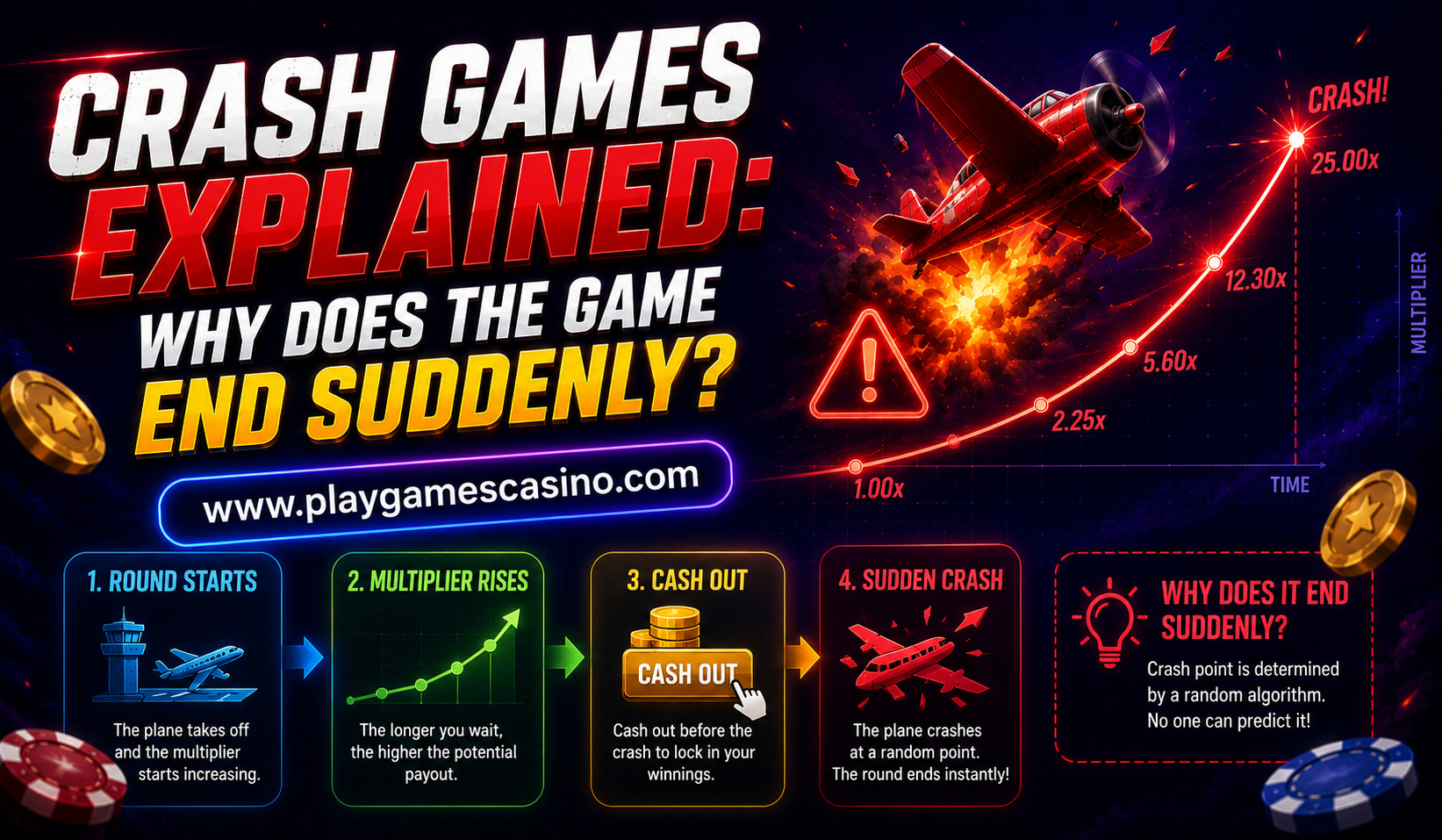
Crash games have become one of the most recognizable formats in the online gaming and gambling industry. Their interface is usually simple: a multiplier begins to rise, players watch it climb, and they decide whether to cash out before the round ends. Then, without warning, the multiplier stops and the game “crashes.”
For newcomers, that sudden ending can be confusing. It may seem as though the game has stopped randomly at the exact moment when the multiplier was becoming interesting. In reality, the sudden ending is the central mechanic around which crash games are designed. The result is generated according to the game’s underlying system, and the player has to make a cash-out decision before that predetermined or randomly generated crash point is reached.
Popular titles in this category can use different themes, interfaces and technical systems, but they share the same basic idea. Understanding why the game ends suddenly can make the format much easier to understand and can also help players avoid common misconceptions about patterns and predictions.
What Is a Crash Game?
A crash game is a type of online game built around a rising multiplier. At the start of a round, the multiplier generally begins around 1.00x and increases as the round continues. Players can usually cash out at any point before the crash.
For example, imagine a player places a hypothetical ₹100 wager. If the player cashes out when the multiplier reaches 1.80x, the gross return would correspond to ₹180 under a straightforward multiplier calculation. If the multiplier reaches 4.00x before the player exits, the corresponding gross return would be ₹400.
The important part is that the multiplier can stop before the player reaches the level they were waiting for. If the round crashes at 1.70x and someone was waiting for 2.00x, the player may lose that wager because the desired cash-out point was never reached.
This uncertainty is what creates the tension behind the format.
Why Does a Crash Game End Suddenly?
The simplest explanation is that the crash point is part of the round’s outcome. The game does not necessarily “decide” to stop because a player has waited too long or because a particular amount of money has been wagered.
Depending on the title, the result may be generated through a random-number system, a cryptographic mechanism or another certified game process. In games using provably fair technology, cryptographic inputs can be used to determine outcomes while allowing results to be verified afterward.
The rising multiplier is therefore better understood as a visual representation of the potential payout rather than a live indicator showing how much longer the game is guaranteed to continue.
Once the crash point is reached, the round ends immediately. Players who have already completed a valid cash-out receive the applicable payout, while wagers that remain active at the crash can be lost according to the game’s rules.
Is the Crash Point Truly Random?
The answer depends on the specific game and its technical design. Many crash games use systems intended to generate unpredictable outcomes, while some use cryptographic processes designed to make results independently verifiable.
It is important to distinguish between randomness, fairness and predictability. A game can have a transparent method for generating results without allowing players to predict the next result.
For example, a provably fair system may allow someone to verify how a previous round was calculated. That does not mean the person can determine the next crash point before it happens.
Players should therefore check the information supplied by the game’s developer or licensed operator rather than assuming that all crash games use exactly the same technology.
What Happens During a Typical Crash Round?
A typical crash round follows a relatively simple sequence. The player places a wager before the round begins. The player then decides whether to cash out or continue waiting.
The round can end at a low multiplier such as 1.10x, or it may continue much further. There is no requirement that every round reach a particular threshold.
A simplified example looks like this:
| Stage | Example Multiplier | What It Means |
| Round starts | 1.00x | Multiplier begins |
| Early movement | 1.25x | Potential return begins increasing |
| Mid-round | 2.00x | Potential return is twice the wager |
| Higher point | 5.00x | Potential return is five times the wager |
| Crash | 5.47x | Round ends at this point |
The numbers in this example are illustrative only. They do not represent a prediction or probability for any particular crash game.
Why Can One Round End at 1.05x While Another Reaches 20x?
This is one of the most important features of crash games. The distribution of results can contain both very short rounds and much longer ones.
A round ending at 1.05x may appear disappointing to someone hoping for a larger multiplier, while a 20x round can attract attention because it produces a much larger potential payout for anyone who successfully cashes out at that level.
However, the existence of a high result does not mean that another high result is about to occur. Similarly, several short rounds do not automatically mean that a long round is “due.”
This misunderstanding is sometimes referred to as the gambler’s fallacy. If rounds are independently generated, previous results do not force a particular outcome in the next round.
Does the Game Know When Players Cash Out?
Crash games are designed around player cash-out actions, but the presence of players does not necessarily mean the crash point changes because someone is winning or losing.
In a properly designed system, the game outcome follows the rules and mathematical mechanism established by the provider. A player’s decision determines whether they successfully exit before the crash, not whether the underlying crash point should change.
This distinction matters because it is easy to assume that a game might end when a large number of players cash out. Players should instead look at the specific provider’s rules and fairness documentation when they want to understand how a particular title works.
The Role of Random Number Generation
Random-number generation is a common concept in online gaming. A random-number generator, or RNG, is designed to produce outcomes that cannot be reliably predicted by players.
Different games can use different technical implementations, and some providers use independent testing and certification to verify that their systems operate according to published standards.
In crash games, the random or cryptographic process can determine the point at which the multiplier ends. The visual animation then displays that outcome in real time.
This means the animation itself should not be confused with the underlying mathematical process. The aircraft, rocket, astronaut or other visual element is primarily a way of presenting the multiplier to the player.
Why the Sudden Crash Creates So Much Tension
The psychology of the format is closely connected to uncertainty. As the multiplier rises, the potential payout becomes more attractive. At the same time, every additional moment creates exposure to the possibility of a crash.
This produces a difficult decision. Cashing out at 1.50x may feel too early when the multiplier is still climbing. Waiting for 3x or 5x may appear more attractive, but the game can end before those levels are reached.
The interface is intentionally built around this tension. Unlike a conventional slot where a result appears at the end of a spin, crash games allow the player to make a decision while the outcome is unfolding visually.
That does not mean players can control the crash point. Their control is generally limited to the timing of their cash-out decision.
How Auto Cash-Out Changes the Experience
Many crash games offer an auto cash-out feature. Instead of manually pressing the cash-out button, players can set a multiplier in advance.
For instance, a player might select 1.50x as an automatic exit level. If the round reaches that multiplier before crashing, the system attempts to complete the cash-out according to the game’s rules.
Auto cash-out can make the interface easier to manage during a rapidly moving round, but it does not guarantee a successful outcome. If the crash occurs before the selected multiplier is reached, the wager can still be lost.
Players should also read the specific game’s terms to understand how automatic cash-outs are processed, particularly in situations involving connectivity issues or simultaneous events.
Understanding RTP in Crash Games
Another term frequently associated with crash games is RTP, or Return to Player. RTP represents the theoretical percentage of wagers that a game is designed to return over a very large number of plays.
It is not a promise about what will happen during one session.
For example, a theoretical RTP of 97% does not mean someone who wagers ₹10,000 will necessarily receive ₹9,700. The crash multiplier and RTP also represent different concepts. The multiplier determines the payout associated with a successful cash-out, while RTP describes the game’s theoretical long-term return structure.
How to Evaluate a Crash Game
The sudden ending of a crash game is not, by itself, evidence that a particular game is unfair. A better approach is to examine the information provided about the game.
Players can look at the developer, published game rules, RTP information, betting limits and available fairness or verification documentation. They can also check whether responsible-gaming tools are available.
| Factor | What Players Should Understand |
| Developer | Identifies who created the game |
| RTP | Shows theoretical long-term return |
| Crash mechanism | Explains how round outcomes are generated |
| Betting limits | Defines permitted wager ranges |
| Cash-out rules | Explains how exits are processed |
| Fairness information | Provides details about testing or verification |
These details are more useful than attempting to predict the next multiplier by studying a history of previous rounds.
Conclusion
The sudden ending of a crash game is not an accidental interruption. It is the central feature of the format. A round continues while the multiplier rises and ends when the game’s underlying crash point is reached.
The exact technical process can vary between titles, but players should understand that the rising number is not a promise that the round will continue. A multiplier of 2x does not guarantee 3x, and a sequence of low results does not guarantee that a high result is next.
The most useful way to approach crash games is therefore to understand their mechanics rather than search for hidden patterns. Knowing how crash points, multipliers, cash-outs, RTP and randomization work can provide a much clearer picture of what is happening on the screen.
Ultimately, the sudden crash is what gives the format its identity. It creates a rapid decision between securing a current multiplier and accepting additional risk. Because outcomes remain uncertain, players should treat crash games as gambling entertainment, set appropriate limits and never rely on them as a source of guaranteed income.
Frequently Asked Questions
Why does a crash game suddenly stop?
A crash game stops when the round reaches its predetermined or randomly generated crash point according to the game’s underlying mechanism. The exact method depends on the individual title.
Can a crash game stop at 1.00x?
Some games can produce very low crash results close to the starting multiplier. The exact minimum and distribution depend on the game’s mathematical design and published rules.
Can previous crash results predict the next crash?
No reliable prediction can be made simply by studying previous results. If rounds are independently generated, earlier outcomes do not determine the next one.
Does a high multiplier mean another high multiplier is coming?
No. A previous high multiplier does not guarantee another high result in the next round. Similarly, several low results do not guarantee that a high result is due.
What happens if I do not cash out before the crash?
If the player still has an active wager when the crash occurs, the wager is generally lost according to the game’s rules. Any successfully completed cash-out before the crash is handled according to the applicable payout conditions.