Understanding Casino Game Odds
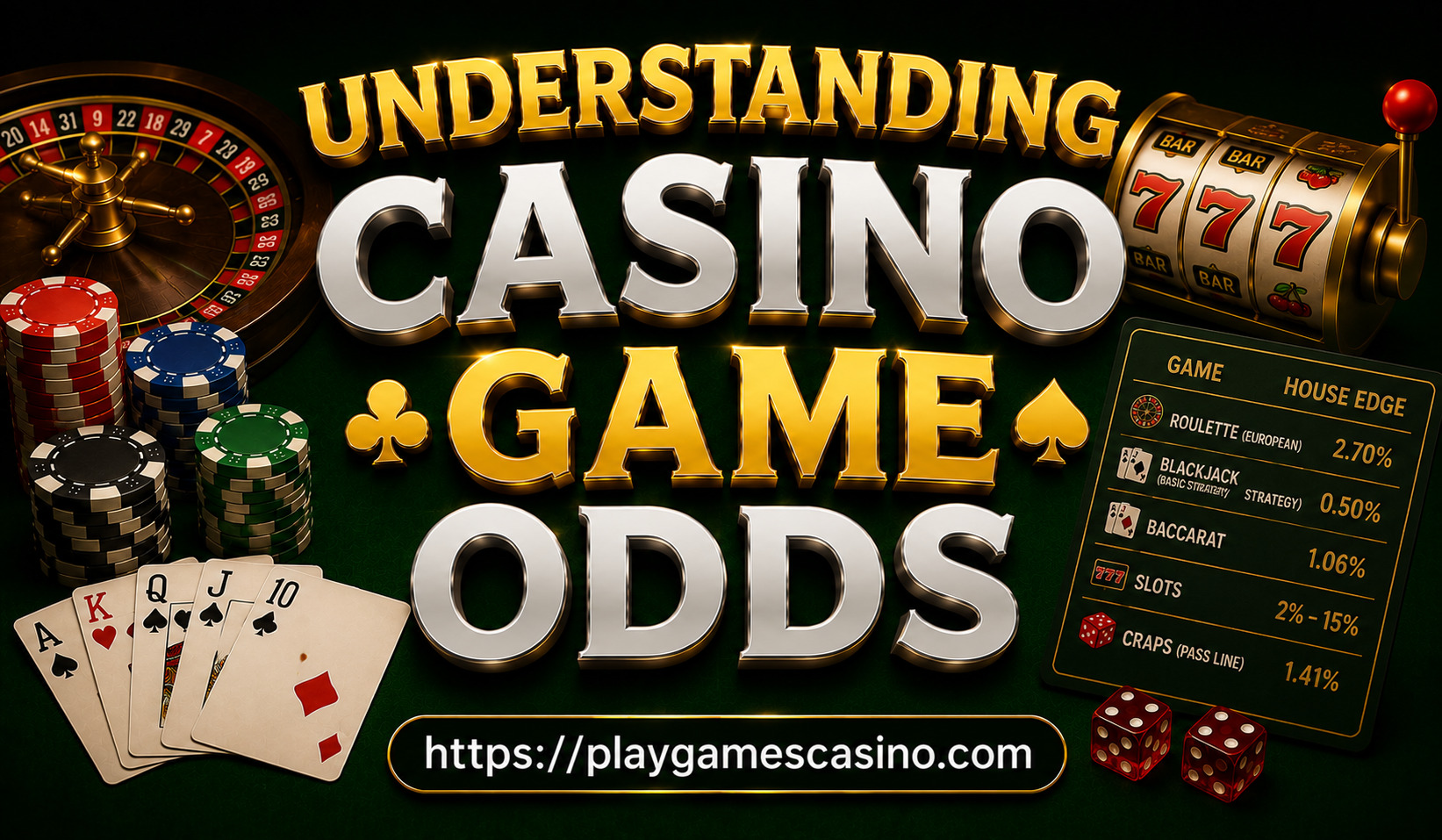
Casino game odds can seem complicated when you first encounter terms such as probability, house edge, RTP, variance, and payout ratios. However, understanding the basics can make casino games much easier to evaluate. Whether you are learning about roulette, blackjack, baccarat, slots, or other popular games, odds explain how likely different outcomes are and how payouts are structured.
It is important to remember that casino odds do not predict exactly what will happen during one game or one session. A player can experience an unexpected win or loss even when the mathematical probability is well understood. Instead, odds describe the statistical relationship between possible outcomes over repeated events.
This guide explains the fundamentals of casino game odds, how different games compare, what common terms mean, and why understanding probability is important before considering any form of gambling.
What Are Casino Game Odds?
Casino game odds describe the likelihood of different outcomes occurring in a particular game. They are determined by the rules, number of possible outcomes, payout structure, and mathematical design of the game.
For example, roulette has a fixed number of pockets on its wheel. A European roulette wheel contains 37 pockets: numbers 1 through 36 and a single zero. If you place a straight-up bet on one number, there is only one winning pocket among those 37 possibilities.
The payout for that bet, however, does not correspond perfectly to the probability. A successful straight-up roulette bet typically pays 35 to 1, rather than the 36 to 1 that would represent a completely fair mathematical return. The difference contributes to the casino’s house edge.
This basic relationship between probability and payout is at the heart of casino mathematics.
Probability vs. Payout
A common mistake among beginners is assuming that a higher payout automatically means better odds. In reality, payout and probability are two different concepts.
A bet can offer a large potential reward because the probability of winning is relatively low. Conversely, a bet that pays a smaller amount can cover a larger number of possible outcomes.
For example, a roulette bet on a single number offers a much larger payout than a red or black bet. However, the chance of landing on one particular number is much lower than the chance of landing on one of the 18 red numbers.
The important question is therefore not simply, “How much does this bet pay?” It is also, “How likely is this outcome, and how does the payout compare with that probability?”
Understanding the House Edge
The house edge represents the mathematical advantage that a casino has over players over a large number of wagers.
If a game has a theoretical house edge of 4%, the casino has a long-term mathematical expectation equivalent to approximately $4 for every $100 wagered, although actual results can vary significantly.
This does not mean that every player will lose 4% of their money. Someone could win substantially more, while another person could lose substantially more. The figure describes a statistical expectation over a large sample.
House edge is particularly useful when comparing different casino games because it provides an indication of how the mathematical structure favors the operator.
What Is RTP?
RTP, or Return to Player, is another important measurement used in casino gaming. It is particularly common when discussing slot machines and other electronic games.
An RTP of 96% means that, theoretically, the game is designed to return approximately $96 for every $100 wagered over a very large number of plays.
The remaining 4% represents the theoretical house edge.
However, RTP should never be interpreted as a personal refund rate. A player who wagers $100 might win $200, lose $100, or experience another result entirely. The RTP calculation becomes meaningful only across a very large number of outcomes.
A simple comparison looks like this:
| Theoretical RTP | Approximate House Edge |
| 99% | 1% |
| 98% | 2% |
| 97% | 3% |
| 96% | 4% |
| 95% | 5% |
| 90% | 10% |
These figures illustrate the mathematical relationship, not a guarantee of individual results.
How Roulette Odds Work
Roulette is one of the easiest casino games to use when learning about odds because its wheel has a clearly defined number of possible outcomes.
European roulette has 37 pockets, including one zero. American roulette has 38 pockets because it includes both zero and double zero.
A straight-up bet covers one number, while outside bets such as red, black, odd, even, low, and high cover much larger groups.
The additional zero pockets are important because they give the casino its mathematical advantage. On a standard European wheel, the house edge for most common bets is approximately 2.70%. On a standard American wheel, it is approximately 5.26%.
This difference demonstrates why the specific version of a game matters when comparing odds.
How Blackjack Odds Work
Blackjack is different because the player’s decisions can affect the mathematical outcome.
Players can make decisions such as hitting, standing, doubling down, and splitting.
Because the player has choices, blackjack odds depend on both the table rules and the decisions made during play.
Basic strategy is a mathematical system that identifies the statistically preferable action for different combinations of player cards and dealer cards. It does not guarantee a win, but it can reduce mistakes and potentially lower the house edge compared with making decisions based purely on intuition.
Rules also matter. Blackjack games can differ in the number of decks used, blackjack payouts, dealer requirements, doubling restrictions, and splitting rules.
Therefore, two blackjack tables may not have identical odds even though they appear to offer the same basic game.
Understanding Baccarat Odds
Baccarat is another game where different bets have different mathematical characteristics.
The Banker and Player bets generally have relatively straightforward rules, while the Tie bet often has a considerably higher house edge.
This is an important lesson when evaluating casino odds: the game name alone is not enough. You also need to understand the specific bet being placed.
A bet with an attractive payout may have a lower probability of winning. Looking at the combination of probability, payout, and house edge provides a much more useful comparison.
Understanding Slot Machine Odds
Slot machine odds work differently from table-game odds because modern slots generally use programmed mathematical models and Random Number Generators.
Instead of a physical wheel with a small number of clearly visible outcomes, a slot machine can contain numerous possible symbol combinations and payout configurations.
RTP is commonly used to describe the long-term theoretical return of a slot. Another important concept is volatility, which describes the general pattern of payouts.
A high-volatility slot may offer larger potential wins but produce them less frequently.
Volatility does not tell you whether the next spin will win. It describes the game’s broader payout characteristics.
What Is Variance in Casino Games?
Variance refers to how much individual results can differ from the expected average.
Imagine two games with similar theoretical RTPs. One might produce many small payouts, while another might produce occasional large payouts separated by longer periods without significant wins.
The mathematical return could be similar over a sufficiently large sample, but the experience of playing the two games could be very different.
This is why RTP alone does not tell the entire story, particularly when comparing slot machines.
Players should understand that high variance can lead to significant short-term fluctuations. A small number of results cannot reliably demonstrate whether a game is performing according to its long-term mathematical expectation.
Why Previous Results Do Not Change Casino Odds
One of the most important lessons in understanding casino odds is that previous results generally do not determine independent future outcomes.
Suppose a roulette wheel produces five consecutive black results. A player might conclude that red is now more likely because it has not appeared recently.
That reasoning is an example of the gambler’s fallacy.
The next spin does not normally “remember” the previous five results. The probability associated with the wheel remains the same.
The same principle applies to slot machines. A machine that has not produced a major payout recently is not necessarily “due” for one.
Past results can be recorded and analyzed, but they do not provide a guaranteed prediction of the next independent outcome.
Why High Payouts Do Not Mean Better Odds
Large jackpots and attractive payout figures naturally attract attention. However, the size of a potential prize does not tell you how likely you are to receive it.
A bet with a very large payout generally covers a smaller range of outcomes or requires a particularly specific result.
For example, a roulette straight-up bet pays considerably more than a red/black bet, but the winning number must be one specific pocket. A red/black wager covers 18 red pockets, although the payout is much smaller.
Understanding this relationship helps prevent beginners from evaluating games solely by looking at the biggest advertised prize.
How to Compare Casino Game Odds
There is no single number that completely describes every casino game. A meaningful comparison may require looking at the house edge, RTP, volatility, rules, and type of wager.
When evaluating a game, consider these factors:
- What are the possible outcomes?
- How likely is the selected outcome?
- What does a winning wager pay?
- What is the theoretical house edge?
- Does player strategy affect the mathematical result?
- Are there special rules that change the odds?
Reading the game’s rules and paytable is usually more useful than relying on promotional claims or anecdotal stories from other players.
Are Casino Odds the Same Everywhere?
No. Odds can vary between games, versions, operators, and specific rule sets.
A blackjack table with one set of rules can have a different mathematical house edge from another blackjack table. Roulette can vary depending on whether the wheel has one zero or two. Slot machines can have different RTP and volatility settings.
This is why players should not assume that every version of a particular game has identical mathematics.
If the rules change, the odds can change as well.
Can a Betting Strategy Change the Odds?
Changing the size or timing of wagers generally does not change the underlying probability of an independent random event.
For example, doubling a roulette bet after a loss does not make the next spin more likely to win. The wheel’s probabilities remain the same.
In games involving decisions, however, strategy can matter. Blackjack is the clearest example. Choosing the mathematically preferable action can influence the player’s expected result.
Even then, strategy does not guarantee a win. It simply helps a player make decisions that are statistically more favorable under the specific rules.
Frequently Asked Questions
What are casino game odds?
Casino game odds describe the mathematical likelihood of different outcomes and the relationship between those probabilities and the game’s payouts.
Is a higher payout better?
Not necessarily. The house edge and probability provide more useful information than the payout alone.
What casino game has the best odds?
There is no universal answer because odds depend on the exact game, rules, and wager. Some blackjack games with favorable rules and correct basic strategy can have relatively low house edges.
Does RTP guarantee that I will get my money back?
No. RTP is a long-term theoretical measurement. Individual sessions can produce results that are significantly higher or lower than the stated RTP.
Can I predict casino results by studying previous outcomes?
Generally, no. Independent random outcomes do not become more or less likely simply because of what happened previously.
Does a larger bet improve my chances?
A larger wager generally increases the amount that can be won or lost, but it does not automatically change the probability of the underlying outcome.
Why do casino games have different odds?
Each game has its own rules, number of possible outcomes, payout structure, and mathematical design. These factors determine the game’s theoretical odds and house advantage.
Final Thoughts
Understanding casino game odds is less about finding a guaranteed way to win and more about learning how probability and payouts work together. Concepts such as house edge, RTP, variance, and probability provide a clearer picture of the mathematical structure behind casino games.
Roulette demonstrates how the number of pockets affects probability, while blackjack shows how player decisions can influence expected results. Baccarat illustrates how different wagers within the same game can have different mathematical characteristics, and slots demonstrate why RTP and volatility are important measurements.
The most important lesson is that odds describe probabilities, not promises. A game with a relatively low house edge can still produce losses, while a player can win temporarily in a game with a much higher mathematical disadvantage.
Casino games involve financial risk, and no ordinary betting system can remove that risk. Anyone who chooses to gamble should understand the rules and odds of the specific game, set reasonable limits, and treat gambling as entertainment rather than a dependable method of earning money.