Blackjack Basic Strategy: A Complete Guide
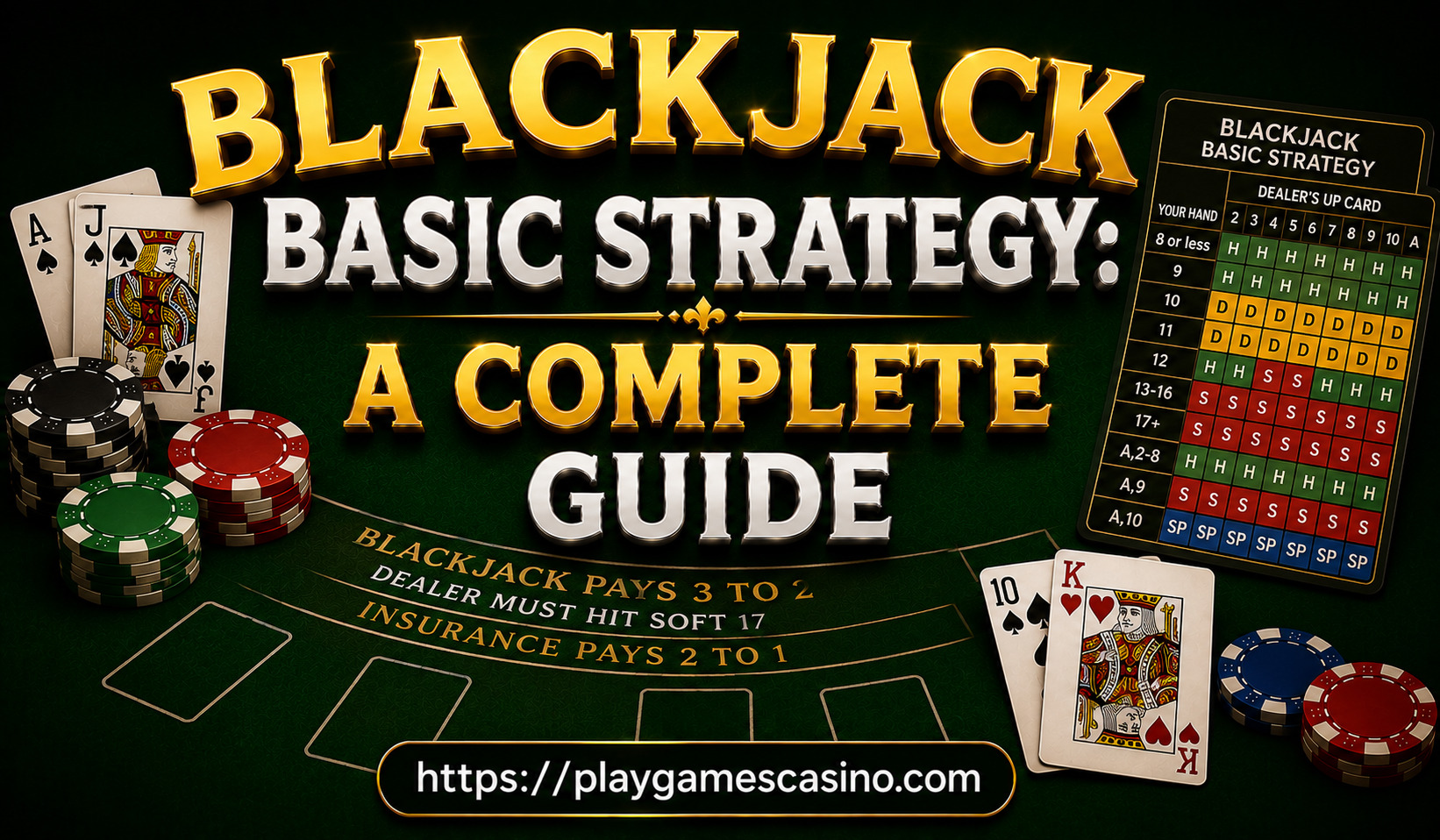
Unlike games where players mainly choose where to place a wager, blackjack gives players several opportunities to influence how a hand is played. Knowing when to hit, stand, double down, or split can make a significant difference to the mathematical outcome of the game.
This is where blackjack basic strategy becomes important. Basic strategy is a collection of mathematically calculated decisions that tells players which action is generally strongest for a particular hand against the dealer’s visible card. It does not guarantee a win, but it can help reduce unnecessary mistakes and lower the casino’s mathematical advantage under suitable rules.
This guide explains how basic strategy works, why the dealer’s upcard matters, how to approach hard and soft hands, when pairs can be split, and what beginners should know before using a blackjack strategy chart.
What Is Blackjack Basic Strategy?
Blackjack basic strategy is a mathematical decision-making system developed by analyzing the possible outcomes of different player actions.
Instead of relying on intuition, basic strategy considers the player’s cards and the dealer’s visible card. It then identifies whether hitting, standing, doubling, or splitting has the best expected result.
For example, having a total of 16 might seem like a strong reason to stand because taking another card could cause a bust. However, the correct decision depends on the dealer’s upcard. If the dealer is showing a strong card, hitting may sometimes be mathematically preferable even though the player faces a significant bust risk.
The purpose of basic strategy is therefore not to predict the next card. It is to make the statistically strongest decision based on the information available.
Why Does Basic Strategy Matter?
The casino has a mathematical advantage in blackjack because the rules favor the dealer in several ways. The player acts first, and if the player busts, the hand ends before the dealer needs to complete their hand.
Basic strategy cannot remove every element of the house edge, but it can help players avoid decisions that are unnecessarily unfavorable.
A player who makes decisions randomly may give the casino a much larger advantage than someone who follows an appropriate strategy. The exact mathematical benefit depends on the rules of the table, including the number of decks, blackjack payout, dealer rules, and available player options.
This is why a basic strategy chart should ideally match the specific blackjack game being played.
Understanding the Dealer’s Upcard
The dealer’s visible card is one of the most important pieces of information in blackjack.
A dealer showing a 4, 5, or 6 is generally considered to have a weaker position because the dealer may need to draw additional cards and has a greater possibility of busting. A dealer showing a 7, 8, 9, 10, or ace generally has a stronger starting position.
This does not mean that the dealer will automatically lose with a low card or win with a high card. It simply means that the mathematical expectations change.
For example, a player with a relatively strong hand may behave differently against a dealer’s 6 than against a dealer’s ace. Basic strategy accounts for these differences rather than treating every dealer upcard the same.
Hard Hands and Basic Strategy
A hard hand is a blackjack hand where an ace is either absent or must count as 1 to prevent the hand from exceeding 21.
Hard hands are among the easiest parts of basic strategy to understand because their totals have relatively fixed values.
For example, a hand of 10 and 6 has a hard total of 16. If another card is taken, the player can bust with a 6, 7, 8, 9, or 10-value card.
However, standing is not automatically the best decision. The dealer’s visible card needs to be considered.
Some broad principles for hard hands include:
- Very low totals usually require another card because standing leaves little chance of winning.
- Strong totals are often better candidates for standing.
- Medium totals require careful consideration of the dealer’s upcard.
- Doubling can be appropriate when the player’s starting hand has a favorable mathematical position.
These are general principles rather than a replacement for a complete strategy chart.
Soft Hands Explained
A soft hand contains an ace that can currently count as 11 without causing the hand to exceed 21.
For example, an ace and a 6 create a soft 17 because the hand can be valued as 17 using the ace as 11, or as 7 if necessary.
Soft hands are particularly interesting because taking another card does not always carry the same bust risk as it would with a hard hand.
If a player has a soft 17 and receives a high card, the ace can change from 11 to 1. This flexibility gives certain soft hands opportunities for aggressive actions such as doubling.
Basic strategy therefore treats soft hands differently from hard hands, even when their numerical totals appear identical.
When Should You Hit?
Hitting means taking another card.
The decision to hit depends on the player’s total and the dealer’s upcard. Beginners often make the mistake of using a single rule, such as always standing on a particular number.
In reality, the correct decision can change depending on the dealer.
A hand that is strong enough to stand against a weak dealer card may need another card against a stronger dealer card. This is one of the central ideas behind basic strategy.
The objective is not to avoid every possibility of busting. Busting is certainly undesirable, but sometimes standing with a weak hand produces an even worse mathematical outcome.
When Should You Stand?
Standing becomes increasingly attractive as the player’s total improves, but the dealer’s upcard remains important.
For example, a player with a strong total may have little reason to risk another card. On the other hand, a mediocre total against a strong dealer card may require a different approach.
Basic strategy balances the probability of improving the player’s hand against the probability of busting and the dealer’s expected final result.
When Should You Double Down?
Doubling down allows the player to double the original wager and receive one additional card, after which the hand normally ends.
This can be a powerful option when the mathematical expectation favors increasing the wager before receiving another card.
A common example is when the player has a favorable starting total and the dealer is showing a relatively weak card. However, exact doubling decisions vary according to the rules.
Players should remember that doubling increases financial exposure. A mathematically favorable decision can still lose because blackjack outcomes remain uncertain.
When Should You Split Pairs?
When a player receives two cards of the same value, certain rules allow the cards to be split into separate hands.
Splitting requires an additional wager, meaning the player is effectively creating two separate opportunities from the original pair.
Not every pair should automatically be split. The correct decision depends on the pair and the dealer’s upcard.
Some pairs are generally strong candidates for splitting, while others are often better kept together. The exact recommendations can also vary depending on table rules.
This is why a complete basic strategy chart includes a separate section for pair decisions.
A Basic Strategy Overview
The following table provides a simplified overview. It is not a substitute for a strategy chart tailored to the exact rules of a specific blackjack table.
| Situation | General Approach |
| Weak total against a strong dealer card | Often consider hitting |
| Strong total | Standing is frequently preferred |
| Favorable starting total | Doubling may be appropriate |
| Certain pairs | Splitting can be advantageous |
| Soft totals | Evaluate differently from hard totals |
| Dealer showing 4–6 | The dealer may be in a weaker position |
The exact decision should always depend on the player’s cards, dealer upcard, and game rules.
Blackjack Rules Can Change Basic Strategy
One of the most important points about blackjack strategy is that there is no single universal chart that applies perfectly to every table.
Rules can differ in several ways. A table may use one, two, six, or eight decks. Blackjack may pay 3:2 or another amount. The dealer may hit or stand on soft 17. Players may have different restrictions on doubling or splitting.
These variations can change the house edge and, in some situations, change the mathematically preferred action.
Before using a strategy chart, players should identify the rules of the particular game.
Basic Strategy Does Not Guarantee Winning
This point deserves emphasis. Basic strategy improves decision-making, but it does not predict individual outcomes.
A player can follow the correct strategy and still lose a hand. They can also make an incorrect decision and happen to win.
The quality of a blackjack decision should therefore be judged by its mathematical expectation rather than by whether that particular hand won.
Over a large number of hands, consistently making stronger decisions can have a meaningful effect on results. However, randomness and the house edge remain part of the game.
Basic Strategy and the House Edge
Blackjack is unusual compared with many casino games because the player’s decisions can influence that advantage. Correct basic strategy can generally reduce the house edge compared with making arbitrary choices.
However, the final house edge depends on the specific rules and whether the player consistently follows the appropriate strategy.
This is why comparing blackjack tables can be useful. A table with favorable rules can have different mathematical characteristics from one with less favorable conditions.
Should Beginners Memorize a Strategy Chart?
Beginners do not necessarily need to memorize an entire chart immediately.
A practical approach is to first understand the concepts behind the chart. Learn why dealer upcards matter, understand the difference between hard and soft hands, and become familiar with the purpose of doubling and splitting.
Once those concepts are clear, practicing with a strategy chart can make the decisions easier to remember.
Some players eventually memorize basic strategy, while others refer to an appropriate chart while learning. The important point is to use a chart that corresponds to the rules of the game.
Frequently Asked Questions
Is blackjack basic strategy guaranteed to win?
No. Basic strategy does not guarantee winning hands or profitable sessions. It simply identifies mathematically preferable decisions based on the cards available.
Should I always stand on 17?
Not necessarily. The correct action can depend on whether the hand is hard or soft and on the dealer’s visible card. This is why basic strategy distinguishes between different types of 17.
Can basic strategy eliminate the house edge?
Usually, no. It can reduce the house edge substantially compared with poor decision-making, but standard blackjack rules generally still give the casino a mathematical advantage.
Is card counting part of basic strategy?
No. Basic strategy tells you how to play individual hands based on the cards currently visible. Card counting is a separate technique that attempts to track the composition of the remaining deck.
Final Thoughts
Blackjack basic strategy provides a structured way to make better mathematical decisions during the game. Instead of relying on instinct, players can consider their hand, the dealer’s upcard, and the rules of the table when deciding whether to hit, stand, double, or split.
The strategy becomes easier to understand once players learn the difference between hard and soft hands and recognize why the dealer’s visible card is so important. It is also essential to remember that different blackjack rules can require different strategy charts.
Most importantly, basic strategy is not a guaranteed winning system. Blackjack remains a game of chance, and even a perfectly played hand can lose. Strategy can improve decision quality and potentially reduce the house edge, but it cannot remove financial risk.
For beginners, the best approach is to learn the rules first, practice basic strategy with the correct chart, understand the specific table conditions, and set a sensible gambling budget. Blackjack can be an engaging game to study, but it should always be approached as entertainment rather than as a dependable way to make money.