Progressive Jackpots Explained
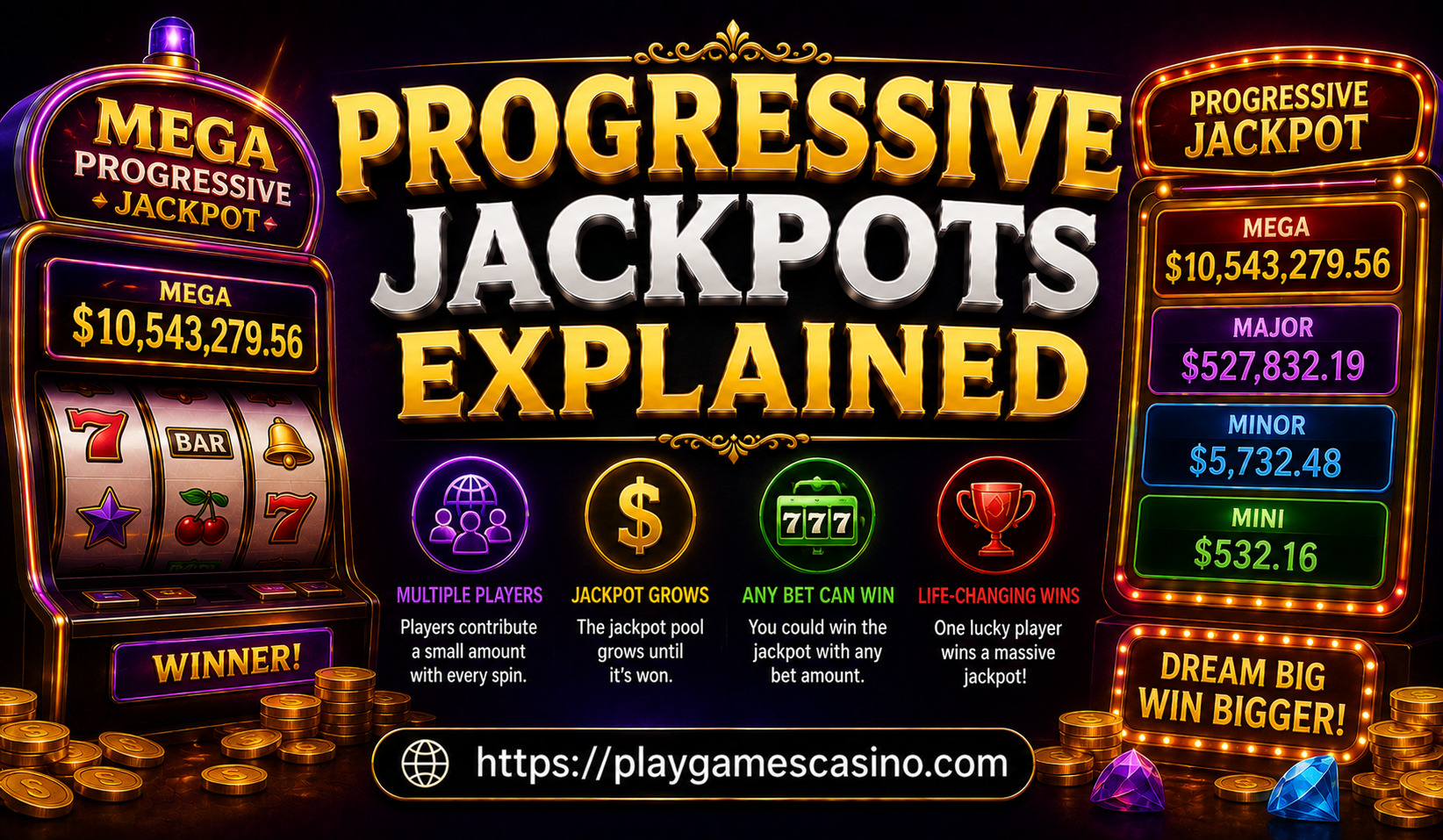
Progressive jackpots are among the most recognizable features in modern casino gaming. Unlike fixed jackpots, which generally remain at a predetermined amount, progressive jackpots can increase as more players place qualifying wagers. This creates the possibility of a very large prize that can continue growing until someone wins it.
The concept is relatively simple, but progressive jackpots involve several different types, rules, payout structures, and mathematical considerations. Understanding how they work can help players distinguish between the size of a jackpot and the actual probability of winning it.
A progressive jackpot can be attached to a slot machine, table game, online casino game, or network of games. While the exact rules vary, the basic idea remains the same: a portion of qualifying wagers contributes to a prize pool that grows over time.
What Is a Progressive Jackpot?
A progressive jackpot is a prize that increases as qualifying bets are made.
With a conventional fixed jackpot, the advertised prize might remain at a set amount until the winning combination is triggered. A progressive jackpot works differently because the prize can increase continuously or at regular intervals.
For example, imagine a progressive slot displaying a jackpot of $500,000. If players continue making eligible wagers, a small portion of those wagers may be added to the jackpot pool. The displayed amount could therefore rise to $500,100, then $500,500, and potentially much higher.
When the jackpot is won, the progressive amount is typically reset according to the game’s rules.
The exact contribution percentage is determined by the game operator or provider and does not necessarily equal the entire wager.
How Progressive Jackpots Grow
Progressive jackpots generally grow because qualifying wagers contribute a portion toward the prize pool.
Suppose a hypothetical game allocates a small fraction of each eligible wager to its progressive jackpot. If thousands of players make wagers, the accumulated contributions can cause the jackpot to increase significantly.
The growth rate depends on factors such as:
- The number of players participating.
- The amount being wagered.
- The percentage allocated to the progressive pool.
- The rules established by the game provider.
Some jackpots may grow quickly because they are connected to popular games with large numbers of players. Others may increase much more slowly.
The displayed jackpot is therefore influenced by participation as well as the game’s underlying mathematical design.
Types of Progressive Jackpots
Not all progressive jackpots operate in exactly the same way. They can generally be divided into several broad categories.
Standalone Progressive Jackpots
A standalone progressive jackpot is connected to one specific game or machine.
The jackpot increases based on qualifying wagers made on that particular game. Because the prize pool is not shared across a large network, its growth can depend heavily on how popular that individual game is.
These progressives may appeal to players who prefer a particular title and want to participate in its dedicated jackpot.
Local or Linked Progressive Jackpots
A linked progressive connects several machines or games within the same casino or platform.
Every qualifying wager across the participating games can contribute to the same jackpot pool. This can cause the prize to grow faster than a standalone jackpot because more wagers are contributing to it.
However, more participating players can also mean more people are competing for the same jackpot opportunity.
Wide-Area Progressive Jackpots
Some progressive systems connect games across multiple casinos, locations, or online platforms.
Because the network can involve a very large number of wagers, the jackpot may grow to an extremely high amount.
These systems can produce some of the biggest advertised jackpots in casino gaming. The trade-off is that the probability of hitting the top prize can be extremely low, depending on the game’s rules.
Progressive Jackpots vs. Fixed Jackpots
The main difference between progressive and fixed jackpots is how the prize amount is determined.
A fixed jackpot remains relatively stable unless the operator changes it or a qualifying event occurs. A progressive jackpot can increase as additional qualifying wagers are made.
| Feature | Fixed Jackpot | Progressive Jackpot |
| Prize Amount | Usually predetermined | Can increase over time |
| Growth | Limited | Based on qualifying wagers |
| Reset After Win | According to game rules | Usually resets to a lower amount |
| Potential Prize | Generally fixed | Can become very large |
| Player Attraction | Predictable prize | Growing jackpot amount |
A larger progressive prize can attract additional attention, which can encourage more participation and cause the jackpot to grow further.
How Do You Win a Progressive Jackpot?
The exact conditions for winning depend entirely on the individual game.
Some progressive slots require a specific combination of symbols to appear. Others may use a bonus game, random selection, or a special jackpot feature.
A game might have multiple progressive levels, such as a minor, major, or grand jackpot. Each level can have different qualifying conditions and payout amounts.
Players should always check the game’s paytable and jackpot rules before wagering.
It is also important to determine whether the jackpot requires a particular wager amount. Some games may allow every eligible spin to participate, while others may require a specific bet level for certain jackpot tiers.
Are Bigger Jackpots Harder to Win?
The size of a progressive jackpot does not automatically tell you its probability of being won.
A jackpot can grow to a very large amount without necessarily becoming more likely to hit.
The probability is determined by the game’s mathematical design and jackpot conditions. A rising prize may make the opportunity more attractive, but it does not necessarily change the odds.
This is one of the most important concepts to understand about progressive jackpots.
A jackpot that has reached $2 million is not automatically “due” to be won simply because it has become large.
Why Progressive Jackpots Can Become So Large
Progressive jackpots can reach substantial amounts because contributions from many wagers accumulate over time.
A networked jackpot can receive contributions from thousands or potentially many more players. If the jackpot is not won for an extended period, those contributions continue accumulating.
This creates a feedback effect. A larger jackpot attracts attention, more players participate, and additional wagers can contribute to the prize pool.
However, the amount displayed on the screen should not be interpreted as pure profit available to every player. It is the prize associated with a specific winning event and subject to the game’s rules.
Progressive Jackpot Contributions
A common question is how much of a player’s wager actually goes toward the progressive prize.
There is no universal percentage.
The game provider determines how its mathematical model allocates wagers. A portion may contribute to the progressive pool, while the remainder accounts for payouts, operating costs, and the casino’s theoretical advantage.
This means players should not assume that a certain percentage of every wager is added directly to the jackpot.
The game’s published information is the best source for understanding eligibility and contribution rules.
What Is a Seeded Jackpot?
Some progressive jackpots begin with a predetermined starting amount known as a seed value or seeded jackpot.
For example, a game might launch with a jackpot already displaying $100,000. Future qualifying wagers can then increase that amount.
The starting value can make a progressive jackpot appear attractive immediately after its introduction.
The seed amount and growth rules vary from one game to another, so players should not assume that every progressive uses the same structure.
Multiple Progressive Jackpot Levels
Many modern progressive games offer several jackpot tiers.
A game might have:
- A small or minor jackpot.
- A medium or major jackpot.
- A top-level or grand jackpot.
Each tier can have its own qualifying conditions and prize amount.
This structure gives the game multiple significant payout opportunities rather than relying on a single top prize.
However, lower-tier jackpots may still have different mathematical conditions than the grand prize. Players should review the paytable to understand what is required to trigger each level.
Progressive Jackpots and RTP
Progressive jackpots can affect how a game’s theoretical Return to Player, or RTP, is calculated.
A game’s RTP may include the expected contribution from its jackpot feature. However, the exact treatment depends on the game’s mathematical model and published specifications.
A progressive jackpot can therefore be an important component of the overall payout structure.
For players comparing games, it can be useful to look at both the stated RTP and the jackpot mechanics rather than focusing only on the advertised prize.
A high jackpot does not automatically mean the game has a high RTP.
Does a Larger Jackpot Mean Better Value?
Not necessarily.
A larger jackpot increases the potential prize, but the probability of winning remains an important part of the equation.
Imagine two hypothetical progressive games. One has a $100,000 jackpot with relatively favorable qualifying odds, while another advertises a $5 million jackpot with an extremely rare winning condition.
The second prize is much larger, but that does not automatically make it the better mathematical opportunity.
This is why jackpot size should always be considered alongside the game’s rules, RTP, volatility, and qualifying requirements.
Progressive Jackpots and Volatility
Progressive jackpots can contribute to a game’s overall volatility.
If a significant portion of a game’s theoretical return comes from rare jackpot outcomes, the game may produce more pronounced swings for individual players.
A player could experience many ordinary spins without a major payout, while the theoretical RTP includes the possibility of an extremely large jackpot.
This is one reason progressive games can feel very different from games that distribute their theoretical returns through many smaller prizes.
However, volatility varies by game, and the existence of a progressive jackpot does not automatically establish its exact volatility classification.
Progressive Jackpots in Online Casinos
Online casino games can also feature progressive jackpots.
Digital platforms can connect players across large networks, allowing jackpot pools to grow through wagers from multiple locations.
Online progressive games may use the same basic concept as land-based progressives, but their rules, eligibility requirements, and jackpot structures can differ.
Some online games may also display jackpot values in real time, allowing players to see the prize increase as qualifying activity occurs.
Before playing, users should review the game’s rules and the applicable terms for jackpot eligibility.
Are Progressive Jackpots Random?
The method used to determine a jackpot win depends on the specific game.
Many digital casino games use Random Number Generators (RNGs) to determine outcomes. A jackpot may be triggered by a particular symbol combination or by another random event defined by the game’s mathematical model.
Some progressive systems may use different mechanisms.
Therefore, it is not accurate to assume that every progressive jackpot is won in exactly the same way.
The game’s official rules should explain the qualifying conditions and how the jackpot is awarded.
Frequently Asked Questions
What is a progressive jackpot?
A progressive jackpot is a prize that can increase as qualifying wagers are made. The jackpot typically continues growing until a player meets the game’s winning conditions.
Does a progressive jackpot become easier to win as it grows?
Not necessarily. The jackpot amount can increase without the probability of winning changing. The game’s mathematical rules determine the winning chance.
Can every bet contribute to a progressive jackpot?
Not always. Some games require specific wagers, bet levels, or qualifying conditions. Players should check the individual game’s rules.
Are progressive jackpots better than fixed jackpots?
Neither is automatically better. Progressive jackpots offer the possibility of a growing prize, while fixed jackpots provide a more predictable prize structure. The game’s odds and rules are important factors.
Do progressive jackpots affect RTP?
They can. Depending on the game’s mathematical design, jackpot payouts may form part of the overall RTP calculation. The exact treatment varies between games.
Final Thoughts
Progressive jackpots add an exciting dimension to casino games by allowing prizes to grow as qualifying wagers are made. Standalone, linked, and wide-area progressive systems can all create different jackpot structures, with some prizes potentially reaching very substantial amounts.
However, the size of a jackpot should never be confused with the probability of winning it. A prize can grow dramatically without becoming “due,” and playing more spins does not guarantee that a jackpot will eventually be won.
RTP, volatility, jackpot conditions, and wager requirements all provide useful information when evaluating a progressive game. Understanding these factors can help players distinguish between the attraction of a large advertised prize and the actual mathematics behind the game.
Progressive jackpots are ultimately built around probability and chance. A growing prize can make a game more appealing, but it does not remove the financial risk associated with gambling. Anyone who chooses to participate should understand the rules, check the qualifying conditions, set a clear budget, and treat progressive jackpot games as entertainment rather than as a reliable way to make money.