How Slot RTP and Volatility Affect Gameplay
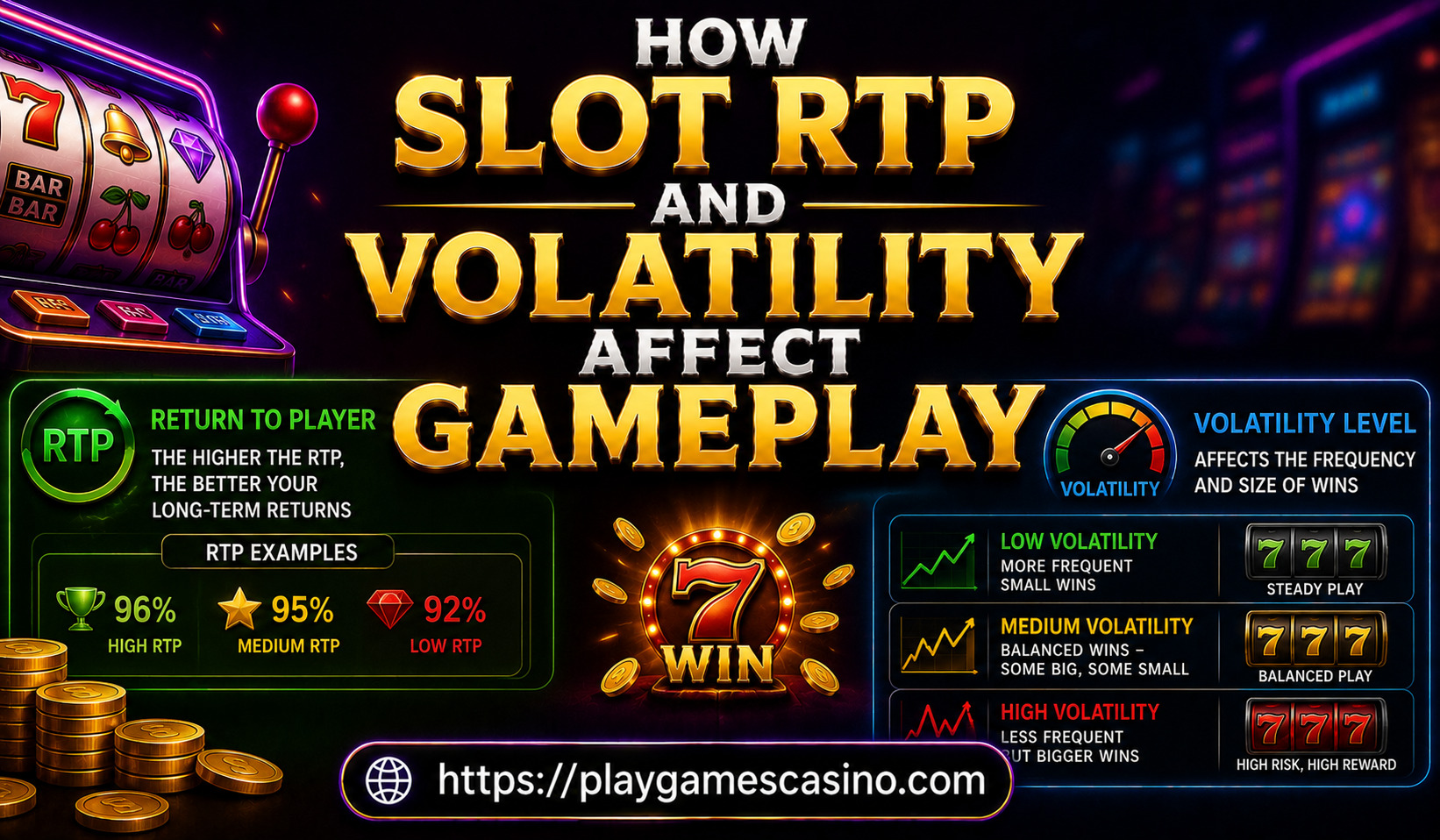
Slot games are built around mathematical systems that determine how often different outcomes can occur and how much those outcomes may pay. Two of the most important concepts for understanding these systems are Return to Player (RTP) and volatility. While both influence the overall character of a slot, they describe different aspects of the game.
RTP focuses on the theoretical amount a slot is designed to return to players over a very large number of spins. Volatility, sometimes called variance, describes how frequently wins may occur and how dramatically payouts can fluctuate.
Understanding both concepts can help players compare slot games more effectively. It can also explain why two games with similar RTP percentages may feel completely different during play.
What Is Slot RTP?
Return to Player, or RTP, is a percentage representing the theoretical amount a slot is designed to return to players over an extremely large number of spins.
For example, a slot with a 96% RTP theoretically returns around $96 for every $100 wagered over a very large sample of play. The remaining 4% represents the theoretical house edge.
However, RTP does not mean that a player will receive $96 after wagering $100 during one session.
A player might win significantly more than their total wagers during a short session, while another player might lose most or all of their bankroll. RTP becomes meaningful as a statistical measurement across a very large number of outcomes.
Common RTP Percentages
Different slot games can have different RTP values. Some may have RTP figures in the mid-90% range, while others may offer higher or lower theoretical returns.
| RTP | Theoretical House Edge |
| 99% | 1% |
| 97% | 3% |
| 96% | 4% |
| 95% | 5% |
| 94% | 6% |
A higher RTP generally means a lower theoretical house edge, assuming the figures are calculated under comparable conditions.
However, RTP alone does not tell you how often you will win or how large individual payouts may be.
What Is Slot Volatility?
Volatility describes how a slot distributes its payouts and how much the results can fluctuate.
Slots are often broadly classified as low, medium, or high volatility.
Low-volatility games generally tend to offer smaller wins more frequently. High-volatility games may produce larger potential payouts but can also involve longer periods without significant wins.
Medium-volatility slots typically sit between these two extremes.
It is important to understand that volatility is not a prediction of what will happen on the next spin. It describes the broader mathematical characteristics of the game.
A high-volatility slot does not become more likely to produce a large win simply because a player has experienced several losing spins.
Low, Medium, and High Volatility Explained
Low-volatility slots are often associated with relatively frequent winning combinations. Individual payouts may be modest, which can result in smaller fluctuations in a player’s balance.
Medium-volatility games provide a mixture of payout frequencies and sizes. They may offer occasional larger wins without relying as heavily on rare outcomes as some high-volatility games.
High-volatility games generally involve greater swings. A player may experience a longer sequence of unsuccessful or low-value spins before receiving a substantial payout.
The three broad categories can be summarized as:
- Low volatility: More frequent, generally smaller payouts.
- Medium volatility: A balance between payout frequency and size.
- High volatility: Less frequent significant payouts with potentially larger rewards.
These classifications are general, and the exact characteristics vary from one slot to another.
RTP and Volatility Are Not the Same
RTP and volatility are sometimes confused because both relate to a slot’s mathematical design.
Volatility tells you more about the distribution and fluctuation of those returns.
Consider two hypothetical slots with an RTP of 96%. One might provide frequent small wins, while the other might produce fewer wins but offer larger potential payouts.
Both games can have the same theoretical RTP while providing very different gameplay experiences.
This is why looking at RTP without considering volatility can provide an incomplete picture.
How RTP Affects Gameplay
RTP primarily affects the long-term mathematical relationship between wagers and theoretical returns.
A game with a higher RTP has a lower theoretical house edge. For example, a 97% RTP corresponds to a theoretical 3% house edge, while a 94% RTP corresponds to a theoretical 6% house edge.
Over a sufficiently large number of spins, this difference can become mathematically significant.
However, RTP does not determine how quickly a player’s balance changes during an individual session.
A high-RTP slot can still produce substantial short-term losses. Likewise, a lower-RTP game can produce a large short-term win.
The percentage describes the long-term mathematical model rather than the outcome of a particular session.
How Volatility Affects Gameplay
Volatility can have a more noticeable effect on the immediate playing experience.
A low-volatility game may produce more regular winning combinations. These wins can help offset some losing spins, although they may not always be large enough to create an overall profit.
A high-volatility game can produce more dramatic changes. A player may see a series of losing spins followed by a larger payout, or they may experience a long sequence without a significant win.
This difference can influence how quickly a bankroll rises or falls.
Volatility therefore affects the pattern of results, while RTP primarily describes the game’s theoretical long-term return.
How RTP and Volatility Work Together
RTP and volatility should be viewed as complementary measurements.
Imagine two slots:
Slot A: 97% RTP, low volatility
Slot B: 97% RTP, high volatility
The theoretical RTP is identical, meaning both have the same long-term percentage return under the stated mathematical model.
However, the experience can be very different. Slot A may distribute its theoretical returns through more frequent, smaller outcomes. Slot B may distribute returns through fewer, potentially larger outcomes.
Neither game guarantees a particular result, and neither necessarily offers a better short-term experience for every player.
The key difference is how the mathematical return is distributed.
Why a High RTP Does Not Guarantee Frequent Wins
A common misunderstanding is that a high RTP should mean frequent winning spins.
That is not necessarily true.
RTP does not specify how often a winning combination appears. A highly volatile slot can have a relatively high RTP while still producing significant gaps between major payouts.
For example, a game could theoretically return 97% while allocating part of its mathematical return to occasional larger prizes.
A player could therefore experience many losing spins before receiving a substantial payout.
This is why RTP should never be interpreted as a promise about payout frequency.
Why Volatility Does Not Determine Profitability
Volatility also should not be confused with profitability.
A high-volatility slot can provide large winning opportunities, but that does not mean it has a favorable mathematical expectation.
Similarly, a low-volatility slot may provide frequent small wins but still have a house edge that works against the player over the long term.
The game’s RTP remains an important measurement when considering theoretical returns.
Volatility tells you about the pattern of outcomes, not whether the game will produce a long-term profit.
The Role of Bankroll in Volatile Games
Volatility can become particularly important when considering the size of a player’s bankroll.
A high-volatility game may involve larger fluctuations. Someone using a small budget could run out of funds before experiencing one of the game’s larger payouts.
A lower-volatility game may produce smaller balance movements, but it can still result in losses.
Players should therefore avoid assuming that low volatility means low financial risk.
A sensible approach is to decide how much money can be spent before starting and avoid increasing wagers simply to recover previous losses.
Does Bet Size Change RTP or Volatility?
Increasing the bet amount generally does not change the underlying RTP or volatility of the slot.
However, it changes the monetary impact of each outcome.
If a slot pays 10 times the stake for a particular combination, a $2 wager produces a $20 payout, while a $10 wager produces a $100 payout.
The same mathematical relationship applies to losses.
Higher bets therefore make the financial swings larger even though the underlying game characteristics remain the same.
This is an important distinction for anyone comparing different wager levels.
Bonus Features and Volatility
Bonus features can play a major role in determining a slot’s volatility.
Free spins, multipliers, expanding wilds, bonus rounds, jackpots, and other features can distribute a significant portion of a game’s theoretical return.
For example, a slot may offer relatively modest base-game payouts but have a bonus feature capable of producing much larger rewards.
This can contribute to greater fluctuations in results.
Players should therefore look beyond the basic reel layout and examine how bonus features contribute to the overall payout structure.
RTP and Volatility in Different Slot Styles
Classic slots and modern video slots can both have different RTP and volatility profiles.
A simple three-reel game may have relatively straightforward payouts and fewer features. A modern video slot can contain several layers of bonus mechanics and potentially much greater variation in outcomes.
However, there is no universal rule saying classic slots always have lower volatility or video slots always have higher volatility.
Each game’s mathematical model is different.
The same applies to themes. A game based on a popular adventure theme is not automatically more volatile than a traditional fruit slot.
How to Compare Slots Using RTP and Volatility
When comparing different slots, it can be helpful to examine RTP and volatility together.
Start by checking the game’s stated RTP. Then look for information about volatility, if the game provider publishes it.
Next, consider the game’s maximum potential payout, bonus mechanics, minimum wager, and overall paytable.
A practical comparison might include:
| Factor | What It Tells You |
| RTP | Theoretical long-term return |
| Volatility | General size and frequency of fluctuations |
| Maximum Win | Potential top payout |
| Paytable | Individual symbol and feature payouts |
| Bonus Features | Additional ways the game can distribute rewards |
No single factor provides a complete picture.
Frequently Asked Questions
What is RTP in a slot game?
RTP, or Return to Player, is the theoretical percentage of wagers a slot is designed to return to players over a very large number of spins.
What does volatility mean in slots?
Low-volatility games tend to produce smaller wins more frequently, while high-volatility games can involve larger fluctuations and potentially less frequent significant wins.
Is a high RTP slot always better?
A higher RTP generally means a lower theoretical house edge, but it does not guarantee frequent wins or short-term profits. Volatility and the game’s payout structure also matter.
Can volatility predict the next spin?
No. Volatility is a statistical characteristic of the overall game and cannot predict whether the next spin will win or lose.
Should I choose low or high volatility?
It depends on your preferences and risk tolerance. Lower volatility generally means smaller fluctuations, while higher volatility can involve larger swings. Neither guarantees better financial results.
Final Thoughts
RTP and volatility are two key concepts for understanding how slot games work. RTP explains the theoretical long-term percentage that a game returns to players, while volatility describes how those returns are distributed across different outcomes.
A high-RTP game can still be highly volatile, and a low-volatility game can still have a significant house edge. This is why neither measurement should be considered in isolation.
Understanding these concepts can make it easier to compare slots and recognize why different games can produce very different experiences. However, neither RTP nor volatility can predict the next spin or guarantee a winning session.
Slot outcomes remain uncertain, and short-term results can differ dramatically from theoretical expectations. Anyone who chooses to play should understand the game’s rules, check its available mathematical information, set a clear spending limit, and treat gambling as entertainment rather than as a reliable way to make money.