Crash Games and Safe Play: Important Tips for New Players
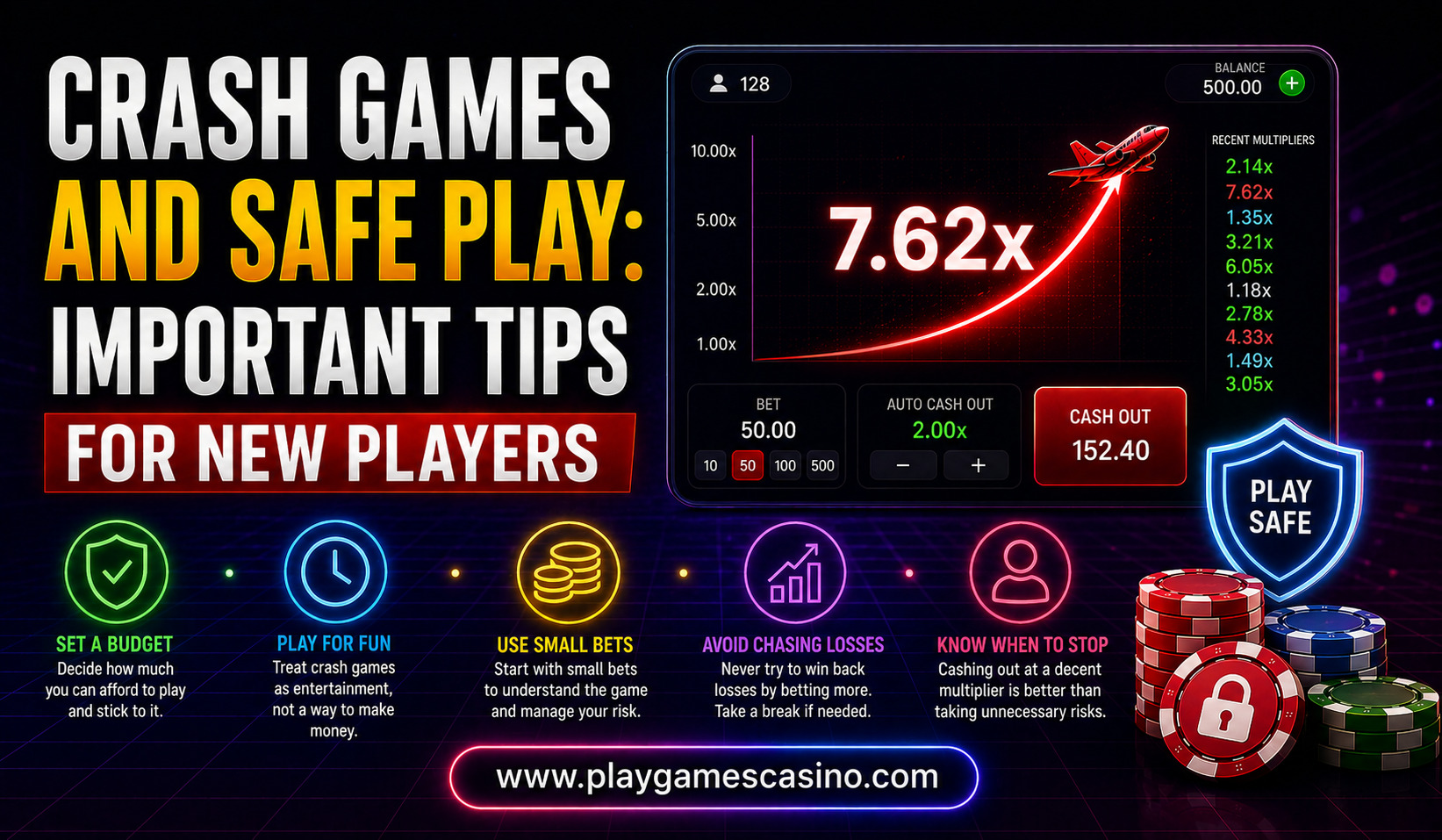
Crash games have become a recognizable part of the online gaming industry, offering a fast-paced format that is different from traditional casino-style games. Instead of cards, reels, or a board, these games usually revolve around a rising multiplier. The multiplier continues upward during a round and eventually stops at an unpredictable point, commonly known as the crash.
The simple visual format can make crash games appear easy to understand. However, simplicity does not mean that the activity is without financial risk. New players may be unfamiliar with the game’s rules, betting controls, cash-out mechanics, or the psychological pressure created by rapid rounds.
For this reason, safe play should be considered an important part of understanding crash games. The focus should not be on finding a guaranteed winning formula. Instead, new players can benefit from understanding the mechanics, setting personal limits, recognizing misleading strategy claims, and treating real-money participation as an activity involving risk.
What Makes Crash Games Different?
Crash games generally operate around a continuously increasing multiplier. A round may begin at 1.00x and move upward while players decide whether to cash out. At an unpredictable point, the round ends.
If a player successfully cashes out before the crash, the applicable multiplier is generally used to calculate the result according to the game’s rules. If the crash happens first, the stake may be lost.
This creates a very different rhythm from games where players wait for a complete hand, spin, or sequence before seeing an outcome. In a crash game, information changes continuously, and decisions may need to be made quickly.
That speed is one reason new players should spend time understanding the interface before considering real-money participation.
Start by Understanding the Rules
The first step toward safer participation is learning how the individual game works. Although crash games share a general concept, their rules and features can vary.
A new player should understand what the multiplier represents, when a round starts, how cash-out works, and what happens when the round crashes. It is also important to understand minimum and maximum stakes and any platform-specific conditions.
A demo mode can be useful where available. It allows users to explore the interface and understand the sequence of a round without immediately placing a real-money wager.
However, demo play should be treated as a learning tool rather than proof that a particular strategy will generate profits.
Never Treat Crash Games as Guaranteed Income
One of the most important safety principles is recognizing that crash games should not be viewed as a reliable source of income.
Online discussions sometimes promote systems that allegedly predict the next crash point or guarantee consistent profits. Such claims should be treated with considerable skepticism.
A strategy may help someone organize their betting decisions, but it cannot guarantee the outcome of a random or independently generated round. Previous results do not automatically determine future results.
New players should therefore be particularly careful with claims involving phrases such as “100% winning strategy,” “guaranteed profit,” or “secret prediction formula.”
Set a Budget Before Playing
If real-money participation is legally available to a player, establishing a personal spending limit before starting can help prevent decisions from becoming uncontrolled.
The amount should be money that the person can afford to lose without affecting essential expenses. It should not come from money reserved for rent, bills, education, emergencies, or other important commitments.
Once the predetermined limit has been reached, continuing in an attempt to recover losses can increase financial exposure.
A simple budget approach can include:
- Decide the maximum amount before starting.
- Avoid increasing the budget during a session.
- Never use essential household money.
- Stop when the predetermined limit is reached.
The purpose of a budget is not to guarantee a profitable session. It is to establish a boundary around potential losses.
Understand the Difference Between Winning and Safe Play
Safe play does not mean finding a method that guarantees more winning rounds. Instead, it means making decisions that reduce the possibility of uncontrolled financial or time-related behavior.
Someone can follow a carefully planned budget and still lose money. Likewise, someone can ignore every limit and temporarily win.
Short-term success does not necessarily indicate that a strategy is safe, while a loss does not automatically mean that a responsible approach was poorly designed.
The two concepts should therefore remain separate. Winning is an outcome; safe play is a behavior.
Be Careful With Loss-Chasing
Loss-chasing is one of the biggest risks associated with fast-paced gambling formats. It occurs when a person continues playing or increases their stakes because they want to recover money lost earlier.
For example, a player may lose several rounds and decide to increase the next stake substantially in an attempt to return to their previous balance. If another loss occurs, the financial impact can become even larger.
This approach does not guarantee recovery because the next round remains uncertain.
A safer response to a losing session is to respect the original spending limit rather than allowing previous losses to determine future decisions.
Why Previous Results Should Not Be Used as Predictions
Crash interfaces commonly display a history of previous multipliers. This can be useful for understanding what has happened in earlier rounds, but it can also encourage incorrect assumptions.
Suppose several rounds end at relatively low multipliers. A player might conclude that a large multiplier is now “due.” Another player might see several high results and assume that a low result must be next.
Neither assumption is automatically valid.
If rounds are independently generated according to the game’s underlying mechanics, previous results do not create a predictable sequence. A history panel is a record of past events, not a guaranteed forecast of the next round.
Understand Auto Cash-Out Carefully
Many crash games offer an auto cash-out function. This allows players to select a multiplier at which the system will attempt to exit automatically.
The feature can make decisions more consistent and reduce the need to manually press a button. However, it does not make the outcome predictable.
If a round ends before the selected multiplier is reached, the intended cash-out may not occur according to the game’s rules. Players should therefore understand exactly how the feature operates before using it.
Automation should be viewed as a convenience or control feature, not as a guaranteed winning strategy.
Avoid Increasing Stakes Just Because You Won
Winning can create a different psychological challenge. After a successful sequence, a player may become more confident and increase their stake because they believe their approach is working.
However, previous wins do not guarantee future wins.
A winning streak can occur naturally in a random environment, just as a losing streak can. Increasing the amount at risk because of temporary success can therefore change the financial consequences of the next unfavorable result.
Maintaining a predetermined budget is generally more important than reacting emotionally to short-term outcomes.
Time Limits Matter Too
Financial limits are only one part of safe play. Time can also become difficult to manage when rounds are short and games can be played continuously.
Because another round may be available within seconds, users can lose track of how long they have been participating. Setting a time boundary before starting can provide another useful stopping point.
Warning signs that it may be time to step away include:
- Playing much longer than originally planned.
- Continuing because of frustration after losses.
- Increasing the frequency of bets without a clear reason.
- Feeling unable or unwilling to stop.
Taking a break can create distance from the immediate cycle of wins, losses, and decisions.
Demo Mode Can Help Beginners Learn
Demo mode is one of the more useful features for newcomers when it is available. It allows users to become familiar with the interface without risking actual funds.
A beginner can use practice mode to understand where the multiplier appears, how betting controls work, how cash-out is displayed, and how round history is presented.
However, demo results should not be used as evidence that a real-money strategy is guaranteed to work.
The main benefit is familiarity. Someone who understands the interface may be less likely to make mistakes caused simply by not knowing where a particular control is located.
Read Platform Information Before Participating
Not all crash games or platforms operate under identical conditions. Before participating with real money, users should review the available information about the game and platform.
Important details can include the game’s rules, applicable limits, payment conditions, fairness information, responsible-gaming tools, and withdrawal requirements.
Players should also verify whether the service is legally available in their jurisdiction. Gambling laws and age restrictions can vary significantly between countries and regions.
Safe Play Checklist
| Area | Safer Approach |
| Budget | Set a fixed amount before starting |
| Time | Decide how long the session will last |
| Strategy claims | Avoid guaranteed-profit promises |
| Previous results | Treat them as historical information |
| Auto features | Understand the settings before using them |
| Losses | Do not chase losses with larger stakes |
| Demo mode | Use it to learn the interface |
| Legal requirements | Check local laws and age restrictions |
This checklist is not a guarantee against losses. It is a practical framework for keeping participation controlled.
Be Skeptical of External “Prediction” Services
New players may encounter websites, social-media accounts, groups, or applications claiming to predict crash points.
Some may advertise algorithms, signals, bots, or private access to supposedly hidden game information. Without credible evidence, these claims should not be treated as reliable.
A genuine game outcome cannot simply be predicted because someone has observed previous multipliers. Users should also be cautious about giving account credentials, payment information, or personal data to third parties claiming to provide guaranteed signals.
Conclusion
Crash games may have simple interfaces, but their fast pace and financial risks mean that new players should approach them carefully. Understanding the multiplier, crash point, cash-out process, betting limits, and platform rules is an important first step.
Safe play is not about discovering a secret formula that guarantees winning. It is about maintaining control over the decisions that can actually be controlled. Setting a budget, establishing time limits, avoiding loss-chasing, questioning prediction claims, and using demo mode for familiarization can all contribute to a more informed approach.
Most importantly, players should remember that previous results cannot guarantee future outcomes. A winning streak can end, a losing streak can continue, and no betting system can remove uncertainty from the game.
Frequently Asked Questions
Are crash games safe for beginners?
Crash games can involve financial risk when played for real money. Beginners should first understand the rules and interface, check applicable legal requirements, and use strict personal limits if they choose to participate.
Can a crash game strategy guarantee a win?
No. A strategy can influence betting decisions but cannot guarantee the outcome of an uncertain game round.
Should beginners use demo mode?
Demo mode can be useful for learning the interface and understanding how rounds work without using real money, where the platform provides it.
Can previous crash results predict the next round?
Previous results are historical information. They should not automatically be treated as reliable predictions of the next outcome.
Is auto cash-out safer than manual cash-out?
Auto cash-out can automate a selected exit condition, but it does not guarantee that the chosen multiplier will be reached. Its usefulness depends on how the individual game implements the feature.
What should I do after losing several rounds?
Avoid increasing stakes simply to recover losses. If the predetermined budget or time limit has been reached, stopping the session is the more controlled option.