Crash Game Terminology: Important Terms Beginners Should Know
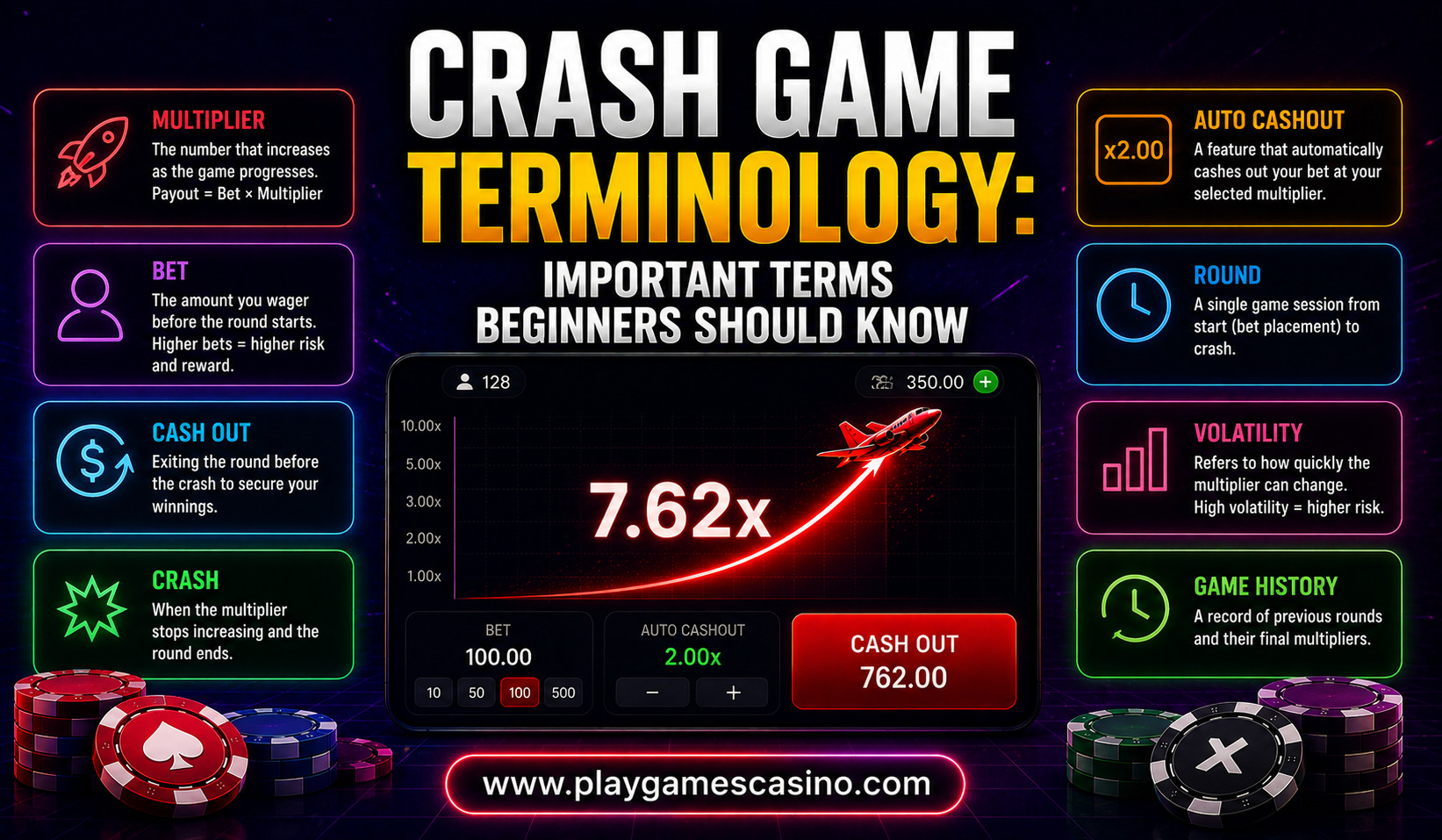
Crash games have become increasingly visible across the online gaming industry, offering a fast-paced format built around a rising multiplier and an unpredictable end to each round. Although the basic concept is relatively easy to understand, beginners can encounter unfamiliar terminology when they first explore a crash game interface.
Terms such as multiplier, crash point, cash-out, auto cash-out, round history, stake, RTP, RNG, and probably fair can appear frequently on gaming platforms. Understanding these words can make it easier to follow the rules, interpret the interface, and distinguish between factual game information and unsupported strategy claims.
Crash game terminology is not simply a collection of technical words. Many terms describe important parts of the game’s mechanics or financial structure. Learning them before participating can help users make more informed decisions, particularly when real money is involved.
What Is a Crash Game?
Before exploring individual terms, it is useful to understand the basic format. A crash game normally begins with a multiplier, often starting around 1.00x, which increases as the round progresses. At an unpredictable point, the round ends, commonly referred to as the game “crashing.”
If a player has completed a cash-out before the crash, the applicable multiplier may determine the return according to the game’s rules. The exact mechanics vary between games, but this basic structure explains why terminology surrounding multipliers, cash-outs, rounds, and results is so important.
Multiplier
The multiplier is one of the most important terms in crash games. It represents the factor by which a qualifying stake can be multiplied if the player successfully exits at that point.
For example, a display showing 2.00x means the multiplier has reached two times the original stake. If the game rules allow a player to cash out at that point, the applicable return is generally based on that multiplier.
The multiplier usually appears in large text at the center of the game interface because it is the primary indicator of the current round’s progress.
However, a rising multiplier should not be interpreted as evidence that it will continue rising. The round can end at any point according to the game’s underlying mechanics.
Crash Point
For example, if a round stops at 1.75x, that number represents the crash point for that particular round. Players who have not successfully exited before the crash may lose their stake according to the game’s rules.
The crash point is determined by the game’s technical system. Previous crash points should not automatically be treated as signals about what the next round will produce.
Cash-Out
Cash-out refers to the action of exiting a round before it crashes. When a player successfully cashes out, the applicable multiplier at that moment determines the result according to the game’s rules.
Suppose a player enters a round and chooses to cash out when the multiplier reaches 1.80x. If the action is successfully processed at that point, the player’s result is generally calculated using that multiplier.
Cash-out timing is therefore central to the gameplay experience. However, no manual timing method can guarantee that a future round will reach a particular multiplier.
Auto Cash-Out
Auto cash-out is a feature that allows users to specify a multiplier at which the system should automatically attempt to cash out.
Instead of manually watching the multiplier and pressing a button, a player can set a predefined target. If the round reaches that level and the feature operates according to the game’s conditions, the system can process the cash-out automatically.
This feature can make interaction more consistent, but it is important to understand what it does not do. Auto cash-out is an automation tool, not a prediction mechanism.
Stake
The stake is the amount of money or virtual currency placed on a particular round.
If a player selects a ₹100 stake, for example, ₹100 represents the amount being committed according to the game’s rules. In demo mode, the same concept may apply to virtual credits rather than real money.
Stake size is important because the same multiplier can produce very different financial results depending on the amount involved.
Round
A round is one complete cycle of a crash game, beginning when the game accepts participation and ending when the crash occurs.
The round normally follows a recognizable sequence. Players may place eligible stakes, the multiplier begins increasing, cash-out actions can take place, and eventually the round ends.
Once the round is completed, its result may be added to the game’s history before the next round begins.
Round History
Round history is the section of an interface that displays previous crash results. It may show a series of recent multipliers in chronological order.
For beginners, this feature can be useful for understanding what has happened recently. It can also help users become familiar with how the game records completed rounds.
However, historical results should not be confused with a prediction system. A list of previous multipliers describes past events and does not necessarily indicate what the next crash point will be.
RNG
RNG stands for Random Number Generator. It refers to a technical system used by many digital games to produce outcomes through random or pseudorandom processes.
In crash games that use an RNG-based system, the technology helps determine round outcomes according to the game’s programmed rules.
Understanding RNG is important because it explains why previous results generally cannot be used as a reliable method for predicting the next round. Randomized outcomes are specifically designed to prevent players from simply knowing what will happen next.
The exact implementation should always be checked in the individual game’s documentation.
Provably Fair
Probably fair is a term commonly associated with certain online gaming systems that provide a method for users to verify aspects of how game outcomes were generated.
Instead of asking users to rely entirely on trust, a provably fair system can use cryptographic information, such as server-side and client-side values, to allow outcome verification after a round.
The exact process differs between platforms. Users interested in fairness should read the game’s explanation of its verification system rather than assuming that the term has the same implementation everywhere.
RTP
RTP, or Return to Player, is a percentage used in many forms of gambling to describe the theoretical amount returned to players over a very large number of plays.
For example, a game advertised with a theoretical RTP of 96% would mathematically return ₹96 for every ₹100 wagered over a sufficiently large sample under the relevant assumptions. RTP is therefore a long-term mathematical concept, not a personal guarantee.
House Edge
The house edge represents the mathematical advantage built into a gambling game for the operator under its stated conditions.
RTP and house edge are closely related concepts in many games. If a game has a theoretical RTP of 96%, the corresponding theoretical house edge would generally be 4%, assuming the figures are directly complementary.
These numbers describe mathematical expectations rather than individual outcomes. A player can win or lose significantly more or less than the theoretical percentage during a short session.
Bet Limit
A bet limit defines the minimum or maximum amount that can be wagered in a particular game or platform.
Limits can vary depending on the game, account conditions, currency, jurisdiction, and platform policies. Beginners should check these values before placing any wager.
Understanding limits is particularly important for responsible participation because it clarifies the amount that can be committed during a round.
Demo Mode
Demo mode allows users to experience a crash game without using real-money wagers, where the platform provides such a feature.
Virtual credits may be used to demonstrate the game’s mechanics. This can help beginners learn the interface, multiplier display, cash-out controls, and round structure.
However, demo results should not be interpreted as proof that a strategy will produce real-money profits.
Auto-Bet
Auto-bet is a feature that can automate repeated betting actions according to settings selected by the user. Depending on the platform, it may work alongside an auto cash-out function.
Automation can reduce the need to manually repeat the same action, but it can also increase the speed or frequency of participation. Users should understand the settings before activating such features.
Automation changes how a player interacts with the game; it does not change the fundamental uncertainty of the game’s outcomes.
Session
A session refers to a period during which a user participates in a game. It may last only a few minutes or continue for a longer period.
Tracking a session can help users understand how much time they are spending on a game. When real money is involved, setting personal time and spending boundaries can also support responsible gaming.
Important Terms at a Glance
| Term | Meaning |
| Multiplier | The factor displayed as the round progresses |
| Crash Point | The multiplier where the round ends |
| Cash-Out | Exiting a round before the crash |
| Auto Cash-Out | Automated exit at a selected multiplier |
| Stake | Amount committed to a round |
| Round | One complete game cycle |
| Round History | Record of previous round results |
| RNG | Random Number Generator |
| RTP | Theoretical Return to Player percentage |
| House Edge | Mathematical advantage for the operator |
| Demo Mode | Practice version using virtual credits |
| Auto-Bet | Automated betting feature |
Why Beginners Should Learn the Terminology
Learning these terms does more than make a player comfortable with a game’s interface. It can also help prevent misunderstandings.
For example, knowing the difference between a crash point and a cash-out point makes it easier to understand why a player can exit one round successfully while another round ends before an exit is completed.
Similarly, understanding RTP and house edge helps separate long-term mathematical concepts from claims about guaranteed personal returns.
Four areas are particularly useful for beginners to understand:
- Game mechanics: multiplier, crash point, round, and cash-out.
- Financial terms: stake, bet limits, RTP, and house edge.
- Technical terms: RNG and provably fair systems.
- Interface features: demo mode, auto-bet, auto cash-out, and round history.
Terms That Should Not Be Confused With Strategies
A common problem in crash game discussions is treating technical terminology as evidence of a winning strategy.
For example, knowing what a crash point is does not make it possible to predict the next crash point. Understanding RNG does not provide a method for controlling random outcomes. Similarly, using auto cash-out does not guarantee that a chosen multiplier will be reached.
Terminology explains how a system works; it does not necessarily provide a way to defeat its mathematical structure.
This distinction is particularly important when users encounter online claims about “secret” formulas or guaranteed prediction systems.
Conclusion
Crash game terminology can initially appear complicated, but most important terms relate directly to a few basic ideas: how a round works, how the multiplier changes, how cash-out operates, how outcomes are generated, and how financial information is calculated.
Words such as multiplier, crash point, cash-out, stake, RNG, RTP, house edge, auto cash-out, demo mode, and round history provide the foundation for understanding a crash game’s interface and rules.
For beginners, learning these definitions is more useful than searching immediately for a supposed winning formula. Understanding terminology makes it easier to read game information critically and recognize the difference between factual mechanics and unsupported strategy claims.
Frequently Asked Questions
What is the most important crash game term for beginners?
The multiplier is usually the most important term because it is central to the visual progression of the round. However, beginners should also understand crash point, cash-out, stake, and round.
What does crash point mean?
The crash point is the multiplier at which a particular round ends. The exact value varies from round to round according to the game’s underlying system.
Is auto cash-out a strategy?
Auto cash-out is better understood as an automation feature. It allows a user to select a predefined multiplier for an attempted automatic exit, but it cannot guarantee a winning outcome.
What does RNG mean in crash games?
RNG means Random Number Generator. It refers to technology used to generate randomized or pseudorandom outcomes in digital games, depending on the game’s technical design.
Does RTP guarantee that a player will get money back?
No. RTP is a theoretical long-term mathematical measurement. It does not guarantee a particular result for an individual player or a single session.