RTP vs. House Edge: Understanding Casino Math
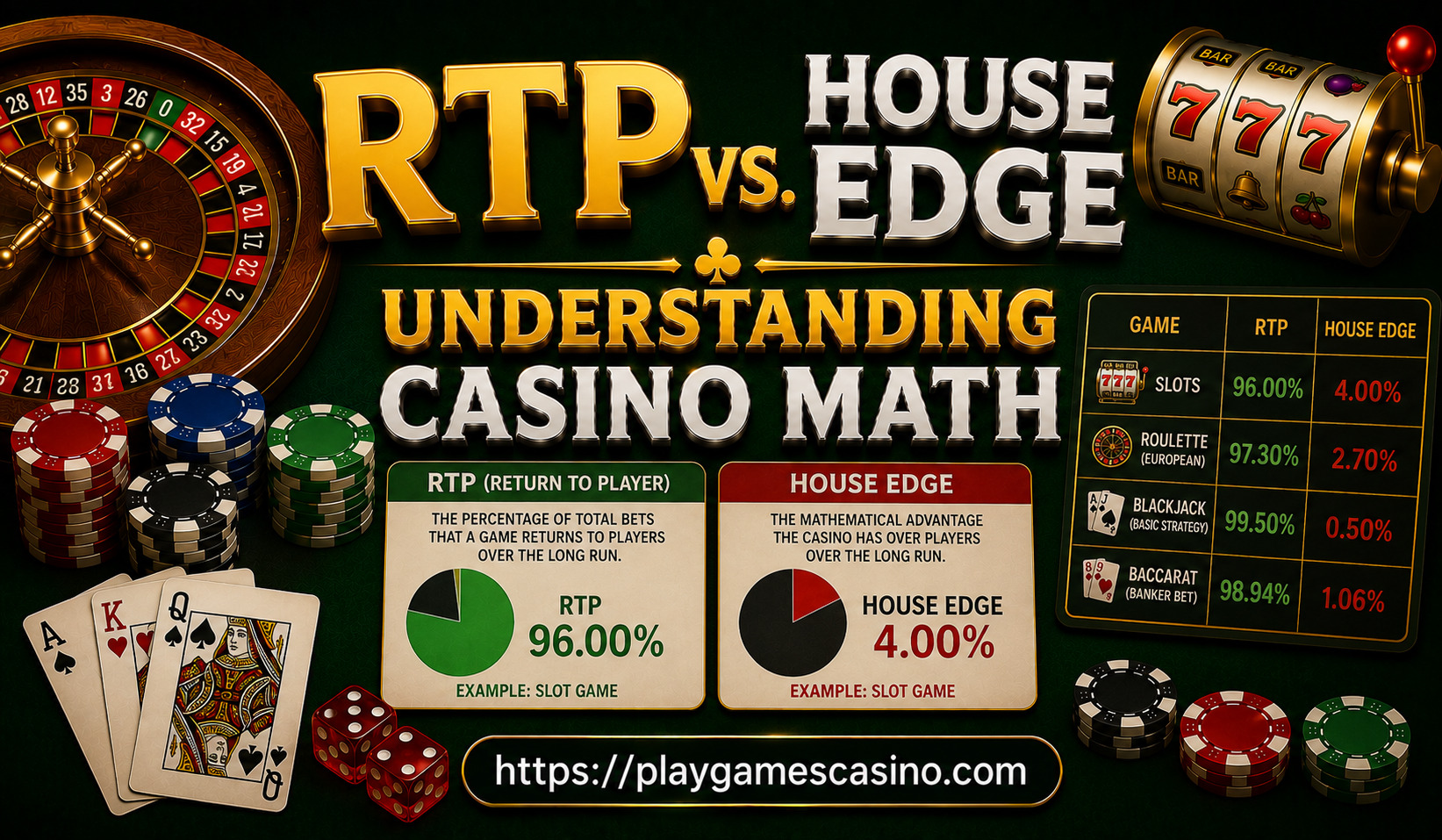
When people start exploring casino games, they often come across terms such as RTP, house edge, probability, and expected return. These terms can seem technical at first, but understanding them is useful because they explain how casino games are designed mathematically.
Two of the most important concepts are Return to Player, commonly called RTP, and house edge. Although they describe closely related ideas, they are not exactly the same. RTP focuses on the theoretical percentage returned to players, while house edge represents the casino’s mathematical advantage.
Understanding the difference can make it easier to compare casino games and interpret their advertised statistics. However, neither measurement predicts what will happen during one individual session. They describe long-term mathematical expectations rather than guaranteed personal results.
What Is RTP?
RTP stands for Return to Player. It is a theoretical percentage that describes how much of the money wagered on a particular game is expected to be returned to players over a very large number of plays.
For example, imagine a casino game with an RTP of 96%. In mathematical terms, the game is designed to return approximately $96 for every $100 wagered over an extremely large sample.
This does not mean a player who deposits $100 will receive $96 back. Individual results can be dramatically different. A player might lose the entire amount, win significantly more, or finish somewhere in between.
RTP is therefore a long-term statistical measurement, not a personal guarantee.
What Is House Edge?
If a game has a 4% house edge, the casino theoretically expects to retain around $4 for every $100 wagered over a very large number of bets.
The basic relationship between RTP and house edge is:
House Edge = 100% − RTP
For example, a game with a 96% RTP has a theoretical house edge of 4%.
Likewise, a game with a 95% RTP has a 5% house edge.
This relationship makes the two measurements easy to compare, even though they are expressed from opposite perspectives.
RTP vs. House Edge: The Main Difference
The easiest way to understand the distinction is to think about who the percentage describes.
RTP describes the theoretical portion of wagers that returns to players. House edge describes the theoretical portion that the casino retains.
Consider a game with a 97% RTP.
The calculation is:
100% − 97% = 3%
The player-facing measurement is 97% RTP, while the casino-facing measurement is a 3% house edge.
| RTP | Theoretical House Edge |
| 99% | 1% |
| 98% | 2% |
| 97% | 3% |
| 96% | 4% |
| 95% | 5% |
| 90% | 10% |
These percentages describe theoretical long-term results and should not be interpreted as guaranteed returns.
How RTP Works in Practice
RTP becomes more meaningful when a game is played a very large number of times.
Suppose a hypothetical slot has a theoretical RTP of 96%. Across millions of spins and a large amount of total wagering, the mathematical model is designed to return approximately 96% of the money wagered to players collectively.
That does not mean every player receives 96% of their money back.
One player could experience a major jackpot, while another could lose money quickly. The overall mathematical return is based on the game’s underlying probability and payout structure.
This is similar to other statistical measurements: a long-term average does not determine the result of every individual event.
How House Edge Works
House edge operates on the same mathematical principle from the casino’s perspective.
Imagine a game with a 4% house edge and $1 million in total wagers over a sufficiently large sample. The theoretical expectation would be approximately $40,000 retained by the casino.
A casino might win more than the expected amount during one period or less than the expected amount during another. Random variation is always present.
Over a sufficiently large number of wagers, however, the results are expected to move closer to the game’s mathematical expectation.
RTP and House Edge in Slot Machines
RTP is particularly common when discussing slot machines.
A slot may advertise or disclose an RTP such as 95%, 96%, or 97%. This figure represents the theoretical long-term return built into the game’s mathematical model.
Slots can also have different levels of volatility. Two games can have similar RTP figures while producing very different patterns of wins.
A lower-volatility game may produce smaller payouts more frequently, while a higher-volatility game may have larger potential payouts with longer periods between significant wins.
This means RTP alone does not tell you everything about how a slot behaves.
Why RTP Does Not Predict Your Session
Suppose you play a slot with a 96% theoretical RTP and wager $500 in total.
It would be incorrect to assume that you are entitled to receive exactly $480 back.
The RTP is calculated across a huge number of outcomes. Your particular 100 spins, 500 spins, or even several thousand spins can produce results far above or below the theoretical average.
Short-term variance can be substantial.
RTP and Table Games
Table games often use house edge rather than RTP when describing their mathematics.
Roulette, blackjack, baccarat, and craps can have different house edges depending on the exact rules and wagers.
For example, roulette has different mathematical characteristics depending on whether the wheel contains one zero or both zero and double zero.
Blackjack is even more dependent on table rules because factors such as the number of decks, blackjack payout, dealer rules, and doubling restrictions can affect the mathematical advantage.
Therefore, simply knowing the name of a game is not always enough to determine its exact house edge.
How Blackjack Demonstrates Casino Math
Blackjack is particularly interesting because player decisions can influence the mathematical outcome.
If players make poor decisions, the effective house edge can be higher than it would be when using mathematically optimal basic strategy.
Basic strategy provides the statistically preferred action for different player hands and dealer upcards.
However, even correct basic strategy does not normally guarantee a positive expected return. The exact house edge depends on the rules of the game.
This makes blackjack a useful example of why casino mathematics involves more than simply looking at a single advertised percentage.
Roulette and House Edge
Roulette provides a straightforward example of house edge.
On a standard European wheel, there are 37 pockets: numbers 1 through 36 plus zero. On an American wheel, there are 38 pockets because both zero and double zero are included.
That additional zero changes the mathematics.
Standard European roulette generally has a house edge of about 2.70%, while standard American roulette has a house edge of about 5.26%.
The difference may appear small, but it can become significant over a large amount of wagering.
This is why understanding the exact version of a casino game can be more important than simply knowing its general category.
Why a Lower House Edge Is Important
When comparing similar casino games, a lower theoretical house edge generally means a smaller mathematical disadvantage for the player.
For example, assuming all other factors are comparable, a game with a 2% house edge is mathematically more favorable to the player than a game with a 7% house edge.
However, a lower house edge does not mean a player is guaranteed to win.
Random results can still produce substantial short-term losses. The house edge describes the expected mathematical relationship over a large number of wagers.
Players should also consider the rules, minimum and maximum wagers, volatility, and their own budget rather than focusing on one percentage alone.
What Is Expected Value?
Expected value, or EV, is another useful concept in casino mathematics.
It represents the theoretical average outcome of a particular wager if the same situation could be repeated a very large number of times.
For a casino game with a 5% house edge, the player’s theoretical expected value is generally negative by approximately 5% of the amount wagered, assuming the house edge applies to that wager.
For example, a simplified $100 wager with a 5% house edge would have a theoretical expected loss of $5.
That does not mean the player will actually lose $5. They could win $100, lose $100, or experience another result.
EV helps explain long-term mathematical expectations rather than individual outcomes.
RTP, House Edge, and Variance
RTP and house edge describe long-term mathematical expectations, while variance or volatility describes how widely individual results can fluctuate.
This distinction is important.
Consider two hypothetical games that both have a 96% RTP. One might provide frequent small wins, while the other might provide fewer but potentially larger payouts.
The theoretical RTP can be identical even though the short-term experience is very different.
Therefore, players should avoid assuming that a high RTP automatically means frequent wins.
Does RTP Change Over Time?
RTP is normally determined by the game’s mathematical design and rules. However, different versions of the same game can have different RTP settings.
For example, a casino may offer multiple versions of a slot with different theoretical returns. Table games can also have different house edges because of rule variations.
Players should therefore check the information provided for the specific game rather than assuming that every version has identical mathematics.
A game’s RTP also does not normally change simply because a player has experienced a series of losses or wins.
Can Betting Systems Overcome House Edge?
Betting systems generally change the size and timing of wagers rather than the underlying probability of the game.
For example, increasing a roulette wager after a loss does not change the probability of the next spin.
Similarly, a progression system cannot turn a negative-expectation game into a guaranteed positive one.
The house edge remains part of the game’s mathematical structure unless the rules themselves provide a different mathematical advantage.
How to Compare Casino Games Using RTP and House Edge
When comparing games, it can be useful to start with the theoretical RTP or house edge, but that should not be the only consideration.
A practical comparison involves several factors:
- The game’s theoretical RTP or house edge.
- The volatility or variance of results.
- The specific rules and payout structure.
- The amount you can afford to wager.
- Whether your decisions influence the outcome.
A game with a favorable mathematical profile can still involve substantial short-term risk.
Frequently Asked Questions
Is RTP the same as house edge?
They are closely related but describe different sides of the same mathematical relationship. RTP represents the theoretical percentage returned to players, while house edge represents the theoretical percentage retained by the casino.
Is higher RTP always better?
From a purely mathematical perspective, a higher RTP generally means a lower house edge. However, RTP does not describe short-term volatility or guarantee that an individual player will win.
Does 96% RTP mean I get $96 back from every $100?
No. RTP is calculated over a very large number of outcomes. An individual player can receive substantially more or less than the theoretical percentage.
Can house edge be eliminated with a betting strategy?
Generally, no. Betting strategies can change wager sizes but do not normally change the underlying mathematical advantage built into the game.
Which casino games have lower house edges?
The answer depends on the exact rules and wagers. Some blackjack and baccarat bets can have relatively low house edges under favorable conditions, while particular bets in games such as roulette can have considerably higher disadvantages.
Final Thoughts
RTP and house edge are two sides of the same fundamental casino mathematics. RTP looks at the theoretical percentage returned to players, while house edge describes the casino’s expected mathematical advantage. The simple relationship between them is RTP + house edge = 100% in the standard theoretical framework.
Understanding these figures can help players compare games more intelligently. However, neither percentage predicts what will happen during a single session. Random variation can produce large wins or losses regardless of the theoretical numbers.
RTP is especially common in slot games, while house edge is frequently used when discussing table games. Blackjack demonstrates how player decisions can influence mathematical outcomes, while roulette shows how different wheel designs can change the house advantage.
Ultimately, casino mathematics is about probabilities and long-term expectations, not guaranteed results. A lower house edge can mean a more favorable mathematical position, but it does not eliminate risk. Anyone who chooses to gamble should understand the specific rules, consider the game’s theoretical mathematics, set a sensible budget, and treat gambling as entertainment rather than a reliable source of income.