Variance in Slot Games Explained
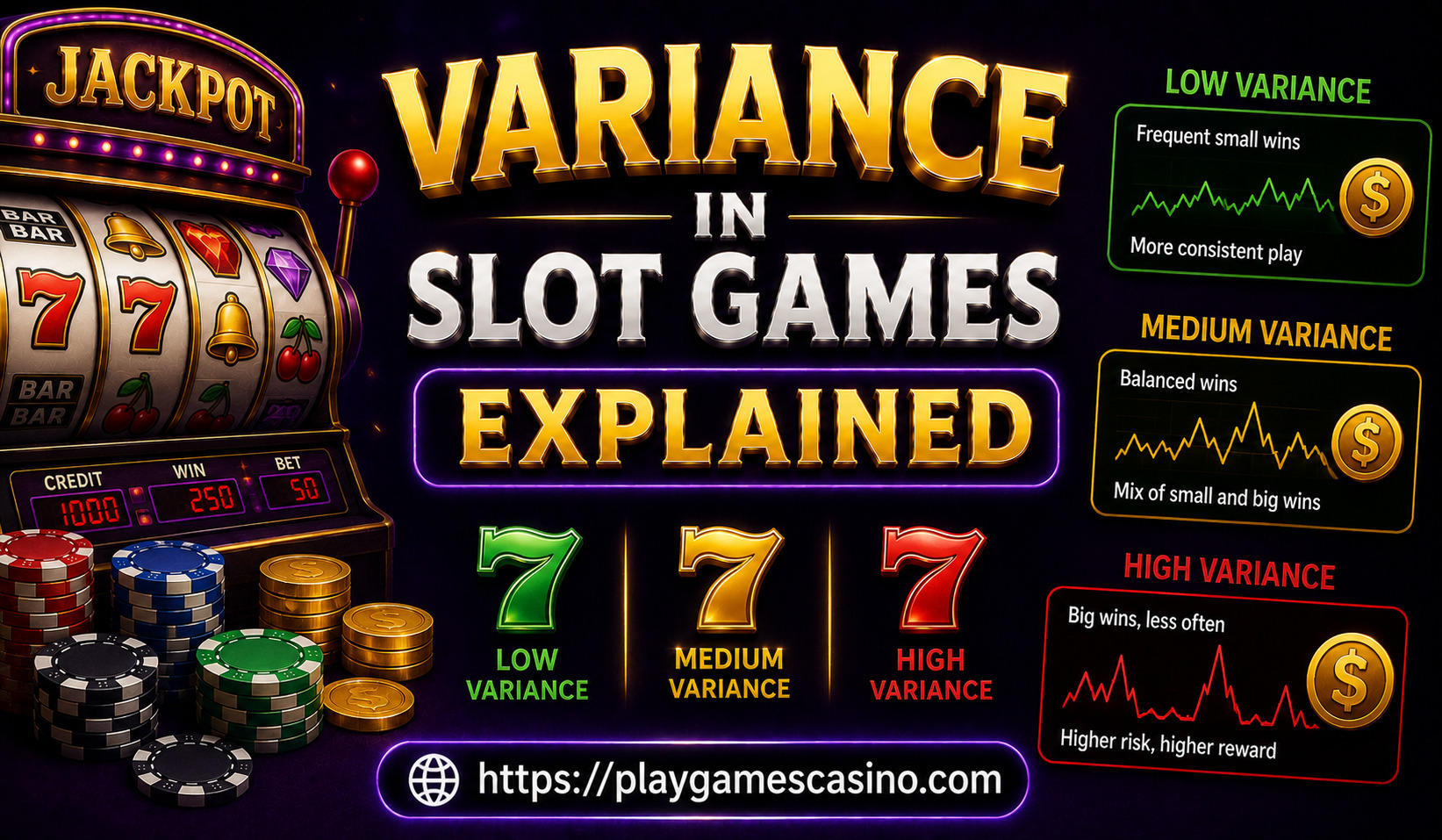
When choosing a slot game, players often look at its theme, jackpot, paylines, or Return to Player (RTP). One important feature that can receive less attention is variance. Understanding variance can provide a clearer idea of how a slot’s payouts are generally distributed and why two games with similar RTP figures can feel completely different to play.
Variance is sometimes described as volatility. Although the terms can have slightly different technical uses depending on the context, they are commonly used in the casino industry to describe how frequently a game tends to pay and how large its payouts may be.
A low-variance slot may produce smaller wins more frequently, while a high-variance slot may have longer periods between significant wins but offer larger potential payouts. Medium-variance games sit somewhere between these extremes.
Understanding variance does not predict when a particular spin will win. It is a way of understanding the overall mathematical characteristics of a slot game.
What Is Variance in Slot Games?
Variance describes how widely individual results can differ from a game’s expected average.
In simple terms, it helps explain whether a slot tends to distribute its returns through many smaller wins or fewer larger wins.
Imagine two hypothetical slots that both have a theoretical RTP of 96%. The first might produce frequent small payouts, while the second might produce fewer wins but occasionally award a much larger amount.
Although their theoretical RTP is identical, the playing experience can be very different. The first game may feel more consistent, while the second can produce larger swings in a player’s balance.
This difference is where variance becomes useful.
Variance does not tell you whether the next spin will win. Instead, it describes the broader pattern of possible results over many spins.
Low, Medium, and High Variance
Slot games are often broadly categorized into low, medium, or high variance.
A low-variance slot generally has more frequent payouts, although individual wins may be relatively modest. These games may appeal to players who prefer smaller fluctuations between spins.
A medium-variance slot provides a balance between payout frequency and payout size. Wins may occur less frequently than in low-variance games, but the potential rewards can be larger.
A high-variance slot typically has greater fluctuations. Significant wins may occur less often, while the game may offer larger potential payouts when winning combinations appear.
| Variance Level | Typical Payout Pattern | General Experience |
| Low | More frequent, smaller wins | Smaller balance fluctuations |
| Medium | Mixed payout frequency and size | Balanced swings |
| High | Less frequent, potentially larger wins | Greater balance fluctuations |
These descriptions are general. Actual results depend on the specific game’s mathematical design.
How Variance Relates to RTP
RTP and variance are related to the mathematics of a slot, but they measure different things.
RTP, or Return to Player, describes the theoretical percentage of wagers that a game is designed to return over a very large number of plays.
Variance describes how those returns are distributed.
For example, consider two slots with a theoretical RTP of 96%. One could return money through frequent smaller wins, while another might return much of its theoretical value through rare, larger payouts.
The RTP is the same, but the variance is different.
This is why looking at RTP alone does not provide a complete picture of a slot’s mathematical characteristics.
A high-RTP slot can still be highly volatile, while a lower-RTP slot can have relatively low variance.
How Variance Affects the Playing Experience
Variance can have a major effect on how a slot feels during a session.
With a lower-variance game, players may encounter winning combinations relatively often. These wins may not be large enough to produce major profits, but they can make the balance move up and down in smaller increments.
High-variance games can feel very different. A player might experience a longer sequence of spins without a meaningful payout before eventually receiving a much larger win.
This does not mean that every high-variance slot will produce a large win after a losing streak. That would be a misunderstanding of probability.
A slot does not become “due” for a payout simply because it has not produced one recently.
Why High Variance Can Mean Bigger Swings
High-variance games can create larger changes in a player’s balance because their payout structures may place more emphasis on less frequent, higher-value outcomes.
Suppose a player wagers $1 per spin. A low-variance game might produce several small wins during a sequence of spins. A high-variance game might produce fewer wins but have the possibility of a much larger payout.
The player could therefore experience longer periods of decline followed by a significant increase when a qualifying combination appears.
However, the opposite is also possible. A player may experience a long sequence of unsuccessful spins without receiving a major payout.
Variance describes the potential distribution of outcomes, not a schedule for when payouts will occur.
Low-Variance Slots Explained
Low-variance slots generally focus on more frequent payouts and smaller individual rewards.
These games may include many combinations that return relatively modest amounts. Their mathematical design can produce a smoother-looking balance compared with highly volatile games.
That does not mean a low-variance slot is safer or guaranteed to be profitable. The house edge still applies, and a player can lose money.
Low variance simply suggests that the game’s results are less likely to be dominated by occasional very large payouts.
Players should therefore avoid interpreting low variance as meaning “low risk.” Any slot involving real-money wagers carries financial risk.
High-Variance Slots Explained
High-variance slots generally place greater emphasis on larger payouts that occur less frequently.
These games may feature large jackpots, bonus features, multipliers, or other mechanics that can create substantial winning outcomes.
Because larger payouts may be less frequent, players can experience longer stretches without significant returns.
High variance can therefore produce substantial swings in a bankroll. A player may win a large amount during one spin and then experience many ordinary or losing spins afterward.
The presence of a large potential jackpot does not mean that winning it is likely. Players should distinguish between maximum possible payout and probability of receiving that payout.
Variance Does Not Predict the Next Spin
One of the most important things to understand about slot variance is that it does not predict individual results.
Suppose a high-variance slot has gone 100 spins without a significant payout. It would be incorrect to assume that a large win must now be coming.
Likewise, a player cannot assume that a low-variance game will produce a small win on the next spin simply because it has paid frequently in the past.
Modern slots generally use Random Number Generators (RNGs) to determine outcomes. Each spin should be evaluated according to the game’s mathematical design rather than recent results.
Past outcomes may be recorded in a game history, but they should not automatically be treated as predictions of future results.
Variance vs. Volatility
The words variance and volatility are often used interchangeably when discussing slot games.
In casino descriptions, both terms generally refer to the way payouts are distributed and the size of fluctuations players might experience.
Technically, variance has a specific statistical meaning related to how much results differ from an expected value. Volatility can be used more broadly to describe how dramatically results can change.
For everyday slot comparisons, however, players will often see low, medium, or high volatility used to communicate the game’s general payout characteristics.
The important point is to understand what the casino or game provider means by the classification rather than focusing too heavily on terminology.
Can Variance Change the RTP?
Variance and RTP are separate mathematical properties.
Changing the variance of a game does not automatically mean changing its RTP. A slot can theoretically maintain the same long-term RTP while redistributing its payouts between more frequent smaller wins and less frequent larger wins.
For example, a simplified game might be designed to return 96% of wagers over a huge number of spins. The game’s mathematical designers can distribute that theoretical return in different ways.
One version could offer numerous modest payouts. Another could offer fewer larger payouts.
Both can have the same RTP while having different variance.
This is one reason why RTP and variance should be considered together rather than treating either measurement as a complete description of a slot.
What Is the Relationship Between Variance and Jackpot Slots?
Jackpot-focused slots are often associated with higher variance because their mathematical structures may allocate a portion of potential returns to larger prizes.
However, the existence of a jackpot does not automatically mean a game has high variance. The actual classification depends on the game’s complete mathematical model.
A progressive jackpot can also involve a separate prize pool that changes over time.
Players should therefore look at the game’s published information rather than assuming its variance based solely on its theme or advertised maximum win.
How to Choose Between Different Variance Levels
There is no universally “best” variance level because the appropriate choice depends on what a player expects from the game and how much financial risk they are prepared to accept.
Someone who dislikes large fluctuations may prefer to explore lower-variance games. Another person may be attracted to the possibility of larger but less frequent payouts.
However, preference should not be confused with mathematical advantage.
When comparing slots, it can be useful to consider several characteristics:
- The game’s stated RTP.
- Its variance or volatility classification.
- The maximum potential payout.
- The game’s bonus features and payout structure.
These factors provide a more complete picture than simply looking at the game’s advertised jackpot.
Does Bet Size Affect Variance?
The underlying variance of a slot does not normally change simply because the player changes their bet size.
However, the financial impact of variance can become larger when the wager increases.
For example, if a player doubles their bet from $1 to $2 per spin, a winning combination may produce twice the monetary payout, but a losing spin can also cost twice as much.
This means larger wagers can make the same underlying volatility more significant for a player’s bankroll.
Changing bet size therefore changes the amount of money exposed to each outcome, not necessarily the mathematical structure of the slot itself.
Frequently Asked Questions
What does variance mean in slot games?
Variance describes how widely a slot’s results can fluctuate and how its payouts are generally distributed. Low-variance games tend to have more frequent smaller payouts, while high-variance games can have fewer but potentially larger payouts.
Is high variance better than low variance?
Neither is automatically better. High and low variance simply offer different payout patterns. High variance can involve larger fluctuations, while low variance generally produces smaller changes in results.
Does high variance mean a bigger win is guaranteed?
No. Variance does not predict when a large payout will occur. A player can experience many unsuccessful spins on a high-variance slot without receiving a major win.
Is variance the same as RTP?
No. RTP measures the theoretical percentage returned to players over a very large number of plays, while variance describes how those returns are distributed across different outcomes.
Can I use variance to predict a slot’s next spin?
No. Variance is a statistical characteristic of the game and cannot tell you whether the next spin will win or lose.
Final Thoughts
Variance is an important part of understanding slot games because it explains why games with similar RTP figures can provide very different payout experiences. Low-variance slots generally emphasize more frequent, smaller wins, while high-variance games can involve fewer significant payouts and larger fluctuations.
However, variance should never be interpreted as a prediction tool. A high-variance slot does not become more likely to pay after a losing streak, and a low-variance game does not guarantee frequent profits.
RTP and variance answer different questions. RTP helps explain the game’s theoretical long-term return, while variance provides insight into the distribution and size of its payouts. Looking at both can give players a more complete understanding of a slot’s mathematical design.
Most importantly, neither measurement removes the financial risk associated with gambling. Slot outcomes remain uncertain, and no variance level guarantees a particular result. Anyone who chooses to play should understand the game’s rules and statistics, set a clear spending limit, and treat slots as entertainment rather than as a reliable way to earn money.