How to Calculate Your Chances in Casino Games
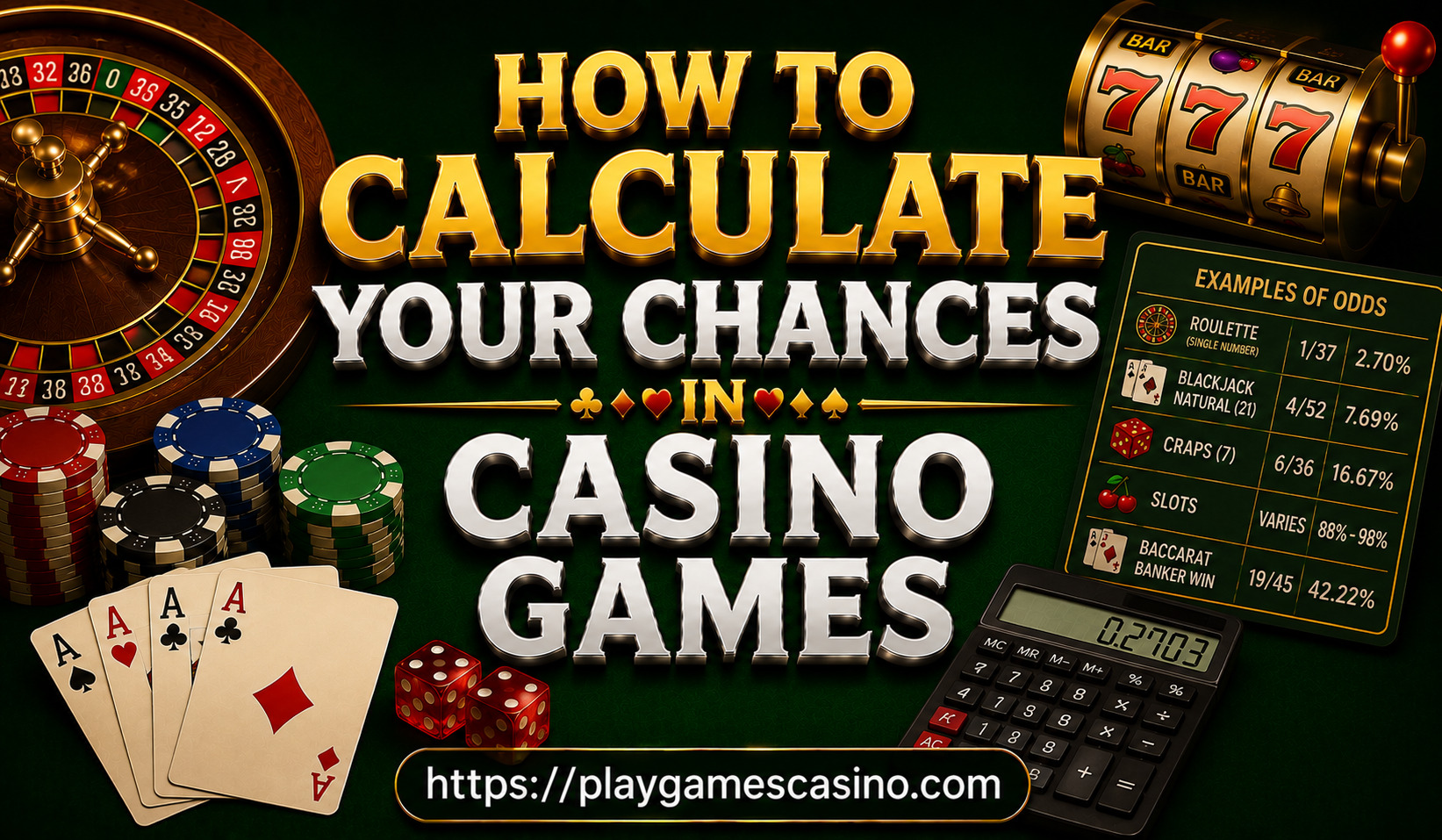
Understanding your chances in casino games is an important part of learning how gambling works. Whether you are looking at roulette, blackjack, baccarat, slots, or another casino game, probability can help explain how likely different outcomes are.
Casino games are designed around mathematical rules. While individual results are unpredictable, the probability of an outcome can often be calculated or estimated from the game’s rules. Learning these calculations does not guarantee a win, but it can help you understand the risks involved and make more informed decisions.
For beginners, probability can sound complicated. In practice, many basic casino calculations use simple ideas such as the number of favorable outcomes, the total number of possible outcomes, payout ratios, and house edge. Once these concepts are clear, it becomes much easier to understand the mathematics behind popular casino games.
What Does “Chance of Winning” Mean?
The chance of winning describes the probability that a particular event will occur.
Probability is commonly expressed as a fraction, decimal, or percentage. For example, if there are 10 equally likely outcomes and one produces a win, the probability of winning is:
1 ÷ 10 = 0.10 = 10%
The calculation is straightforward when all outcomes are equally likely.
However, casino games can contain different types of bets and outcomes, so the calculation depends on exactly what you are betting on.
It is also important to distinguish between the chance of winning a bet and the expected financial result. A bet can have a relatively high probability of winning while still offering a poor mathematical return because its payout is low.
The Basic Probability Formula
The simplest probability formula is:
Probability = Favorable Outcomes ÷ Total Possible Outcomes
This formula is useful when the possible outcomes are known and equally likely.
For example, a standard six-sided die has six possible results. If you want to know the chance of rolling a 4, there is one favorable outcome out of six:
1 ÷ 6 = 16.67%
Casino games often use more complicated versions of this principle, but the underlying concept remains the same.
When calculating casino probabilities, first identify what counts as a successful outcome. Then determine how many possible outcomes exist and how many of them satisfy your chosen condition.
How to Calculate Roulette Chances
Roulette is one of the easiest casino games for demonstrating probability.
A standard European roulette wheel has 37 pockets: numbers 1 through 36 and one zero. An American roulette wheel has 38 pockets because it contains both zero and double zero.
There is one winning pocket out of 37.
The probability is therefore:
1 ÷ 37 × 100 = approximately 2.70%
For American roulette, the calculation becomes:
1 ÷ 38 × 100 = approximately 2.63%
These figures represent the chance that the ball lands on one particular number.
However, the house edge comes from the relationship between this probability and the payout. A standard straight-up roulette bet generally pays 35:1 rather than the 36:1 that would be required for a perfectly fair game.
Calculating Red or Black
A red or black bet covers 18 numbers on a standard roulette wheel.
On a European wheel, there are 18 red numbers out of 37 total pockets.
Therefore:
18 ÷ 37 × 100 = approximately 48.65%
The probability is not exactly 50% because of the zero.
On an American wheel, there are 18 red numbers out of 38 pockets, producing a probability of approximately 47.37%.
This illustrates why the number of zero pockets matters when comparing roulette variants.
Calculating Blackjack Probabilities
Blackjack probability is more complicated than roulette because cards are removed from the deck as the game progresses and players make decisions.
The probability of receiving a particular card depends on the number of cards remaining and the number of cards of that value still available.
A standard deck contains 52 cards. There are four aces, four twos, four threes, and so on through the nine. There are 16 cards worth 10 points because tens, jacks, queens, and kings each count as 10.
At the beginning of a single-deck game, the probability of receiving a 10-value card is:
16 ÷ 52 = approximately 30.77%
This probability can change after cards have been dealt because the composition of the remaining deck changes.
That is one reason blackjack probabilities are more dynamic than simple roulette probabilities.
Player Decisions Affect Blackjack Chances
Blackjack also demonstrates why probability alone does not determine the best decision.
Suppose you have a hard 16. Taking another card gives you a significant chance of busting. However, standing may still be a poor choice if the dealer has a strong upcard.
Basic blackjack strategy compares the expected outcomes of different actions rather than simply asking whether the next card will be favorable.
This is why blackjack strategy charts are based on mathematical calculations involving the player’s hand, dealer’s upcard, and table rules.
Understanding Baccarat Probabilities
Baccarat uses a different card-value system, but probability can still be analyzed mathematically.
The main wagers are generally Player, Banker, and Tie. The drawing rules are predetermined, meaning players do not normally decide whether additional cards are taken.
Because of the game’s structure, the Banker and Player outcomes have slightly different probabilities.
The Banker outcome generally occurs slightly more often than the Player outcome under standard rules. However, casinos commonly charge a commission on winning Banker bets, which affects the overall expected return.
The Tie outcome is less frequent but typically offers a much larger payout. A larger payout should not be confused with a better chance of winning.
Probability and Casino Payouts
Knowing the chance of winning is only half of the equation. You also need to consider how much the game pays for a successful wager.
Imagine a hypothetical game where you have a 25% chance of winning. If the game pays 4:1 on a successful wager, the mathematical relationship is very different from a game that pays only 2:1.
This is where expected value becomes useful.
What Is Expected Value?
Expected value, often abbreviated as EV, represents the average result you would theoretically expect from repeatedly making the same wager under identical conditions.
A simplified formula is:
EV = Probability of Win × Profit from Win − Probability of Loss × Amount Lost
For example, suppose a hypothetical bet has a 50% chance of winning $10 and a 50% chance of losing $10.
The calculation would be:
(0.50 × $10) − (0.50 × $10) = $0
That would represent a theoretically fair bet before considering any additional costs or fees.
Casino games are generally structured so that the player’s expected value is negative over the long term.
Understanding House Edge
If a game has a 5% house edge, the casino theoretically expects to retain about $5 for every $100 wagered over a very large number of bets.
This does not mean a player will lose exactly 5% during one session.
Someone might win $200 after wagering $100, while another player might lose their entire $100. Random variation can produce very different short-term results.
The house edge becomes meaningful when analyzing the game over a large number of wagers.
RTP and Calculating Casino Returns
For many electronic casino games, especially slots, Return to Player (RTP) is commonly used.
If a slot has a theoretical RTP of 96%, the corresponding theoretical house edge is approximately 4%.
The basic relationship is:
House Edge = 100% − RTP
So, for example:
| RTP | Theoretical House Edge |
| 99% | 1% |
| 97% | 3% |
| 96% | 4% |
| 95% | 5% |
| 90% | 10% |
RTP is a long-term statistical measurement, not a promise that a player will receive a particular percentage back during an individual session.
How to Calculate Your Chance of Winning Multiple Times
Probability becomes more interesting when you consider several independent events.
Suppose a hypothetical game gives you a 50% chance of winning each round. The chance of winning two consecutive rounds would be:
0.50 × 0.50 = 0.25
That equals 25%.
For three consecutive wins:
0.50 × 0.50 × 0.50 = 0.125
That equals 12.5%.
The general principle is that when independent events all need to happen, their probabilities are multiplied.
However, casino outcomes are not always completely independent. Card games can be affected by cards already removed from the deck, while electronic games use their own programmed probability structures.
Calculating the Chance of Losing
The probability of losing is often found by subtracting the probability of winning from 1.
For example, if the probability of winning is 30%, then:
100% − 30% = 70%
The chance of losing is therefore 70%, assuming the only possible outcomes are winning or losing.
Games that include a third outcome, such as a Tie in baccarat, require additional calculations because the probabilities must account for all possible results.
Why Short-Term Results Can Be Misleading
One of the biggest mistakes beginners make is assuming that a small sample of results represents the game’s true probability.
Imagine a coin that is theoretically fair. You could flip it 10 times and get seven heads. That does not necessarily mean the coin has a 70% chance of landing heads.
Similarly, a roulette wheel can produce several consecutive red results without changing the underlying probability of the next spin.
This is known as the gambler’s fallacy when people assume that a particular outcome becomes “due” after a streak.
A casino game’s theoretical probability becomes more meaningful as the number of observations becomes very large.
Does a Betting System Change Your Chances?
Changing your bet size generally does not change the probability of the underlying event.
For example, if a roulette bet has a particular probability of winning, increasing the wager after a loss does not make the next spin more likely to produce that result.
Betting systems can change how much money is exposed on different outcomes, but they do not normally change the wheel’s mathematical structure.
Games involving player decisions are different. In blackjack, for example, choosing the statistically preferable action can affect the expected result.
Using Casino Odds Responsibly
Calculating probabilities can provide useful information, but it should not create a false sense of control.
Even when you know the exact odds, individual results remain uncertain. A low-probability event can happen, while a high-probability event can fail.
Anyone choosing to gamble should understand that probability does not eliminate financial risk. Setting a budget before playing and avoiding money needed for essential expenses can help keep gambling within reasonable limits.
It is also important not to chase losses by increasing wagers simply because previous results were unfavorable.
Frequently Asked Questions
How do I calculate my chance of winning a casino bet?
Start by identifying the number of possible outcomes and the number of outcomes that would produce a win. Divide the favorable outcomes by the total possible outcomes and multiply by 100 to express the result as a percentage.
Does a higher payout mean better odds?
No. A higher payout often reflects a lower probability of winning. Probability and payout should be considered together when evaluating a wager.
Can I calculate the exact odds of every casino game?
Many probabilities can be calculated, but some games require complex mathematical models. Blackjack, for example, depends on the cards remaining in the deck, player decisions, and table rules.
Does knowing the odds guarantee a profit?
No. Understanding probability helps explain risk and expected outcomes, but it cannot guarantee what will happen in a particular hand, spin, or session.
Can previous casino results change future odds?
For independent events such as standard roulette spins, previous outcomes do not normally change the probability of the next result. Card games can be different because previously dealt cards can affect the remaining deck.
Final Thoughts
Learning how to calculate your chances in casino games provides a valuable foundation for understanding gambling mathematics. The basic probability formula is simple: divide the number of favorable outcomes by the total number of possible outcomes. More advanced concepts, including expected value, house edge, RTP, and variance, provide additional insight into how casino games operate.
Roulette offers a straightforward example because the number of wheel pockets is fixed. Blackjack is more complex because cards are removed from the deck and player decisions influence the expected result. Baccarat has predetermined drawing rules, while slots rely on programmed mathematical models and commonly use RTP to describe theoretical returns.
The most important lesson is that probability describes possibilities, not guarantees. A player can experience an unlikely win or loss regardless of the theoretical odds. Understanding the mathematics can make casino games easier to evaluate, but it does not remove the risks involved.
Anyone who chooses to gamble should understand the specific rules and probabilities of the game, set a realistic spending limit, and treat gambling as entertainment rather than as a dependable way to make money.