What Is House Edge in Casino Games?
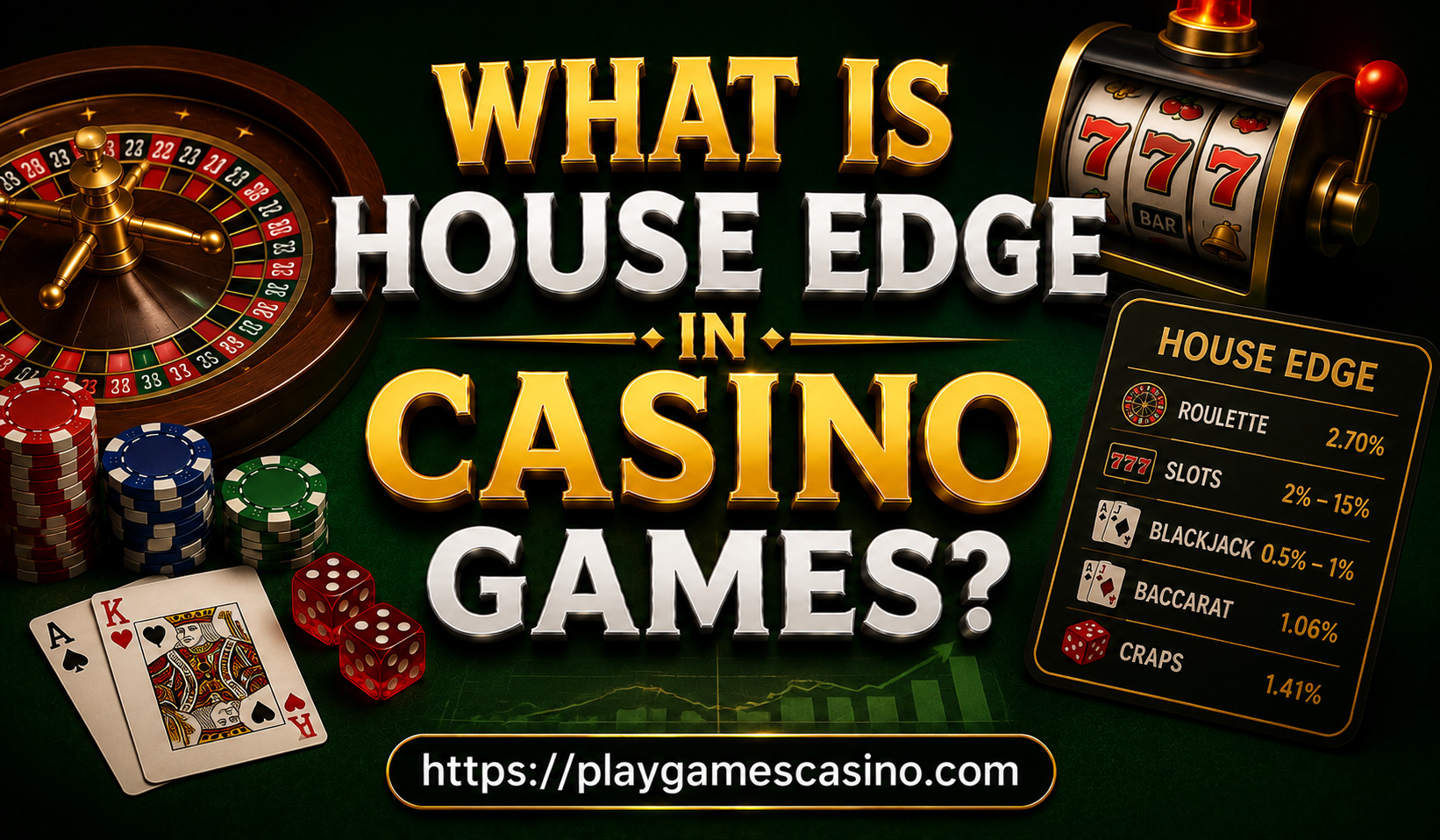
The term house edge is one of the most important concepts to understand when learning about casino games. Whether you are looking at roulette, blackjack, baccarat, slots, or another casino game, the house edge helps explain how the casino makes money over the long term.
For beginners, the term can sometimes sound more complicated than it actually is. In simple terms, the house edge is the mathematical advantage built into a casino game. It represents the percentage of money the casino is theoretically expected to retain over a very large number of wagers.
Understanding house edge does not allow anyone to predict individual results or guarantee a win. Instead, it provides a clearer picture of the mathematical structure behind casino games and explains why gambling should be viewed as entertainment rather than a reliable source of income.
What Does House Edge Mean?
The house edge is the mathematical advantage that a casino has over players in a particular game. It is usually expressed as a percentage.
For example, suppose a casino game has a theoretical house edge of 5%. Over a very large number of wagers, the casino would theoretically retain approximately $5 for every $100 wagered, while the remaining amount would be returned to players through winnings.
This does not mean that a player who wagers $100 will automatically lose $5. A player could win $100, lose the entire amount, or experience many different outcomes. The house edge describes a long-term mathematical expectation rather than the result of an individual session.
This distinction is important because casino games involve randomness. Short-term results can differ substantially from long-term statistical expectations.
How Does the House Edge Work?
Every casino game has rules that determine how winning outcomes are paid. Those rules are designed so that, over time, the casino has a mathematical advantage.
Consider a simplified example. Imagine a game with two equally likely outcomes, but the payout for a winning wager is slightly less than what would be required for a completely fair game. That difference creates an advantage for the operator.
Real casino games are more complicated, but the principle is similar.
In roulette, for example, the presence of zero creates an advantage for the casino because zero does not belong to the standard red/black or odd/even categories. In blackjack, the house edge comes from several rules governing cards, dealer actions, payouts, and player decisions.
The house edge is therefore not necessarily a fee that is visibly removed from every wager. Instead, it is generally incorporated into the mathematical design of the game.
House Edge vs. Player Payouts
One useful way to understand house edge is to compare it with the theoretical return to the player.
If a game has a theoretical house edge of 4%, its corresponding long-term return is approximately 96%, assuming the two measurements are directly comparable.
This relationship can be summarized simply:
| House Edge | Theoretical Return |
| 1% | 99% |
| 2% | 98% |
| 3% | 97% |
| 4% | 96% |
| 5% | 95% |
| 10% | 90% |
These figures should not be interpreted as guarantees for an individual player. They describe mathematical expectations over a sufficiently large number of wagers.
What Is RTP?
RTP, or Return to Player, is another term frequently used in casino gaming, particularly with slot machines and electronic games.
An RTP of 96% means that, theoretically, the game is designed to return approximately $96 for every $100 wagered over a very large sample of play.
The remaining 4% represents the theoretical house advantage.
However, RTP does not mean that every player will receive exactly 96% of their money back. One person might win significantly more, while another might lose significantly more. Random variation can produce very different short-term results.
RTP is therefore best understood as a long-term statistical measurement.
House Edge in Popular Casino Games
Different casino games have different mathematical structures. As a result, their house edges can vary significantly.
Roulette
Roulette provides a straightforward example of how the house edge is created.
A standard European roulette wheel contains 37 pockets: numbers 1 through 36 and a single zero. Because of the zero, the wheel is not perfectly balanced between red and black, even though there are 18 red and 18 black numbers.
The standard house edge on many European roulette bets is approximately 2.70%.
American roulette includes both 0 and 00, giving the wheel 38 pockets. The additional double-zero pocket increases the standard house edge to approximately 5.26%.
This is why the difference between European and American roulette is mathematically significant.
Blackjack
Blackjack is more complicated because its house edge depends on the specific rules and the decisions made by the player.
Factors such as the number of decks, blackjack payout, dealer rules, doubling restrictions, splitting rules, and player strategy can all influence the mathematical advantage.
A player who follows appropriate basic strategy can generally achieve a much lower house edge than someone who makes decisions randomly.
However, basic strategy does not remove the casino’s advantage entirely under standard conditions.
Baccarat
Baccarat is another example where the house edge varies depending on the type of bet.
The Banker and Player bets generally have different mathematical characteristics, while the Tie bet usually carries a substantially higher house edge.
This demonstrates why simply choosing the bet with the largest advertised payout is not necessarily a good way to evaluate a game.
Slot Machines
Slot machines typically use RTP rather than presenting house edge as the primary headline figure.
A slot with a theoretical RTP of 96% would correspond to a theoretical house edge of approximately 4%.
However, slots can have different volatility levels. Two games can have similar RTPs while distributing their payouts very differently. One may produce smaller wins more frequently, while another may produce larger wins less often.
Why Does the House Edge Exist?
Casinos are businesses, and the house edge is one of the mechanisms that allows gambling operators to generate revenue.
If a casino game were perfectly fair and had no operator advantage, the casino would have difficulty generating predictable long-term revenue from the game itself.
The house edge creates a mathematical expectation in favor of the operator.
It is important to understand that this does not mean the casino wins every hand, spin, or session. Casinos can lose money on individual players or individual games. The advantage becomes meaningful over a large number of wagers.
This is similar to how an insurance company or other business can operate with statistical expectations rather than knowing the result of every individual event.
Does a Lower House Edge Mean You Will Win?
No.
A lower house edge means the mathematical disadvantage is smaller under the relevant conditions.
For example, a game with a 1% theoretical house edge can still produce substantial short-term losses. Random outcomes can create large fluctuations.
Likewise, a player can win while playing a game with a much higher house edge.
The house edge is therefore useful for comparing mathematical structures, not for predicting the result of an individual session.
What Is the Difference Between House Edge and House Advantage?
The terms house edge and house advantage are often used interchangeably.
Both describe the casino’s mathematical advantage over players in a particular game.
The exact terminology can vary depending on the source, but the underlying concept is the same: the casino has a positive expected return over a sufficiently large number of wagers.
For beginners, there is no need to treat these as completely different concepts unless a specific game or statistical calculation defines them differently.
Does the House Edge Apply to Every Bet?
Not necessarily in exactly the same way.
Different bets within the same game can have different house edges.
Roulette is a good example. Most standard bets on a single-zero European wheel have the same theoretical house edge, but certain special rules can alter the advantage.
Baccarat provides another clear example because Banker, Player, and Tie wagers have different mathematical characteristics.
This means players should look at the specific bet rather than assuming that every option on a table has identical odds.
Can Betting Systems Beat the House Edge?
Many betting systems claim to help players overcome or exploit casino mathematics. Examples include systems that recommend increasing wagers after losses or changing bet sizes according to previous results.
These systems can change the pattern of wagers, but they generally do not change the underlying probability of the game.
If a roulette bet has a mathematical house edge, changing the size of the next wager does not remove that edge.
A losing streak also does not make a winning result automatically “due.” Random events do not normally remember previous outcomes.
Some important misconceptions to avoid include:
- A cold machine is not necessarily due for a payout.
- A long losing streak does not guarantee an upcoming win.
- Increasing a wager does not change the underlying odds.
- A previous result does not normally determine the next independent result.
Why Understanding House Edge Matters
Learning about house edge gives players a more realistic understanding of casino games.
Without this knowledge, it can be easy to focus only on advertised jackpots, payout amounts, or occasional winning stories. Those features do not provide a complete picture of the game’s mathematical structure.
House edge encourages players to think about the long-term probabilities rather than focusing exclusively on short-term results.
It can also help explain why two games that appear similar can have very different mathematical characteristics.
For anyone researching casino games, understanding house edge is therefore more valuable than memorizing individual betting systems.
Frequently Asked Questions
What is a 5% house edge?
A 5% house edge means that, theoretically, the casino has a mathematical advantage equivalent to about $5 for every $100 wagered over a very large number of bets. It does not mean every player loses exactly 5%.
Is a lower house edge always better?
From a purely mathematical perspective, a lower house edge generally means a smaller theoretical disadvantage to the player. However, it does not guarantee a win or predict short-term results.
Which casino game has the lowest house edge?
There is no single answer because the house edge can depend on the exact rules, bet, and strategy. Some blackjack games played under favorable rules with correct basic strategy can have relatively low house edges.
Is RTP the same as house edge?
They are closely related. In a directly comparable game, RTP and house edge generally add up to approximately 100%. For example, a 96% RTP corresponds to a 4% theoretical house edge.
Can the house edge be eliminated?
In standard casino games, ordinary betting systems generally cannot eliminate the built-in mathematical advantage. Specific circumstances and promotional offers can have different mathematical characteristics, but the normal game itself retains its designed structure.
Does house edge mean the casino always wins?
No. The casino can lose money on individual players, hands, spins, or sessions. The house edge represents a long-term mathematical expectation, not a guarantee for every individual outcome.
Final Thoughts
The house edge is one of the simplest and most useful concepts for understanding how casino games work. It represents the mathematical advantage that the casino has over players over a large number of wagers.
Different games and even different bets within the same game can have different house edges. European roulette, American roulette, blackjack, baccarat, and slot machines all demonstrate how rules and payout structures influence the mathematics of gambling.
The most important point is that house edge is a long-term statistical concept. It does not predict what will happen on the next spin, hand, or session. A player can win despite playing a high-house-edge game, just as a player can lose despite choosing a game with a relatively low house edge.
Understanding the house edge therefore does not provide a guaranteed winning strategy. Instead, it provides a clearer and more realistic view of casino mathematics, helping beginners understand that casino games involve financial risk and are designed to provide the operator with a long-term mathematical advantage.