What Is RTP in Online Crash Games? Understanding Return to Player
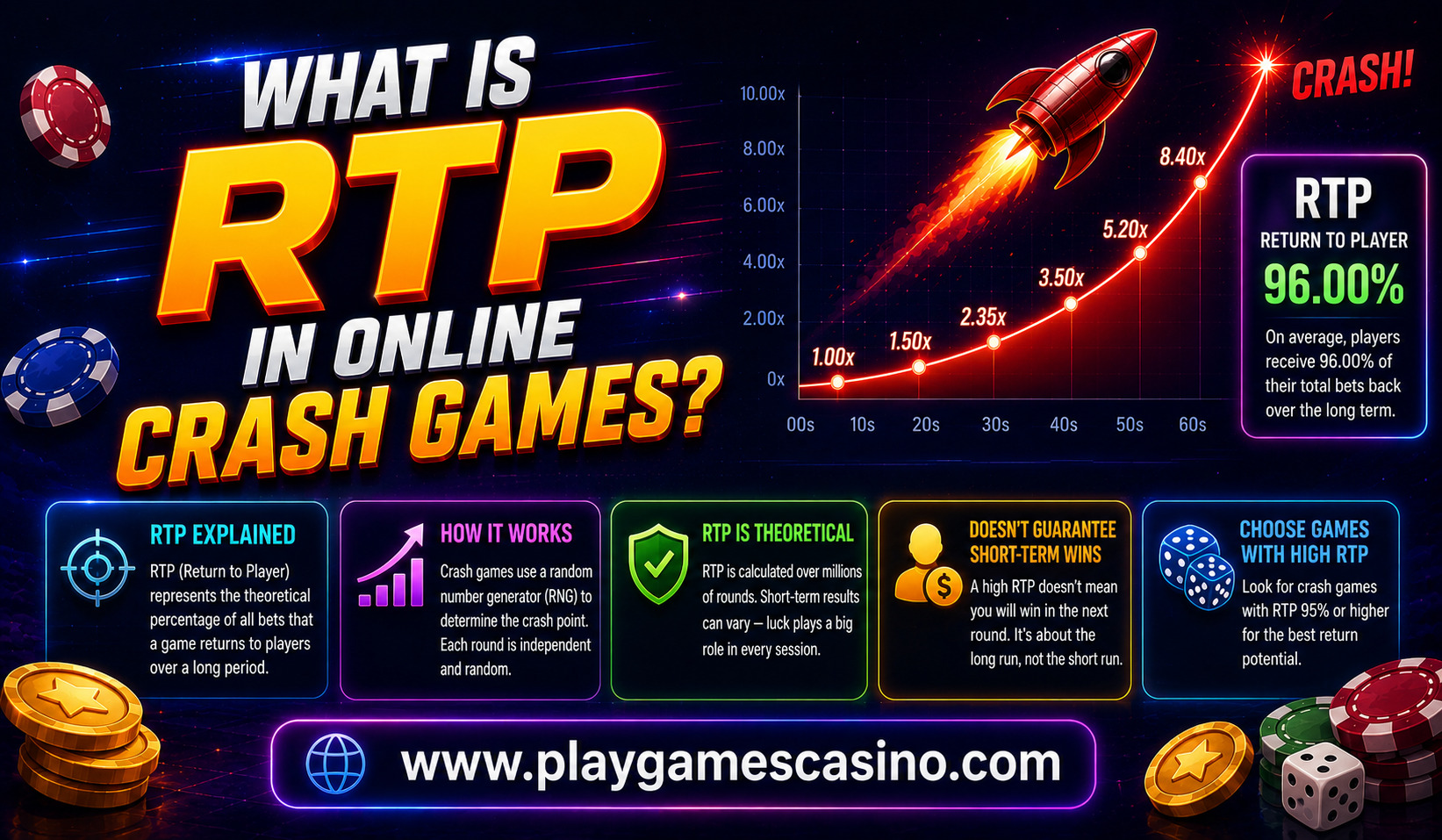
Online crash games have become a recognizable category in digital gaming, combining a simple interface with a multiplier that rises until the round ends. While the gameplay may appear straightforward, one term often creates confusion among new players: RTP, or Return to Player.
RTP is commonly used across online casino and gaming products to describe the theoretical percentage of money that a game returns to players over a large number of plays. In crash games, however, understanding RTP requires looking beyond a single round or a short sequence of results. A game can have a stated RTP while individual rounds still produce dramatically different outcomes.
Understanding RTP can help readers distinguish between long-term mathematical expectations and the results of individual rounds. It can also clarify why RTP should not be interpreted as a promise that a particular player will receive a specific percentage of their money back.
What Does RTP Mean?
RTP stands for Return to Player. It is generally expressed as a percentage and represents the theoretical amount a game is designed to return to players over a very large number of wagers.
For example, if a game has a theoretical RTP of 96%, that means that, under the mathematical model and over a sufficiently large sample of play, approximately ₹96 could theoretically be returned for every ₹100 wagered.
The remaining portion represents the mathematical advantage retained by the operator, commonly referred to as the house edge. In this simplified example, the house edge would be 4%.
However, RTP is a statistical concept, not a short-term guarantee. A player could wager ₹100 and receive nothing back, or could receive considerably more than ₹100 during a particular session. Neither outcome contradicts the game’s theoretical RTP.
How RTP Applies to Crash Games
Crash games work differently from traditional slot-style games because the player generally decides when to cash out during an active multiplier sequence.
The multiplier begins at a starting value and rises until the round ends. If a player cashes out before the crash, the applicable payout is based on the multiplier at that moment. If the crash happens before the player successfully exits, the wager may be lost.
RTP in this environment is connected to the mathematical distribution of crash points and the payout structure. The precise calculation depends on the individual game and its rules.
This means RTP should not be interpreted as saying that every round will return a certain percentage. Instead, it describes a theoretical long-term relationship between wagers and payouts.
A Simple Example of RTP
Consider a hypothetical crash game with a published RTP of 97%.
If a very large number of wagers totaling ₹10 crore were placed under the game’s mathematical conditions, the theoretical return might be around ₹9.7 crore. The remaining ₹30 lakh would represent the theoretical house edge.
| Example | Amount |
| Total theoretical wagers | ₹10 crore |
| RTP | 97% |
| Theoretical player return | ₹9.7 crore |
| Theoretical house edge | 3% |
| Theoretical difference | ₹30 lakh |
These figures are only an illustration of how RTP works mathematically. They do not mean an individual player will receive 97% of their own wagers back.
RTP Is Not a Guarantee
One of the most important points about RTP is that it operates over a large statistical sample.
Suppose someone plays a crash game for only 20 rounds. Their actual return could be substantially higher or lower than the game’s published RTP. A short session is too small to represent the long-term mathematical behavior of the game.
This is similar to other probability-based systems. A coin can theoretically have a 50% probability of landing on heads, but that does not mean ten coin flips must produce exactly five heads.
Likewise, a game with a 97% RTP does not have to return exactly ₹97 every time ₹100 is wagered.
The larger the number of independent outcomes, the more useful RTP becomes as a description of the game’s theoretical mathematical behavior.
RTP and the House Edge
RTP and house edge are closely connected.
If a game has a theoretical RTP of 96%, the corresponding house edge is generally 4%. If the RTP is 98%, the theoretical house edge would generally be 2%.
This relationship can be expressed simply:
House Edge = 100% − RTP
For example:
- 95% RTP = 5% theoretical house edge
- 96% RTP = 4% theoretical house edge
- 97% RTP = 3% theoretical house edge
- 98% RTP = 2% theoretical house edge
The exact interpretation can depend on the game’s rules, bonuses, fees and calculation methodology, so players should always refer to the individual operator or game provider’s published information.
Why RTP Does Not Predict the Next Crash
Crash games often display previous multiplier results, which can tempt players to connect RTP with short-term predictions.
For example, imagine several rounds end at low multipliers. A player might assume that the game’s RTP means a high multiplier must appear soon to “balance” the results.
That is not how RTP works.
RTP does not function as a correction mechanism for individual rounds. It does not monitor a player’s losses and then generate a larger multiplier to compensate for them. If the game uses independent random outcomes, each new round is generated according to its underlying mathematical system.
A sequence of low multipliers therefore does not automatically create a requirement for the next round to produce a high multiplier.
The Relationship Between RTP and Multipliers
The multiplier is central to the payout structure of a crash game, but RTP is determined by the overall mathematical model rather than by one multiplier.
A higher multiplier generally produces a larger payout if a player successfully cashes out there. However, high multipliers may occur less frequently than low multipliers.
This creates a probability distribution in which different crash points contribute differently to the game’s overall return structure.
For instance, a game might frequently produce relatively low crash points while occasionally producing very high multipliers. The combination of these outcomes, along with the game’s payout rules, contributes to the theoretical RTP.
Therefore, looking only at the largest multipliers does not provide enough information to determine whether a game has a high or low RTP.
RTP vs Actual Player Return
The terms “RTP” and “actual return” should not be confused.
RTP is a theoretical percentage based on the game’s mathematical design. Actual player return is what an individual player receives during their own activity.
These figures can differ significantly.
| Term | Meaning |
| RTP | Theoretical long-term return percentage |
| Actual return | Money received by an individual player |
| House edge | Theoretical mathematical advantage of the operator |
| Multiplier | Factor used to calculate a successful cash-out payout |
| Variance | Degree to which short-term results can differ from expectations |
A player can therefore have an individual return above the published RTP during one period and below it during another.
Why Sample Size Matters
Sample size is especially important when discussing crash games.
A small number of rounds can produce unusual results simply because random outcomes naturally vary. A player might see several high multipliers in succession or experience a cluster of very low crashes.
Neither sequence necessarily indicates that the game’s RTP has changed.
As the number of rounds increases, observed results may move closer to the game’s theoretical mathematical expectations. Even then, random variation does not disappear completely.
This is why RTP is more meaningful when considered over a very large number of outcomes rather than a single evening, a short winning streak or a small losing streak.
Does a Higher RTP Mean Better Odds?
In purely mathematical terms, a higher RTP generally indicates a lower theoretical house edge, assuming other conditions are comparable.
For example, a 98% RTP implies a smaller theoretical house edge than a 94% RTP. However, RTP alone does not tell the complete story.
Players should also consider how the game calculates payouts, whether there are additional conditions, how withdrawals and deposits are handled, and whether the published RTP applies to the exact version of the game being played.
A higher RTP should therefore be understood as a mathematical characteristic rather than a guarantee of better short-term results.
RTP, Volatility and Crash Games
RTP and volatility are different concepts.
RTP describes the theoretical long-term return, while volatility describes how widely results can fluctuate over shorter periods.
Two games could theoretically have similar RTP figures while producing very different short-term experiences. One may generate more frequent but smaller payouts, while another may produce fewer but potentially larger payouts.
In crash games, the distribution of multipliers can strongly influence how volatile the experience feels. A game featuring occasional very high multipliers can produce dramatic differences between individual rounds.
This distinction is important because RTP alone cannot tell someone how frequently large or small outcomes will occur.
Can Players Improve RTP Through a Betting Strategy?
A betting strategy does not normally change the mathematical RTP built into a game.
Players may choose different cash-out targets, wager sizes or session limits, but changing those decisions does not automatically alter the underlying probability distribution.
For example, choosing to cash out at 1.50x rather than waiting for 5.00x changes the player’s exposure and potential payout profile. It does not necessarily transform a game with a fixed mathematical RTP into a higher-RTP game.
Similarly, increasing a wager after a loss does not recover the mathematical disadvantage built into the game.
What Should Players Check Before Playing?
Before participating in a crash game, users should look beyond promotional claims and understand the game’s published information. RTP may be listed in the game’s rules, help section or provider documentation, although presentation can differ between platforms.
Useful information to review includes:
- Published RTP: Check whether a theoretical RTP is disclosed.
- Fairness information: Understand whether the game uses RNG or a provably fair mechanism.
- Payout rules: Read how successful cash-outs are calculated.
- Terms and restrictions: Review applicable wagering, withdrawal and account conditions.
Players should also consider local laws and age restrictions before using any real-money gaming service.
Final Thoughts
RTP is one of the most useful concepts for understanding the mathematics behind online crash games, but it is also one of the most commonly misunderstood.
Return to Player represents a theoretical long-term percentage calculated from the game’s mathematical design. It does not predict an individual player’s results, guarantee a particular payout, or determine when the next crash will happen.
The relationship between RTP, house edge, multiplier distribution, probability and volatility provides a clearer picture of how these games operate. Understanding these concepts can help readers interpret game information more realistically and avoid treating short-term results as evidence of a predictable pattern.
Ultimately, RTP is best viewed as a mathematical reference point—not a promise of profit and not a tool for predicting individual crash rounds.
Frequently Asked Questions
What does RTP mean in crash games?
RTP means Return to Player. It represents the theoretical percentage of wagers that a game is designed to return to players over a very large number of outcomes.
Is 97% RTP good?
A 97% RTP represents a theoretical 3% house edge, assuming the calculation is presented on a straightforward basis. Whether that is favorable depends on the game’s rules and the comparison being made.
Does RTP guarantee winnings?
No. RTP is a long-term statistical measure and does not guarantee that an individual player will win or receive a specific percentage of their wagers.
Can RTP predict the next crash?
No. RTP does not predict individual crash points. It describes the game’s theoretical aggregate return over a large number of outcomes.
Is RTP the same as house edge?
No, but they are closely related. In a simple model, house edge equals 100% minus RTP.