How Crash Game Multipliers Work:
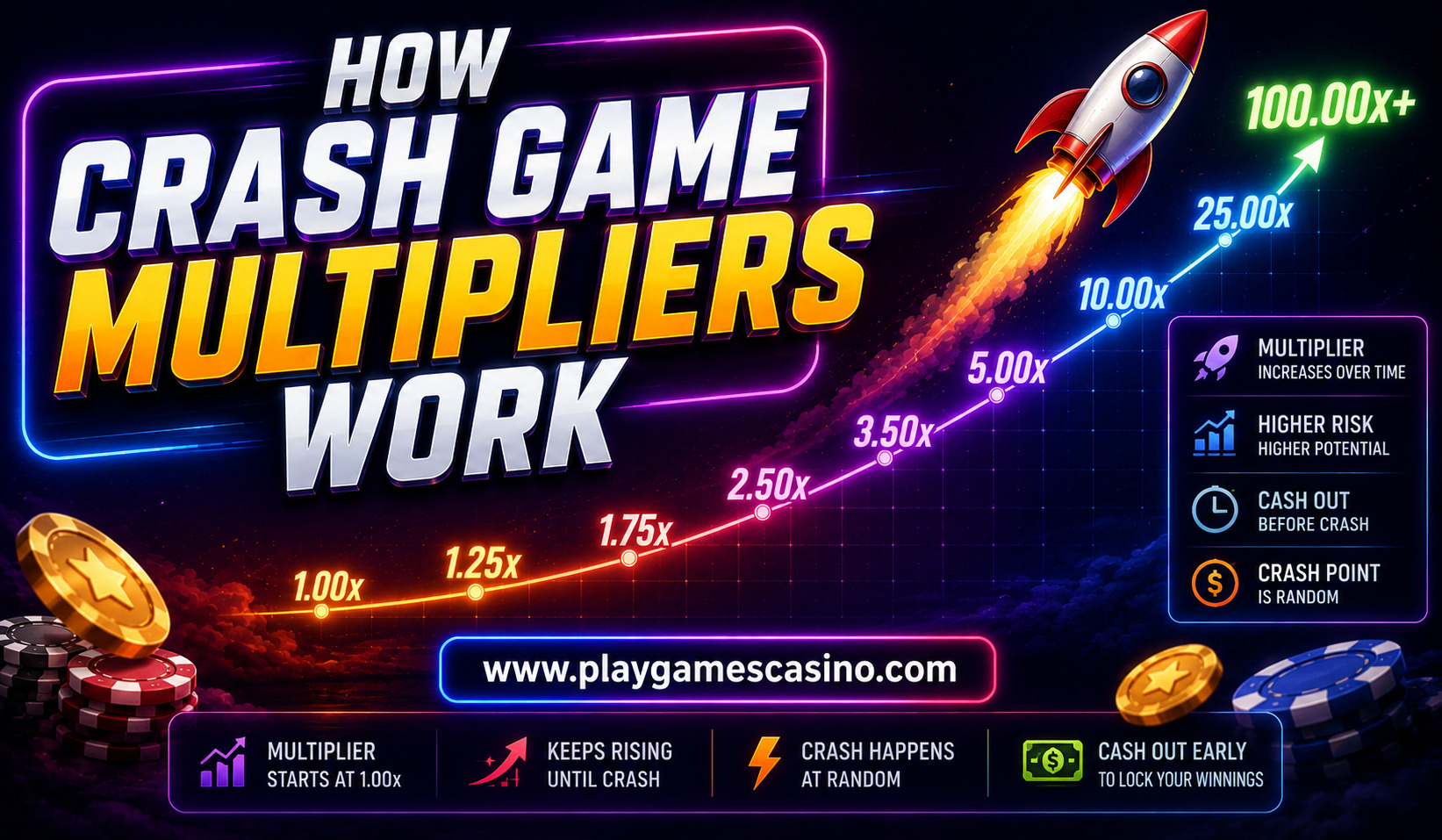
Crash games have become one of the more visible formats in the online gaming industry, largely because their central mechanic is easy to understand. A multiplier begins at a low value, rises continuously, and eventually stops at an unpredictable point. Players who exit before the round ends receive a payout based on the multiplier at which they cash out. If the round ends before they exit, the wager is generally lost.
Despite the simplicity of the interface, the mathematics and technology behind crash game multipliers can be less obvious. The rapidly increasing number may look like a sequence that can be studied and predicted, but each round is normally designed to operate independently. Understanding how multipliers are generated, what determines a crash point, and why previous results do not reliably forecast future rounds can help readers understand the format more clearly.
What Is a Crash Game Multiplier?
The multiplier is the central feature of a crash game. It represents the amount by which a player’s original stake would be multiplied if the player successfully exits at that point.
For example, if a player places a ₹100 wager and cashes out when the multiplier reaches 2.00x, the return associated with that cash-out point would be ₹200 before considering any applicable fees, rules, or platform-specific conditions. At 1.50x, the same ₹100 stake would correspond to ₹150.
The important detail is that the multiplier does not continue indefinitely. At an unknown point, the game “crashes,” ending the round. A player who has not cashed out before that event generally receives no payout for that wager.
This creates the basic tension of the format: waiting for a higher multiplier can increase the potential return, but it also means accepting the possibility that the round will end first.
How Does the Multiplier Increase?
During a typical round, the multiplier starts around 1.00x and increases as time passes. The speed at which it rises can vary depending on the game’s design, but the underlying principle remains similar.
A simplified example might look like this:
| Stage of Round | Example Multiplier |
| Starting point | 1.00x |
| Early stage | 1.25x |
| Mid stage | 2.00x |
| Later stage | 5.00x |
| High multiplier | 10.00x+ |
| Crash | Round ends |
These numbers are only illustrative. They do not represent a prediction or a typical guaranteed sequence.
The multiplier’s visible movement is essentially a display of the game’s current state. It does not mean that the game is “due” for a particular result because the number has reached a certain level.
What Determines the Crash Point?
The crash point is generally determined by the game’s underlying randomization system. Depending on the platform, this may involve a random number generator (RNG), a cryptographic process, or a provably fair mechanism.
In games using provably fair systems, information such as a server seed, client seed, and nonce may be used to produce a verifiable result. The precise implementation differs between providers, so players should consult the individual game’s fairness documentation rather than assuming that every crash game uses the same formula.
The key concept is that the crash point is generated by the game’s underlying algorithm rather than being manually selected based on individual player decisions.
A properly designed random system can produce very different consecutive outcomes. A round may end at 1.03x, followed by another ending at 6.00x, and another reaching 1.40x. The unusual-looking sequence does not automatically indicate that the next result has become predictable.
Why Previous Multipliers Do Not Predict the Next One
One of the most common misunderstandings surrounding crash games is the belief that previous results can determine what happens next.
Suppose several rounds end at relatively low multipliers. A player might conclude that a high multiplier is now “due.” Conversely, after a round reaches 20x, someone might assume that another high result is unlikely immediately afterward.
Neither assumption necessarily follows from an independent random process.
This is an example of the gambler’s fallacy: interpreting independent events as though previous outcomes change the probability of the next outcome. A sequence such as 1.10x, 1.25x, 1.05x and 1.40x does not create a mathematical obligation for the next round to reach 10x.
Likewise, a very high multiplier does not guarantee that the following round will crash early.
Understanding the Role of Probability
Probability is particularly important when discussing crash multipliers because the visual simplicity of the game can make outcomes appear more predictable than they actually are.
A higher multiplier generally corresponds to a less frequent outcome in many crash-game designs. Reaching 10x means the round has continued much further than one ending around 1.20x. However, the exact probability distribution depends on the game’s mathematical model.
For example, a theoretical system might be structured so that extremely high multipliers occur much less frequently than low ones. That does not mean a player can identify the exact round in which a high multiplier will appear.
This distinction between probability and prediction is crucial. Statistical patterns can describe how a system behaves over a large number of rounds, but they do not necessarily provide a reliable method for predicting one specific future round.
What Does Cashing Out Actually Mean?
Cashing out is the player’s decision to end their exposure during an active round. If the multiplier is 1.80x at the moment of a successful cash-out, the applicable return is based on that multiplier.
For instance, a ₹500 wager at 1.80x would correspond to ₹900 before any applicable platform rules or deductions.
However, timing matters. If the player attempts to cash out after the crash has already occurred, the result may not qualify for a payout. Internet latency, platform processing, and the specific game’s rules can also affect how cash-out requests are handled.
This is why the displayed multiplier should not be interpreted as a guaranteed opportunity to receive a particular return. Players should understand the platform’s terms regarding cash-out timing and settlement.
Why High Multipliers Attract Attention
High multipliers are one of the main reasons crash games generate interest. A move from 1.00x to 2.00x is visually straightforward, while a round continuing to 20x, 50x or higher can create a dramatic result.
That visual effect can influence how players perceive risk. A rapidly rising multiplier may create pressure to wait longer, particularly when a player has already watched the number pass several earlier cash-out points.
This is where the difference between potential return and risk becomes important. A higher cash-out target can offer a larger potential return on the same stake, but it also requires the round to survive until that target is reached.
The multiplier itself does not become safer simply because it has already risen significantly.
Can Crash Games Be Predicted?
There is no reliable general method for predicting the exact crash point of a properly implemented random crash game.
Claims about guaranteed multiplier patterns, secret sequences, prediction formulas, or strategies that supposedly identify the next crash should therefore be treated cautiously. A strategy may change how a person manages their wagers, but it cannot turn an uncertain outcome into a guaranteed one.
Some websites and social media accounts promote “prediction signals” or automated crash-game predictors. Their claims should be evaluated critically, particularly when they promise consistent profits or guaranteed results.
A legitimate fairness system is intended to make the result independently generated or verifiable, not something that can be reliably reverse-engineered from a short history of multipliers.
Provably Fair Systems Explained
The term “provably fair” is frequently associated with modern online crash games. The concept is designed to allow users to verify that game outcomes were generated according to a stated cryptographic process.
A typical system may use several inputs to generate an outcome:
- Server seed – A value controlled by the game server.
- Client seed – An additional value that can be supplied or influenced by the player.
- Nonce – A number that changes between successive rounds.
- Cryptographic hashing – A mathematical process used to generate the final result.
The exact formula varies between platforms. A player should therefore examine the game’s own published fairness explanation instead of assuming that one verification process applies universally.
The purpose of such systems is transparency. They can provide a way to check whether a result corresponds with the stated algorithm after the relevant information becomes available.
The Difference Between Randomness and House Edge
Randomness does not mean that every possible result has exactly the same probability.
A crash game can use a random process while still incorporating a mathematical house edge. The house edge represents the long-term advantage built into the game’s design, although its exact value depends on the specific game and rules.
This is an important distinction because some players interpret randomness as meaning that the player and operator have equal mathematical chances. That is not necessarily the case.
A game can generate unpredictable individual outcomes while maintaining a statistical structure that favors the operator over a large number of rounds.
Why a Multiplier History Can Be Misleading
Most crash-game interfaces display previous round results. This history can be useful for observing what has happened, but it can also encourage players to search for patterns that may not have predictive value.
Consider a hypothetical history:
1.12x → 3.40x → 1.05x → 7.80x → 1.31x → 2.20x
Looking at this sequence, different people might reach completely different conclusions. One may expect another low result, while another may anticipate a large multiplier.
Neither interpretation is necessarily justified by the sequence alone.
History describes past outcomes. It does not automatically reveal the next outcome.
What Players Should Understand Before Playing
Anyone exploring crash games should first understand the financial risk involved. The multiplier can rise quickly, but it can also stop before a preferred cash-out point. There is no guaranteed multiplier and no guaranteed winning strategy.
Before participating, players should understand:
- how the game’s RNG or fairness system works;
- how cash-out timing is handled;
- what the published house edge or mathematical model says;
- the minimum and maximum wager rules;
- applicable legal and age restrictions in their jurisdiction.
Responsible participation also means treating wagers as entertainment expenses rather than as a dependable source of income.
The Technology Behind the Experience
Although the interface may look simple, a crash game can involve several technical components working together. The game server must generate or retrieve the round result, synchronize the multiplier display, accept cash-out requests, settle wagers, and communicate the result to connected players.
Real-time synchronization is particularly important because players may be watching the same round simultaneously. The multiplier shown on screen is therefore part of a live digital interface rather than a physical object that can be influenced by player reactions.
The cryptographic or RNG component handles the outcome generation, while the game interface communicates that outcome through the rising multiplier.
Final Thoughts
Crash game multipliers are designed around a straightforward idea: a number rises until an unpredictable stopping point, and players must decide whether to cash out before that point. The simplicity of the mechanic can make the game easy to understand, but it does not make future outcomes predictable.
The most important concept is the difference between observing a pattern and proving that a pattern has predictive power. Previous multipliers can show what happened, while the underlying randomization system determines what happens next.
Understanding RNGs, provably fair systems, probability, cash-out mechanics and house edge provides a much clearer picture of how crash games operate. Most importantly, players should avoid treating multiplier predictions or betting systems as guaranteed methods of making money.
Frequently Asked Questions
What is a crash game multiplier?
A crash game multiplier shows how much a wager would be multiplied if a player successfully cashes out at that point. The round ends when the multiplier crashes.
Does a higher multiplier mean a bigger payout?
Generally, yes. If a player successfully cashes out at a higher multiplier, the potential return on the original stake is higher. However, reaching that multiplier is less certain because the round may end earlier.
Can the next crash multiplier be predicted?
A properly implemented random crash game cannot be reliably predicted from previous results alone. Claims of guaranteed prediction systems should be approached cautiously.
What does provably fair mean?
Probably fair generally refers to a cryptographic system that allows users to verify that game results were generated according to a published process. The exact method differs between platforms.
Do previous crash results affect the next round?
If rounds are independently generated, previous results do not determine the next result. A series of low or high multipliers does not automatically make the opposite outcome “due.”