Baccarat Explained: How to Play and Win
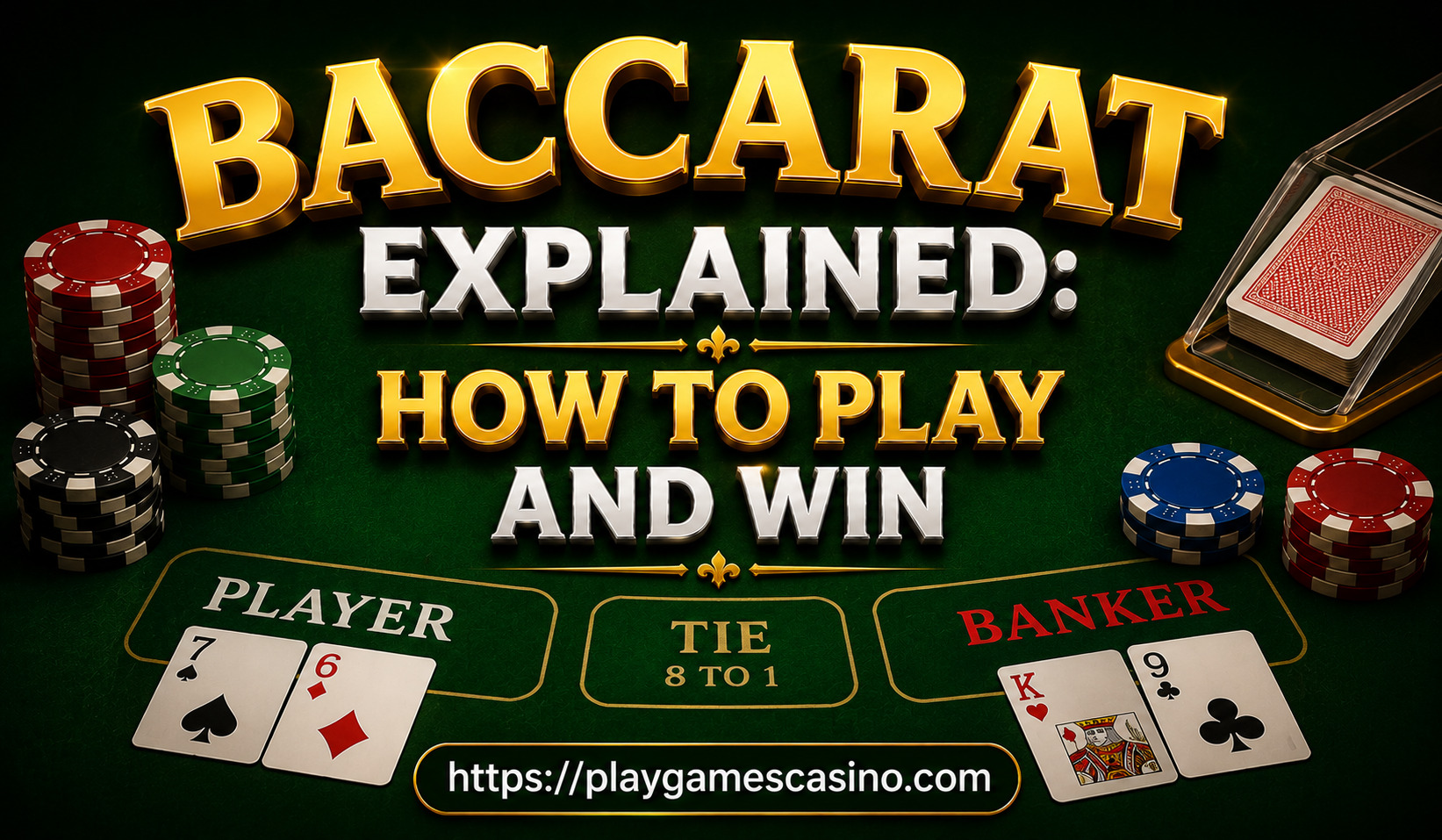
Baccarat is one of the most recognizable casino card games, known for its simple rules, elegant presentation, and relatively straightforward betting options. Although it may appear complicated to someone seeing a baccarat table for the first time, the basic objective is actually quite easy to understand.
Unlike blackjack, players do not normally make decisions about whether to draw or stand. Instead, the game follows predetermined drawing rules, and players mainly choose which outcome they want to bet on. This simplicity is one reason baccarat has remained popular in both traditional and online casinos.
Baccarat is a game of chance, and there is no strategy that can guarantee a profit or predict the next result. Understanding the rules, probabilities, payouts, and differences between bets can help players make more informed decisions, but it cannot eliminate the house advantage.
This guide explains how baccarat works, how cards are valued, the main betting options, the role of the Banker and Player hands, and what beginners should know before playing.
What Is Baccarat?
Baccarat is a card game in which players typically bet on whether the Player hand, Banker hand, or Tie will have the winning total.
Despite the names, the Player and Banker are simply the two sides of the game. A person placing a wager on the Player is not necessarily becoming the Player, and someone betting on Banker does not become the dealer.
The objective is to predict which hand will finish closest to a total of nine.
Each hand normally receives two cards initially. Depending on the totals and the game’s fixed drawing rules, a third card may be dealt. Once all cards have been dealt, the hand closest to nine wins.
How Baccarat Card Values Work
Baccarat uses a simple card-value system.
Cards from 2 through 9 are worth their face value. Tens, jacks, queens, and kings are worth zero. Aces are worth one.
If the total of the cards exceeds nine, only the final digit is used.
For example, suppose a hand contains a 7 and a 6. The total is 13, but in baccarat the hand value is 3.
Similarly, a hand containing a 9 and a 7 totals 16, so its baccarat value is 6.
This system makes it possible for a hand to have a final value between 0 and 9.
How a Baccarat Round Works
A standard baccarat round begins with players placing their wagers. The available options generally include Player, Banker, and Tie.
After betting closes, two cards are dealt to the Player hand and two cards to the Banker hand.
The initial totals are calculated according to baccarat’s card-value system. In certain circumstances, a third card is automatically dealt according to predetermined rules.
The drawing procedure is governed by the game’s rules.
Once the final hands are determined, the totals are compared. The hand closest to nine wins.
The Three Main Baccarat Bets
Most beginners only need to understand three primary betting options.
Player Bet
A Player bet means you are wagering that the Player hand will finish with a higher total than the Banker hand.
If the Player hand wins, the standard payout is generally 1:1. A $10 winning wager would therefore typically produce a $10 profit, plus the original stake returned.
The Player bet is not necessarily better or worse simply because of its name. Its mathematical probability differs slightly from the Banker outcome.
Banker Bet
A Banker bet means you are wagering that the Banker hand will finish with a higher total.
The Banker hand has a small mathematical advantage over the Player hand because of the drawing rules. For this reason, casinos commonly charge a commission on winning Banker bets.
A common arrangement is a 5% commission, resulting in a standard payout of 19:20 rather than a full 1:1 return.
Despite the commission, the Banker bet often has a lower house edge than the standard Player bet under common baccarat rules.
Tie Bet
The Tie bet predicts that the Player and Banker hands will finish with the same total.
Tie bets generally offer a much larger payout than Player or Banker wagers. Depending on the table, a winning Tie bet may pay 8:1 or 9:1.
However, the probability of a tie is considerably lower than the probability of either the Player or Banker winning. As a result, Tie bets typically have a much higher house edge.
This illustrates an important casino principle: a bigger advertised payout does not necessarily mean a better wager.
Baccarat Payouts at a Glance
| Bet | Typical Payout | General Characteristics |
| Player | 1:1 | Simple, relatively low house edge |
| Banker | 1:1 minus commission | Often the lowest house edge of the main bets |
| Tie | Usually 8:1 or 9:1 | Higher payout but substantially higher house edge |
Exact payouts and rules can vary between baccarat versions, so the table conditions should always be reviewed.
What Is a Natural in Baccarat?
A natural occurs when either the Player or Banker hand has a total of 8 or 9 using the first two cards.
When a natural occurs, additional cards are generally not drawn.
For example, if the Player receives a 9 and a 7, the total is 16 and the baccarat value is 6, so it is not a natural.
If the Player receives a 4 and a 5, the total is 9, making it a natural.
A natural 8 or 9 is one of the most important early outcomes because it can determine whether the hand immediately ends.
How the Third Card Rule Works
One feature that distinguishes baccarat from blackjack is that the third-card rules are largely automatic.
The Player hand follows one set of rules, while the Banker hand follows rules that take into account both its own total and, in certain situations, the third card received by the Player.
This can sound complicated, but players generally do not need to memorize every drawing rule simply to place a basic baccarat wager. The dealer or game software handles the card-dealing procedure.
This predetermined structure is part of what makes baccarat easier to play than games requiring frequent player decisions.
Understanding the House Edge
The house edge represents the casino’s mathematical advantage over the long term.
Under common standard baccarat rules, the Banker bet generally has a lower house edge than the Player bet, even after the standard commission is considered. The exact figures can vary depending on the rules and payout structure.
This is important because many betting systems focus on patterns or recent results rather than mathematical probabilities. Understanding the house edge provides a more reliable way to evaluate a wager.
Can You Actually “Win” at Baccarat?
You can certainly win individual baccarat hands or even have a profitable session. However, there is no guaranteed method for consistently winning.
Baccarat outcomes are determined by cards and probabilities. Betting systems cannot change the underlying mathematics of the game.
For example, suppose Banker has won several consecutive rounds. A player might assume that Player is now “due.” But previous outcomes do not normally change the probability of the next independent hand.
Likewise, a long sequence of Player results does not guarantee that Banker will win next.
Popular Baccarat Betting Systems
Various betting systems are often associated with baccarat. Some involve changing wager sizes after wins or losses, while others focus on tracking previous outcomes.
One well-known approach is the Martingale system, where a player increases the wager after losing in an attempt to recover previous losses with a future win.
The problem is that increasing the bet does not change the probability of the underlying outcome. A long losing streak can also cause wager sizes to grow rapidly.
Other systems may use patterns such as Player-Banker sequences or streaks. These patterns can be interesting to observe, but they do not provide a reliable way to predict independent future outcomes.
No betting system can remove the house edge from standard baccarat.
Banker vs. Player: Which Bet Is Better?
From a purely mathematical perspective, the Banker bet is generally considered the strongest of the three standard wagers under common rules because it typically carries the lowest house edge.
However, “better odds” should not be confused with a guaranteed win.
The Banker bet can still lose, and the commission affects the payout. The Player bet is also a legitimate standard wager and may appeal to players who prefer its straightforward 1:1 payout.
The Tie bet has a larger potential payout but a substantially higher mathematical disadvantage in many standard games.
Baccarat vs. Blackjack
Baccarat and blackjack are both card games, but their gameplay is very different.
In blackjack, the player makes decisions throughout the hand. They can hit, stand, double down, split pairs, and sometimes surrender depending on the table rules.
Baccarat is much more automated. Players generally choose a wager, while the game’s rules determine how the cards are dealt.
This makes baccarat attractive to people who prefer a simple decision structure. Blackjack may appeal more to players who enjoy strategic choices.
Online Baccarat
Online baccarat is available in digital formats in jurisdictions where online gambling is legally permitted. Players may encounter both computer-generated baccarat and live-dealer versions.
Computer-based games use software to generate outcomes, while live-dealer games feature a real dealer conducting the game through a video interface.
Regardless of format, the underlying principles remain similar. Players should understand the rules, verify the applicable legal requirements, and check the payout structure before participating.
Important Baccarat Tips for Beginners
Learning the rules is more valuable than trying to find a secret betting pattern. Beginners should focus on understanding the three main wagers, card values, payouts, and house edge.
A few practical principles can make the game easier to understand:
- Learn the rules before placing real-money wagers.
- Understand the difference between Banker, Player, and Tie bets.
- Check the exact payout and commission rules.
- Never assume previous results predict the next hand.
The most important point is to remember that baccarat is a game of chance. A strategy may influence how you manage your bets, but it cannot control which cards appear.
Frequently Asked Questions
Is baccarat easy for beginners?
Yes. Baccarat has relatively simple player decisions because the drawing of additional cards follows predetermined rules. Beginners mainly need to understand card values and the Player, Banker, and Tie wagers.
Is the Banker bet the best baccarat bet?
Under common standard rules, the Banker bet generally has the lowest house edge among the three main wagers. However, it is not guaranteed to win, and a commission is often applied to winning Banker bets.
Can baccarat patterns predict the next result?
No. Previous Player, Banker, or Tie results do not reliably determine the outcome of the next independent hand. Betting patterns may be interesting to observe but are not guaranteed prediction tools.
Why does the Tie bet pay more?
The Tie outcome occurs less frequently than either a Player or Banker win. The larger payout reflects its lower probability, and Tie bets generally have a higher house edge.
Can a baccarat strategy guarantee profit?
No. There is no standard betting strategy that guarantees profit from baccarat. The game remains subject to chance and mathematical probabilities.
Final Thoughts
Baccarat is one of the easier casino card games to understand because players generally do not have to make complicated decisions during a hand. The main task is choosing between the Player, Banker, and Tie outcomes and understanding how each wager works.
The Banker bet typically offers the lowest house edge under standard rules, while the Tie bet offers a much larger potential payout but a significantly higher mathematical disadvantage. Understanding these differences is more useful than relying on streaks, betting patterns, or systems that claim to predict future results.
Although it is possible to win individual hands and have successful short-term sessions, baccarat does not offer a guaranteed way to make money. For beginners, the best way to approach baccarat is to learn the rules, understand the probabilities and payouts, check the specific table conditions, and set clear limits. Treating the game as entertainment rather than as a reliable source of income provides a more realistic understanding of what baccarat can and cannot offer.