Blackjack for Beginners: Rules and Basic Strategy
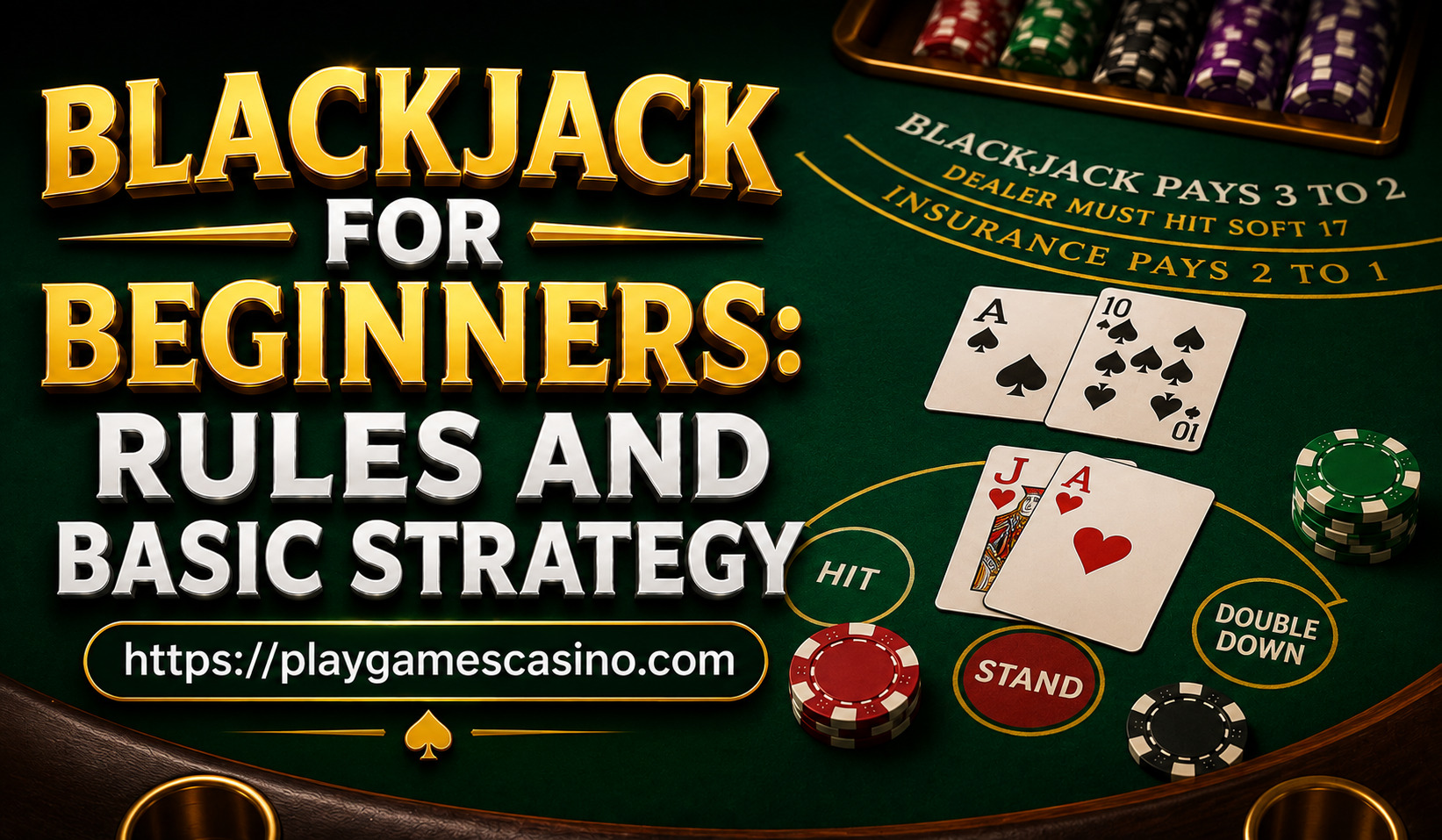
Blackjack is one of the most popular card games in casinos, known for its simple objective and the decisions players can make during a hand. Unlike games that depend almost entirely on selecting a random outcome, blackjack allows players to choose actions based on the cards they hold and the dealer’s visible card.
For beginners, the game can initially seem intimidating because of terms such as hit, stand, double down, split, and blackjack. However, once these concepts are understood, the basic rules are relatively easy to follow.
This guide explains how blackjack works, the rules beginners should know, and the fundamentals of basic strategy. It also covers blackjack payouts, the dealer’s role, common mistakes, and important concepts such as the house edge.
What Is Blackjack?
The primary objective is to have a hand value closer to 21 than the dealer’s hand without going over 21.
Players do not need to reach exactly 21 to win. A hand of 19, for example, can beat a dealer’s 18. However, if a player’s hand exceeds 21, the hand is considered a bust and normally loses immediately.
The game uses one or more standard decks of playing cards, depending on the particular table. Different casinos and blackjack variations can use different numbers of decks and rules, so players should check the table information before playing.
How Are Blackjack Cards Valued?
Understanding card values is the foundation of blackjack.
Jacks, queens, and kings are each worth 10. An ace can count as either 1 or 11, depending on which value is more beneficial to the hand without causing a bust.
For example, an ace and a 7 can have a value of 18 because the ace can count as 11. This is called a soft 18.
If the ace has to count as 1 to avoid exceeding 21, the hand is described as a hard hand. For example, an ace, 7, and 9 has a value of 17 because the ace must count as 1.
The Basic Blackjack Objective
At the beginning of a round, the player and dealer receive cards. The player normally receives two cards, while the dealer receives two cards with one card initially visible in many standard blackjack games.
The player then decides how to play their hand. Depending on the cards and the table rules, the player may choose to hit, stand, double down, or split.
After all player decisions are complete, the dealer plays according to predetermined rules rather than choosing freely from the same range of options.
The final hands are compared. A player wins if their hand is closer to 21 than the dealer’s without busting.
What Is a Blackjack?
A blackjack is a starting hand consisting of an ace and a 10-value card, such as a 10, jack, queen, or king.
This gives the hand a value of 21 using only two cards.
A natural blackjack is generally stronger than an ordinary 21 made with three or more cards. Depending on the table rules, a winning blackjack may receive a special payout, often 3:2 at traditional tables, although some games use different payouts.
Because blackjack payouts can vary, checking the rules before playing is important.
Understanding Player Actions
The main blackjack decisions are straightforward once you understand what each one means.
Hit
To hit means to request another card. Players generally choose this when they believe another card can improve their hand.
For example, if you have 11, receiving another card could potentially give you a strong hand without immediately risking a bust.
However, every additional card introduces uncertainty, so the decision should depend on both your hand and the dealer’s visible card.
Stand
To stand means to keep your current hand and receive no additional cards.
A player may stand when their hand is strong enough or when taking another card creates a significant risk of busting.
Standing on a particular total is not always correct in every situation because the dealer’s visible card also matters.
Double Down
When a player doubles down, they generally double their original wager and receive exactly one additional card before standing.
This option can be valuable in situations where the mathematical odds favor taking one more card with a larger wager.
However, doubling is not simply a way to increase a bet when a hand looks promising. The decision should be based on the specific cards and the table’s rules.
Split
A split is available when the player’s first two cards form a pair of the same value under the applicable rules.
The player separates the pair into two individual hands and places an additional wager equal to the original wager.
Each hand then receives another card and is played separately.
Splitting can create two potentially strong hands, but it also means putting additional money at risk.
How the Dealer Plays
One of the most important differences between blackjack and many other casino games is that the dealer follows fixed rules.
The dealer does not usually decide whether to hit or stand based on personal judgment. Instead, the table rules specify when another card must be taken.
A common rule is that the dealer must hit on totals of 16 or less and stand on 17 or higher. However, some tables have different rules regarding a soft 17, where the dealer has an ace counted as 11.
This detail can affect the mathematical house edge, which is why players should review the table rules.
Blackjack Basic Strategy
Basic strategy is a mathematical approach to blackjack that recommends the statistically strongest action for a particular player hand against the dealer’s visible card.
It does not guarantee a win. Instead, it aims to reduce the casino’s mathematical advantage by helping players avoid decisions that are generally unfavorable.
Basic strategy considers several factors, including:
- The player’s total.
- Whether the hand is hard or soft.
- Whether the player has a pair.
- The dealer’s visible card.
- The specific rules of the blackjack game.
A strategy chart can therefore look complicated at first, but the underlying idea is simple: the best action changes depending on the situation.
Why the Dealer’s Upcard Matters
A beginner might assume that the value of their own cards is the only important factor. In blackjack, however, the dealer’s visible card is equally important when deciding what to do.
For example, a dealer showing a low card such as 4, 5, or 6 is in a relatively vulnerable position because the dealer may need to draw additional cards and potentially bust.
A dealer showing a 7, 8, 9, 10, or ace generally has a stronger starting position.
This is why basic strategy does not simply say, “Always stand on 17” or “Always hit when you have 15.” The correct decision can depend heavily on the dealer’s upcard.
A Simple Basic Strategy Overview
The exact strategy depends on the number of decks and house rules, so a single simplified table should not be treated as universal. Nevertheless, beginners can understand several broad principles.
| Player Situation | General Strategic Idea |
| Very low total | Taking another card is often necessary |
| Strong total | Standing is often appropriate |
| Dealer shows a weak card | The dealer may be more likely to bust |
| Dealer shows a strong card | More caution may be necessary |
| Favorable doubling situation | Increasing the wager may be mathematically justified |
| Certain pairs | Splitting may be preferable depending on the dealer’s card |
A proper basic strategy chart should match the exact blackjack rules being played.
Soft Hands vs. Hard Hands
Understanding soft and hard hands is particularly useful for beginners.
A soft hand contains an ace that can currently count as 11 without causing the hand to exceed 21.
A hard hand either does not contain an ace or contains an ace that must count as 1.
Soft hands can offer more flexibility because the ace can change from 11 to 1 if necessary. This means a player can sometimes take another card without the same immediate bust risk associated with a hard total.
Blackjack and the House Edge
The house edge represents the casino’s mathematical advantage over the long term.
Blackjack is interesting because the house edge can vary considerably depending on the rules and the player’s decisions. Using basic strategy correctly can generally produce a lower house edge than making decisions randomly.
Factors that can affect the mathematical advantage include the number of decks, blackjack payout, dealer rules, doubling restrictions, splitting rules, and other table conditions.
This is why comparing tables based solely on the appearance of the game can be misleading.
Can You Guarantee a Blackjack Win?
No strategy can guarantee that a player will win every blackjack hand.
Even if a player follows basic strategy perfectly, the cards are still uncertain. Basic strategy is designed to improve decision-making over many hands, not to predict the outcome of a specific hand.
Conversely, an unfavorable decision can sometimes produce a win. Short-term outcomes do not necessarily reflect whether a decision was mathematically sound.
Frequently Asked Questions
Is blackjack difficult to learn?
The basic rules are relatively easy to learn. The more challenging part is understanding which action is mathematically preferable in different situations. Beginners can learn the fundamentals first and gradually become familiar with basic strategy.
Is getting 21 always a blackjack?
No. A two-card ace plus a 10-value card is generally considered a natural blackjack. A hand that reaches 21 with three or more cards is usually treated as a regular 21 rather than a natural blackjack.
Should beginners use basic strategy?
Learning basic strategy can help players make more mathematically informed decisions. However, it does not guarantee a profit or eliminate the house advantage.
What is the best hand in blackjack?
A natural blackjack, consisting of an ace and a 10-value card, is generally the strongest starting hand. The exact payout depends on the table rules.
Why does the dealer’s card matter?
The dealer’s visible card provides information about the dealer’s potential final hand. Basic strategy uses this information when determining whether hitting, standing, doubling, or splitting is statistically preferable.
Can blackjack be beaten every time?
No. There is no strategy that guarantees a win on every hand. Blackjack outcomes remain uncertain, even when a player makes mathematically sound decisions.
Final Thoughts
Blackjack is a relatively accessible casino game because its objective is simple: build a hand closer to 21 than the dealer without going over. What makes the game more interesting is the range of decisions available to the player.
Understanding card values, hitting, standing, doubling, splitting, and the dealer’s fixed rules provides a solid foundation. From there, basic strategy can help players understand why certain decisions are generally more favorable than others.
The most important point is that strategy changes probabilities; it does not guarantee outcomes. Blackjack remains a gambling game involving financial risk. Anyone choosing to play should understand the rules, check the table conditions, set appropriate limits, and treat the experience as entertainment rather than as a reliable source of income.