Crash Game Strategies: Why No Strategy Guarantees a Win
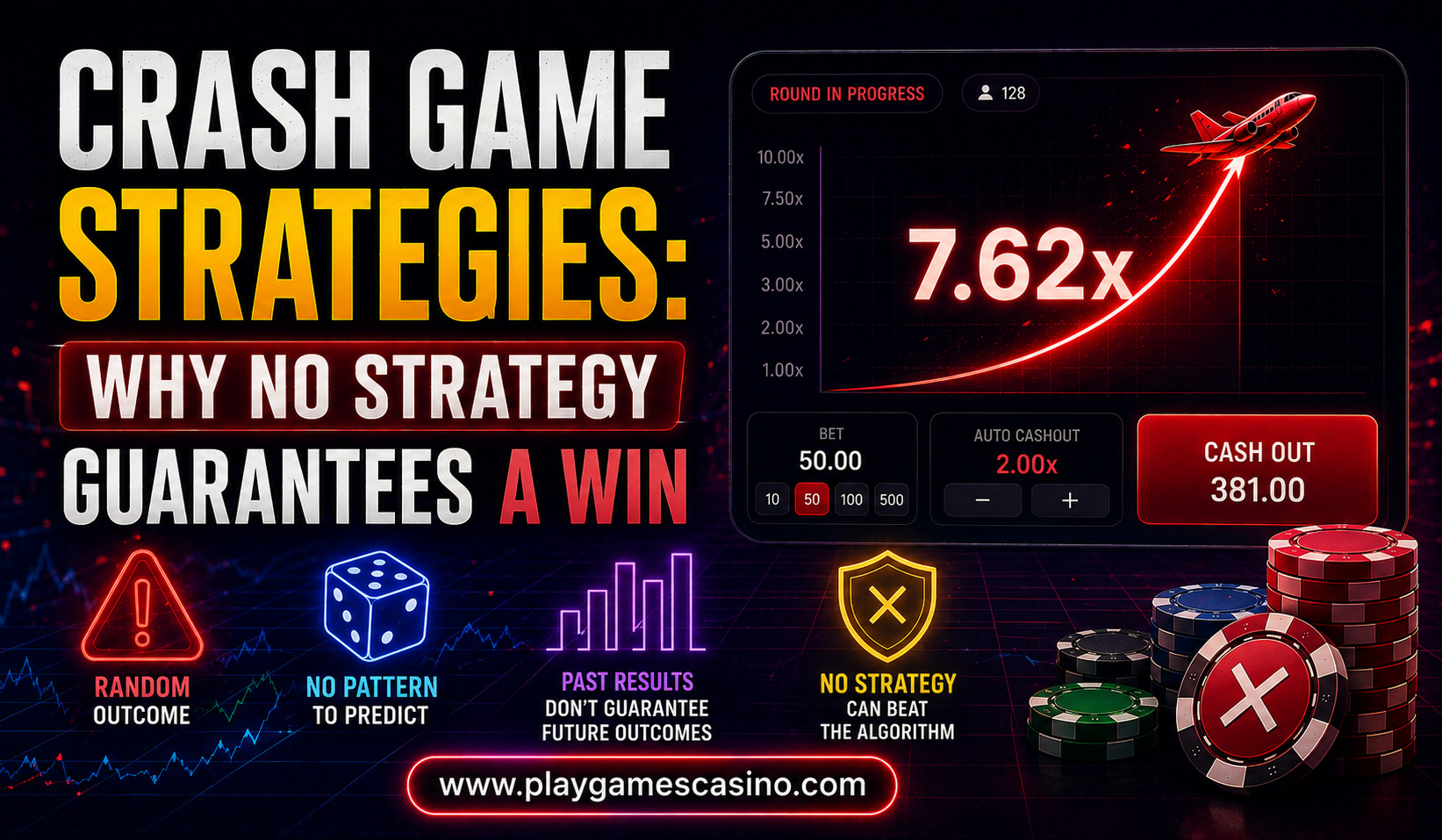
Crash games have become a widely discussed category in online gaming because of their simple rules and fast-moving format. A typical crash game features a multiplier that begins at a low value and increases as the round progresses. At an unpredictable point, the round ends, or “crashes,” and players who have not exited before that moment can lose their stake.
The straightforward design has also created a large market for strategies. Players often search for betting patterns, multiplier targets, previous-round analysis, automatic cash-out settings, and other methods that appear to offer more control over the outcome. However, an important distinction is often overlooked: a strategy can change how someone manages their decisions, but it cannot guarantee a winning result in a game based on random outcomes.
Understanding this difference is essential for anyone researching crash games. Strategies may influence behavior, budgeting, or risk exposure, but they cannot turn an uncertain outcome into a predictable one.
Why Crash Games Attract So Many Strategies
One reason crash games generate so much discussion about strategies is their visual simplicity. Players can see a multiplier rise in real time, which creates the impression that the next moment might be easier to anticipate.
Traditional games can also encourage strategy discussions, but crash games add a rapidly changing visual element. Watching a multiplier move from 1.20x to 2x, 5x, or higher can make the outcome feel like a sequence that might contain recognizable patterns.
This can lead to questions such as whether several low results mean a high result is approaching or whether a particular multiplier appears more frequently at certain times. Without evidence from the game’s underlying mechanics, however, these observations do not provide a reliable method for predicting the next round.
The important point is that observing previous results is not the same as predicting future results.
What Determines the Outcome?
The exact technical system differs between games, but crash games generally rely on a predefined mathematical and technical process to determine round outcomes. Depending on the platform, this can involve random-number generation or a provably fair system designed to produce verifiable results.
The outcome is determined by the game’s underlying mechanism rather than by a player’s betting pattern. A player can decide when to enter, how much to stake, or when to attempt an exit, but those decisions do not necessarily influence when the round itself ends.
This creates an important separation between decision-making and outcome generation. A strategy can control the former, while the latter remains uncertain.
The Gambler’s Fallacy and Crash Games
One of the most common mistakes in strategy discussions is the gambler’s fallacy. This occurs when someone assumes that a particular result becomes more likely because a different result has occurred repeatedly.
Imagine that several consecutive rounds end at relatively low multipliers. A player might believe that a high multiplier is now “due.” But if individual rounds are independently generated according to the game’s rules, the previous results do not create an obligation for the next round to produce a higher number.
The same principle works in reverse. A long sequence of high multipliers does not automatically mean that a low multiplier must appear next.
This is why streak-based strategies should be treated cautiously.
Some commonly discussed approaches include:
- Fixed-stake betting
- Adjusting stakes after wins or losses
- Setting a predetermined multiplier target
- Using automatic cash-out settings
Each approach represents a different way of managing participation. None provides a mathematical guarantee of profit.
Why Automatic Cash-Out Is Not a Winning Formula
Automatic cash-out tools are often presented as a way to remove emotion from decision-making. A player can select a multiplier in advance, and the system attempts to exit automatically if that level is reached.
This can make a decision more consistent, but consistency is not the same as profitability.
For example, choosing a lower automatic cash-out point may mean that successful rounds can occur more frequently than with a much higher target, but the potential return per successful round is also different. The game’s underlying probability and payout structure still determine the overall mathematical picture.
Automatic features are therefore best understood as execution tools, not prediction tools.
Risk Management Is Different From Winning
One of the most important distinctions in crash game discussions is the difference between managing risk and guaranteeing a result.
Risk management can involve deciding how much money someone is prepared to lose, setting time limits, or avoiding attempts to recover losses through increasingly larger bets. These practices can help control exposure.
However, risk management does not transform a negative or uncertain mathematical situation into a guaranteed profit.
A person can follow a disciplined approach and still experience an unfavorable outcome. That is not necessarily evidence that the strategy was incorrectly executed. It is a consequence of uncertainty.
Why High-Multiplier Targets Can Be Misleading
High multipliers often receive significant attention because they can produce visually impressive results. A round reaching 20x, 50x, or even higher can become more memorable than several ordinary rounds.
This can influence how people perceive risk. A player may see an unusually large multiplier and assume that reaching similar numbers is achievable with the right timing strategy.
But the existence of a high result does not mean that another high result is likely to occur soon. Nor does it demonstrate that a particular betting system caused the outcome.
The same principle applies to low multipliers. A series of early crashes may feel like a pattern, but the sequence alone does not establish what the next round will produce.
A Simple Comparison of Strategy and Reality
| Common Strategy Claim | What It Can Actually Do | What It Cannot Do |
| Follow previous results | Help organize observations | Predict the next round |
| Use a fixed cash-out | Create consistent exit rules | Guarantee successful exits |
| Increase stakes after losses | Change bet size | Remove the possibility of further losses |
| Target high multipliers | Define a potential exit point | Make high multipliers more likely |
| Use automated betting | Reduce repeated manual actions | Guarantee profit |
| Analyze streaks | Show historical sequences | Prove future outcomes |
The distinction is important because many strategy discussions focus heavily on what players can control while overlooking the uncertainty built into the game itself.
The House Edge Still Matters
Where crash games involve real-money wagering, the game’s mathematical design generally includes an expected advantage for the operator or a defined payout structure. This means that changing betting patterns does not necessarily remove the underlying mathematical disadvantage.
A player may experience winning sessions, but short-term results should not be confused with a guaranteed long-term outcome.
Understanding concepts such as house edge, probability, payout structure, and expected return can provide a more realistic picture than relying on claims about “secret” strategies.
The exact mathematical model varies between games, so users should consult the specific rules and published information of the platform they are considering.
Why Emotional Decisions Can Become a Problem
Crash games are designed around quick rounds, which can create a rapid cycle of decision and feedback. After a loss, someone may feel an urge to immediately participate again. After a large win, they may become more confident and increase their stake.
These emotional reactions can make a strategy difficult to follow consistently.
A disciplined approach, where someone decides their limits before participating, can reduce impulsive behavior. But discipline should not be interpreted as a method for guaranteeing a positive financial outcome.
The goal of responsible decision-making is to control exposure, not to eliminate uncertainty.
What a Realistic Strategy Can and Cannot Do
A realistic crash game strategy should be described as a framework for decision-making rather than a winning formula. It can help someone establish boundaries and understand how they want to interact with a game.
For example, a person may decide in advance how much they are willing to spend, when they will stop, and how they will respond to a losing session. Those decisions can prevent uncontrolled escalation.
However, no set of rules can guarantee that the next crash point will appear at a particular multiplier.
A useful way to separate realistic strategy from unrealistic claims is to ask whether the proposed method changes the game’s underlying probability. If it does not, it should not be presented as a guaranteed winning system.
Does a Longer Session Improve the Chances?
Playing more rounds does not automatically make a strategy more accurate. In fact, participating in more rounds simply creates more opportunities for both wins and losses.
Short-term results can also be misleading. A player might experience a profitable sequence and conclude that a strategy is working, even though the result could simply reflect normal short-term variation.
Over a larger number of rounds, random variation can produce many different sequences. This is one reason isolated winning streaks should not be treated as evidence of a guaranteed system.
Conclusion
Crash game strategies can influence how players organize their decisions, but they cannot remove the uncertainty built into the game’s outcome. Fixed stakes, automatic cash-out settings, multiplier targets, streak analysis, and changing bet sizes may alter the way someone participates, yet none of these methods can guarantee a win.
The biggest mistake is confusing control over a decision with control over an outcome. Players can control their budget, participation time, and personal limits. They generally cannot control the point at which an independently generated crash round ends.
As interest in crash games continues, understanding probability and responsible gaming is more valuable than chasing claims about secret formulas. A strategy should be viewed as a way to manage decisions and risk—not as a promise of guaranteed profit.
Frequently Asked Questions
Can any crash game strategy guarantee a win?
No. A betting or gameplay strategy can change how decisions are made, but it cannot guarantee the outcome of a round when that outcome is generated by an uncertain or random process.
Can previous crash results predict the next result?
Previous results show what happened in earlier rounds. Unless the game’s rules explicitly create a dependency between rounds, those results should not be treated as reliable predictions of the next outcome.
Does increasing the bet after a loss guarantee recovery?
No. Increasing the stake can increase the amount exposed to risk. A continued losing sequence can produce larger losses rather than automatically recovering earlier ones.
Is automatic cash-out a guaranteed strategy?
No. Automatic cash-out can automate an exit condition, but it cannot guarantee that the selected multiplier will be reached before the round ends.
Are high multipliers more likely after several low multipliers?
Not necessarily. A sequence of low results does not, by itself, establish that a high result is “due.” The next outcome depends on the game’s underlying mechanics.