Crash Games vs Traditional Casino Games: Key Differences
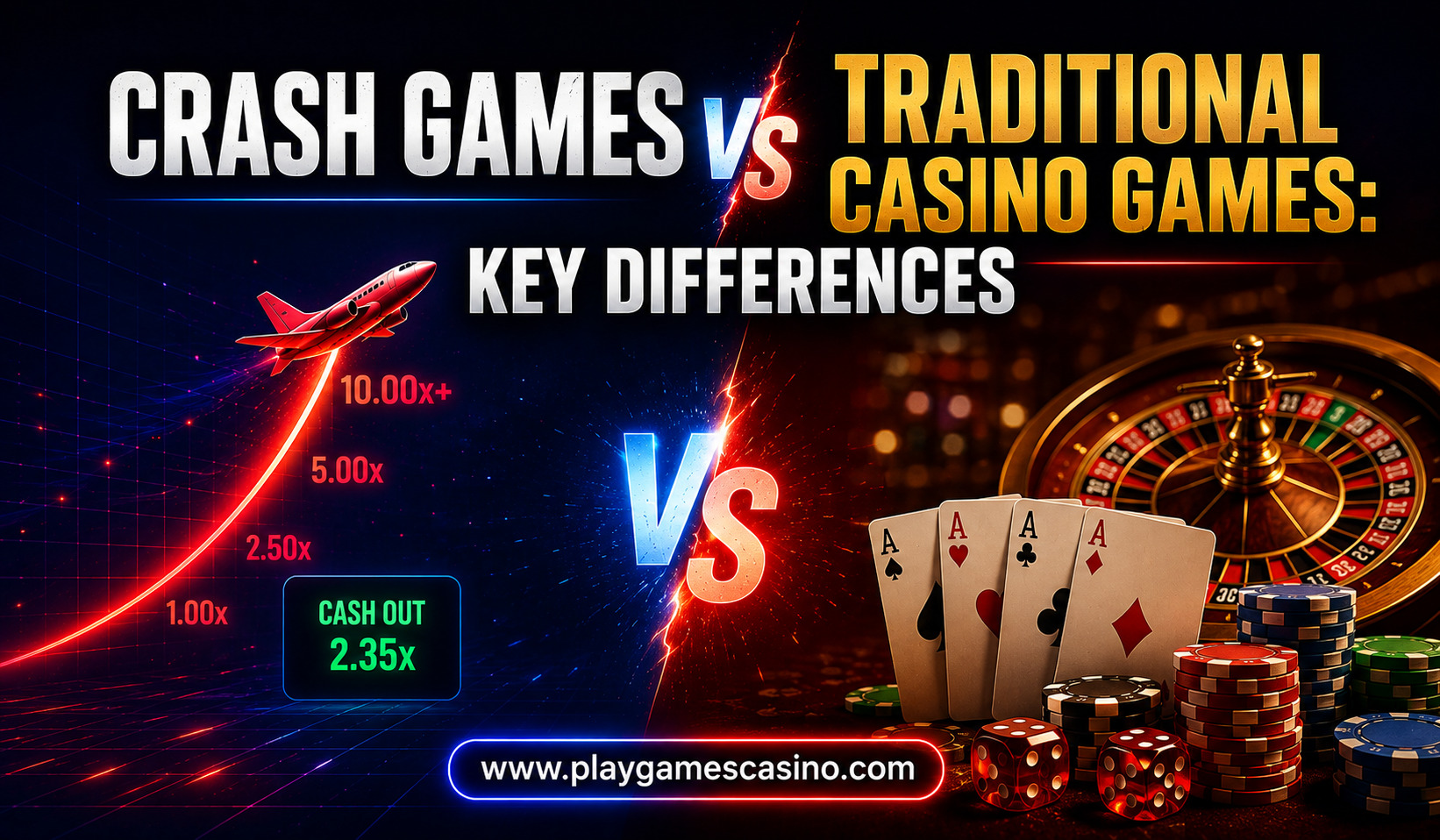
The online gaming industry has changed considerably as digital technology has introduced new ways for users to interact with casino-style games. Traditional formats such as roulette, blackjack, poker and slot games remain widely recognized, while crash games have emerged as a newer category built around a rising multiplier and a sudden stopping point.
At first glance, crash games may appear similar to other casino products because players place wagers and receive payouts based on game outcomes. However, the underlying experience can be quite different. Crash games emphasize timing, a continuously changing multiplier and a cash-out decision, whereas traditional casino games use established mechanics such as cards, reels, wheels or fixed paylines.
Understanding these differences can help explain why crash games have developed their own audience and how they compare with more established online casino formats.
What Are Crash Games?
A crash game generally begins with a multiplier near 1.00x. As the round progresses, the multiplier rises until the game suddenly ends, commonly described as a “crash.”
Players who successfully cash out before the round ends receive a payout based on the multiplier at which they exit. If the round ends before a successful cash-out, the wager may be lost according to the game’s rules.
The central decision is therefore about timing. A player may choose to exit early for a smaller potential multiplier or remain in the round longer in pursuit of a larger one.
This structure gives crash games a very different visual and interactive style compared with many traditional casino games.
What Are Traditional Casino Games?
Traditional casino games include formats that have existed in physical casinos and later moved online. Roulette, blackjack, baccarat, poker and slot machines are some of the best-known examples.
Each format has its own rules and mathematical structure. Roulette revolves around numbers, colors and wheel outcomes. Poker involves player-versus-player competition in many formats, while slots generally use reels, symbols and paylines or ways to win.
Online versions can add digital features, but the underlying rules usually remain recognizable.
The Biggest Difference: How the Game Is Played
The most obvious difference between crash games and traditional casino games is the player’s interaction with the outcome.
In a crash game, the multiplier continuously changes during the round. The player decides when to cash out.
Traditional games usually use a more established sequence. A roulette player selects a wager before the wheel spins. A blackjack player receives cards and makes decisions based on the hand. A slot player spins the reels and waits for the result.
This means crash games often create a sense of continuous movement, while traditional games can involve a series of predefined actions.
| Feature | Crash Games | Traditional Casino Games |
| Main mechanic | Rising multiplier and crash point | Varies by game |
| Central decision | When to cash out | Depends on the format |
| Visual focus | Multiplier | Cards, reels, wheel or table |
| Round structure | Often short and continuous | Varies significantly |
| Strategy element | Mainly timing and wager decisions | Varies from minimal to substantial |
| Game outcome | Usually generated electronically | Can use RNG or other systems online |
Timing Plays a Larger Role in Crash Games
Timing is particularly visible in crash games.
Suppose the multiplier rises from 1.00x to 2.00x, then continues to 3.00x and beyond. The player must decide whether to exit or continue waiting.
A successful cash-out at 2.00x could provide a smaller return than waiting until 5.00x, but the latter requires the round to continue for longer.
Traditional casino games can involve timing decisions too, but the concept is not usually presented as a continuously rising multiplier.
In blackjack, for example, the player decides how to play a hand based on the cards available. In roulette, the primary wager is generally placed before the spin. In a crash game, the changing multiplier itself becomes part of the decision-making process.
The Role of Skill and Strategy
Another important difference is the type of decision-making involved.
Some traditional casino games, particularly blackjack and poker, can involve substantial strategic or skill-based elements. Players may need to understand probabilities, hand strength, betting patterns and game-specific decisions.
Crash games have a simpler core mechanic. Players generally decide how much to wager and when to cash out, but the crash point itself is outside their control.
This means a player can make different choices about risk and timing without being able to determine the underlying result.
It is important not to confuse having a decision to make with having control over the outcome. A cash-out strategy does not guarantee that the multiplier will reach a chosen target.
Crash Games Are Designed for Short Rounds
Speed is another major distinction.
Crash games are generally designed around short, fast-moving rounds. A multiplier can rise and stop within a relatively brief period, allowing users to participate in repeated rounds.
Traditional casino games vary considerably. A slot spin may take only a few seconds, while a poker hand or blackjack session can last much longer.
The speed of crash games is part of their appeal but also means players can accumulate wagers quickly if they do not pay attention to session length.
How Multipliers Differ From Traditional Payouts
Crash games use multipliers as their main payout mechanism.
For example, a ₹100 wager successfully cashed out at 2.50x would correspond to ₹250 before any applicable platform rules or deductions.
Traditional casino games use different payout structures. A roulette bet may have a fixed payout depending on the type of wager. Slots use symbol combinations and paylines, while blackjack typically pays according to the result of the hand and the applicable rules.
The multiplier system gives crash games a visually direct connection between the game state and potential return.
Randomness and Game Outcomes
Both crash games and many traditional online casino games rely on mathematical systems to generate outcomes.
Crash games may use random number generators or cryptographic mechanisms, depending on the provider. Traditional digital casino games such as slots and online roulette commonly use RNG technology as well.
The specific implementation matters. A game’s published rules or fairness documentation should explain how outcomes are generated.
In either case, randomness means that previous results should not automatically be treated as a reliable way to predict the next result.
RTP and House Edge
RTP, or Return to Player, is another concept that applies to many online casino games, including crash games.
RTP represents the theoretical percentage a game is designed to return over a large number of wagers. It is not a promise that an individual player will receive that percentage during a session.
For example, a hypothetical game with 96% RTP would have a theoretical house edge of 4%, assuming a straightforward calculation.
Traditional casino games can have different RTP levels depending on the specific game and rules. Crash games also have mathematical models that determine their theoretical return.
Comparing RTP figures can therefore provide useful information, but RTP alone does not describe the complete player experience.
Volatility Can Differ Significantly
Volatility describes how much game outcomes can vary over time.
In crash games, volatility can be associated with the distribution of multiplier results. A game may produce many lower crash points while occasionally reaching a much higher multiplier.
Traditional games also have different volatility characteristics. Some slot games may feature smaller frequent wins, while others may produce less frequent but larger payouts.
The key point is that RTP and volatility are not the same. Two games can have similar theoretical RTP while providing very different patterns of short-term results.
The Importance of Player Interaction
Crash games tend to place the player in front of a continuously changing display. The multiplier is rising, and the player has to decide whether to remain in the round.
Traditional casino games vary widely in their level of interaction.
A slot game may require little decision-making once a spin has started. Blackjack requires decisions during a hand. Poker can involve extensive strategic interaction between players.
This makes “traditional casino games” a broad category. Comparing them with crash games is therefore more useful when considering the specific format being discussed.
Mobile Compatibility
Both crash games and traditional casino games are available on mobile platforms, but crash games are particularly well suited to compact interfaces.
The core crash-game screen can often be reduced to a multiplier, wager controls and cash-out options. This allows developers to create mobile-friendly interfaces without requiring a large virtual table.
Traditional games such as blackjack and roulette also work effectively on smartphones, although their interfaces may require more visual elements.
Mobile optimization has therefore benefited both categories, but crash games have a particularly simple interface structure.
Which Is More Strategy-Based?
There is no single answer because traditional casino games cover many different formats.
Poker can involve significant strategic decision-making because players compete against other participants. Blackjack includes mathematical decisions regarding how to respond to particular card combinations. Roulette and many slot games offer considerably less player control over the final outcome.
Crash games generally involve decisions about wager size and cash-out timing, but players cannot control the random crash point.
Therefore, it is more accurate to say that crash games emphasize risk timing, while certain traditional games can involve more extensive decision-making based on the rules of the specific game.
Final Thoughts
Crash games and traditional casino games share the broader world of online gaming, but their approaches to gameplay are noticeably different.
Crash games focus on a rising multiplier and the decision to cash out before an unpredictable stopping point. Traditional casino games use a much wider range of mechanics, including reels, cards, wheels, fixed payouts and player-versus-player decisions.
Technology has allowed both categories to become accessible through smartphones and online platforms, while improvements in real-time systems have helped crash games develop their distinctive fast-moving style.
Ultimately, the biggest difference is not simply the visual design. It is the way players interact with risk. Crash games place the timing of the exit at the center of the experience, while traditional casino games offer different forms of interaction depending on the format.
Understanding these differences can help readers approach both categories with more realistic expectations and a clearer understanding of how their mechanics work.
Frequently Asked Questions
Are crash games faster than traditional casino games?
Many crash games are designed around short rounds, making them faster-paced than some traditional formats. However, the speed of traditional games varies significantly.
Do crash games involve strategy?
Players can make decisions about wager size and cash-out timing, but they cannot control the crash point. Some traditional games, such as poker and blackjack, can involve more extensive strategic decision-making.
Do traditional casino games and crash games use RNGs?
Many online casino games use random number generators, while crash games may use RNGs or cryptographic fairness systems depending on the provider.
Can previous crash results predict the next round?
Generally, no. If rounds are independently generated, previous multipliers do not reliably determine the next crash point.