Aviator vs JetX: Key Differences Explained
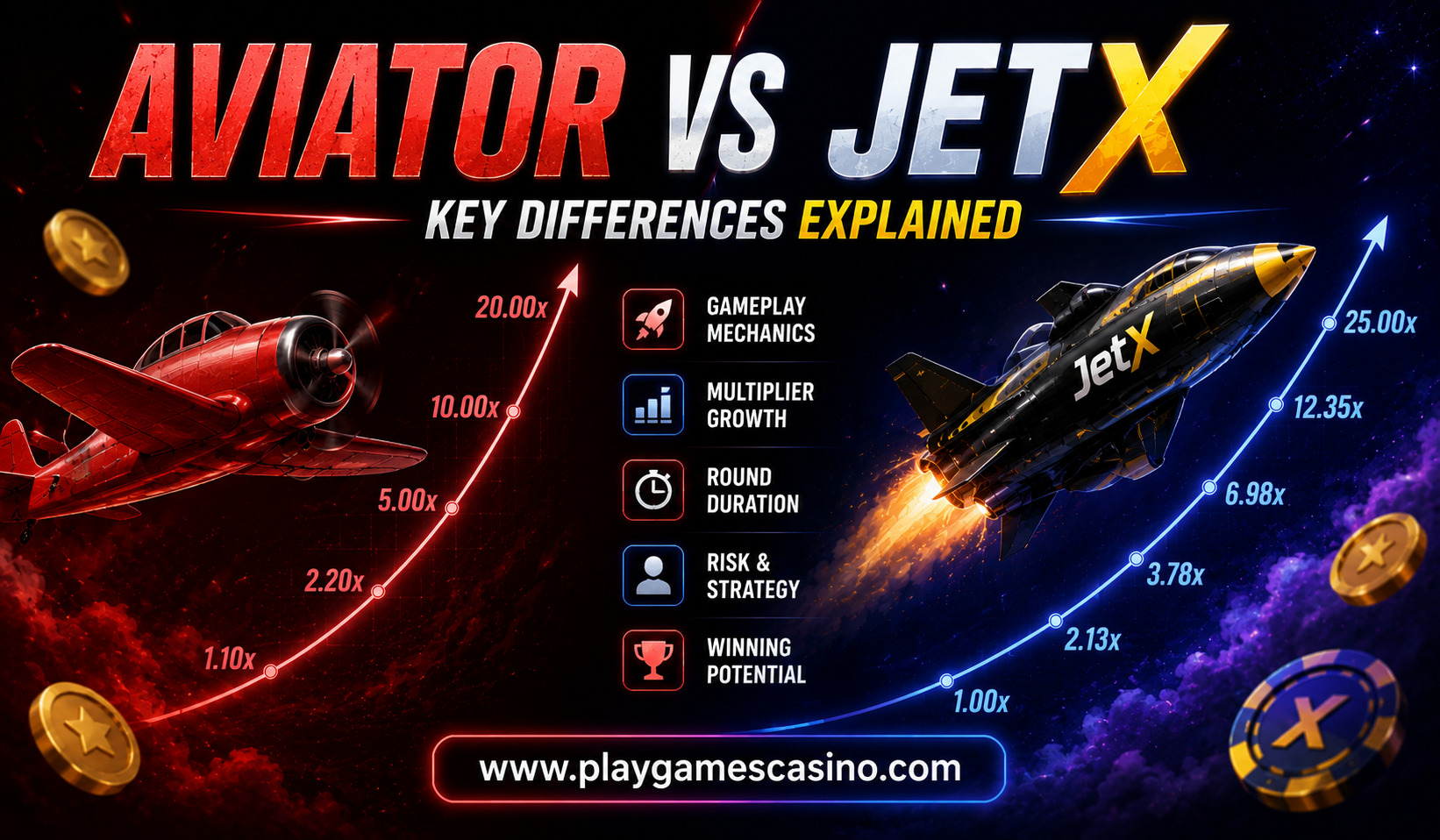
Crash games have become an increasingly visible part of the online gaming industry, offering a format that is much simpler than many traditional casino titles. Instead of reels, cards or a wheel, these games generally revolve around a multiplier that increases during a round.
Aviator and JetX are two recognizable names in this category. Both use an aircraft-themed presentation and a rising multiplier, which can make them appear almost identical at first glance. However, the two games come from different developers and have differences in features, technical specifications, interface design and gameplay options.
Aviator is developed by SPRIBE, while JetX is developed by SmartSoft Gaming. Aviator was introduced as a crash game built around a plane and a multiplier that can increase until the flight ends. JetX follows a similar core concept but adds its own features, including a dual-bet option and a different approach to its visual presentation.
For players comparing the two, the most important point is that neither game provides a reliable way to predict future results. The differences are primarily about gameplay experience and features rather than one game offering a guaranteed advantage.
What Are Aviator and JetX?
Aviator is a multiplayer crash game developed by SPRIBE. The central visual is a red aircraft that takes off while the multiplier increases. Players can cash out while the plane remains in the air. If the aircraft flies away before a wager is settled, the active bet is lost.
SPRIBE describes Aviator as a game where players can place bets, watch the multiplier rise and cash out before the plane disappears. The developer also highlights features such as automatic cash-out, betting history and multiplayer interaction.
JetX, meanwhile, is a crash multiplier game developed by SmartSoft Gaming. Its aircraft travels across the screen while the multiplier increases. Players similarly have to decide when to collect their potential return.
SmartSoft identifies JetX as one of its pioneering crash games, launched in 2018. The developer’s information also describes features such as multiple betting positions and customizable gameplay options. So, while the basic idea is shared, the games are separate products with different developers and technical configurations.
Aviator vs JetX at a Glance
The two games have enough similarities to make a direct comparison useful, but several details separate them.
| Feature | Aviator | JetX |
| Developer | SPRIBE | SmartSoft Gaming |
| Genre | Crash game | Crash multiplier game |
| Main theme | Aircraft | Aircraft |
| Core mechanic | Rising multiplier and cash-out | Rising multiplier and cash-out |
| Betting positions | Supports multiple bets in supported versions | Supports up to two bets in supported versions |
| Auto cash-out | Available | Available |
| Round history | Available | Available |
| RTP | Published game configuration varies by market/version | SmartSoft lists 96.2%–98.9% depending on configuration |
| Launch period | Introduced by SPRIBE before becoming widely distributed | 2018 |
Because online operators can use different configurations and regulatory settings, players should always check the information shown inside the particular version they are accessing.
The Biggest Similarity: The Crash Mechanic
The most obvious similarity between Aviator and JetX is their core gameplay.
In both games, the player places a wager before a round starts. The aircraft then takes off, and the multiplier begins increasing. The longer the flight continues, the higher the potential payout becomes.
However, the aircraft can disappear at an unpredictable point.
Suppose a player places a ₹100 wager. If the player successfully cashes out at 2.00x, the calculated return would be ₹200. If the multiplier reaches 4.00x before the player exits, the potential return would be ₹400.
But there is an important catch. The player cannot assume that the multiplier will reach the chosen target. If the round ends first, the unsettled wager is lost.
This creates the same basic decision in both games: take the current multiplier or continue with the risk of waiting longer.
How Aviator Stands Out
Aviator has developed a strong identity around its visual design, multiplayer environment and recognizable aircraft presentation.
One of the game’s notable characteristics is its emphasis on the social aspect of the round. Players can see activity from other participants and interact through available interface features. This makes the experience feel more like a shared live game than a solitary betting screen.
Aviator also supports automatic cash-out features. Players can select a target multiplier in advance, allowing the system to settle a wager automatically if the target is reached.
Another element that attracts attention is the game’s round history. Previous multipliers can be displayed for players to review, although these historical results should not be treated as a prediction mechanism.
The combination of a recognizable interface, multiplayer presentation and simple controls has helped Aviator become one of the most recognizable crash games in the market.
How JetX Is Different
JetX uses the same basic multiplier-and-crash concept but has its own feature set.
One of the most notable differences is the game’s dual-bet capability. SmartSoft describes JetX as supporting two bets, allowing players to operate two betting positions in the same round.
This creates additional flexibility. A player could, for example, use different cash-out targets for separate positions. One wager could be set toward an earlier exit while another remains active for a potentially higher multiplier.
However, two betting positions do not mean two guaranteed chances to win. Both wagers remain exposed to the same round’s crash event.
JetX also offers customizable auto-cashout functionality and provides game-history information, depending on the platform and configuration.
RTP: An Important Difference to Check
RTP, or Return to Player, is one area where comparisons require particular care.
SmartSoft’s official JetX information lists RTP between 96.2% and 98.9%, depending on the configuration Aviator’s published RTP can also depend on the particular game configuration and market. Therefore, it would be misleading to simply declare one game universally superior based on a single RTP figure found online.
For example, if a game has a theoretical RTP of 97%, a person wagering ₹1,000 is not guaranteed to receive ₹970. Individual results can vary considerably.
Players should therefore check the rules and RTP information displayed by the specific licensed operator they are using.
Auto Cash-Out in Aviator and JetX
Both games provide automatic cash-out functionality, but the exact controls can vary between versions.
Auto cash-out allows a player to select a multiplier in advance. If the multiplier reaches that level before the crash, the wager is automatically settled.
This can be useful from a practical perspective because the player does not have to rely on a last-second manual click. It can also help someone follow a predetermined exit point instead of making an emotional decision while the multiplier is rapidly increasing.
However, auto cash-out should not be confused with a prediction system.
If a player chooses 3.00x and the round ends at 2.70x, the target is never reached. The automatic feature cannot change that result.
In both Aviator and JetX, automation changes how the wager is settled, not when the underlying crash occurs.
Can Either Game Be Predicted?
This is perhaps the most important question for anyone comparing Aviator and JetX.
Neither should be approached as a game where historical multipliers can reliably reveal the next result.
Players may see a series of low multipliers and assume that a high multiplier is due. Conversely, after a large result, they may believe that another high result is unlikely.
These assumptions are examples of the gambler’s fallacy. Previous outcomes do not create a mathematical requirement for a particular future outcome.
A history panel can tell players what happened in previous rounds. It cannot guarantee what will happen in the next one.
Similarly, claims about secret Aviator or JetX prediction algorithms should be treated skeptically. A tool claiming to know the exact future crash point would need access to information beyond what ordinary players can reliably obtain.
Which Game Offers More Flexibility?
The answer depends on what a player means by flexibility.
If social interaction, recognizable presentation and a large multiplayer environment are important, Aviator may appear more appealing. Its identity has been strongly associated with multiplayer crash gaming and a polished aircraft-themed interface.
If the ability to manage two wagers in the same round is more important, JetX has a distinctive advantage through its dual-bet functionality.
Neither feature makes one game mathematically guaranteed to be better.
The choice is therefore more about interface preferences and available features than about finding a guaranteed winning option.
Which Game Is Easier for Beginners?
Both games are relatively easy to understand because their fundamental rules are almost identical.
A beginner needs to understand only a few key concepts: place a wager, watch the multiplier, cash out before the crash and recognize that waiting longer increases both potential return and exposure to loss.
Aviator’s interface may feel familiar to people who have already encountered crash games, while JetX can appeal to players interested in its additional betting functionality.
For a newcomer, the most important step is not choosing the “better” game but learning how the specific platform handles wagers, cash-outs, limits and payouts.
The Role of Game History
Both Aviator and JetX can provide information about previous rounds, and this feature often attracts considerable attention.
A sequence such as 1.10x, 1.40x, 2.10x, 1.20x and 8.00x can look like it contains a pattern. However, interpreting such sequences as a forecast is risky.
Previous results can be useful for understanding what the game has already produced. They should not be used as evidence that a particular multiplier is guaranteed next.
This distinction becomes especially important when players start increasing wagers because they believe a large multiplier is “overdue.”
Aviator vs JetX: Which One Should Players Choose?
There is no universal answer because the games target a very similar audience while offering different features.
Aviator may be more attractive to players who prefer its established multiplayer environment, visual identity and social features. JetX can appeal to those who like the flexibility of multiple betting positions and SmartSoft’s particular game design.
The decision should not be based on claims that one title can predict crashes better than the other. Both games involve uncertain outcomes, and no cash-out strategy can guarantee consistent profits.
A practical comparison should instead focus on the specific version available to the player, including its displayed RTP, betting limits, cash-out functionality, jurisdictional availability and responsible-gaming tools.
Final Thoughts
Aviator and JetX may look similar because both use an aircraft, a rising multiplier and a crash-style cash-out system. Underneath that shared concept, however, they offer different experiences.
Aviator, developed by SPRIBE, has built a strong identity around multiplayer interaction, its recognizable interface and automatic cash-out functionality. JetX, developed by SmartSoft Gaming and launched in 2018, offers a similar core mechanic while standing out with features such as dual betting and configurable gameplay options. For beginners, the biggest lesson is that the games are not fundamentally about predicting the next multiplier. They are about managing a wager in an environment where the end of the round is uncertain.
Aviator may suit players who prefer its social and visual presentation, while JetX may suit those who value additional betting flexibility. Neither provides a guaranteed route to profit.
Anyone considering real-money play should read the specific operator’s rules, verify the displayed RTP and betting conditions, understand the cash-out process and set a strict budget. The most useful comparison is therefore not which game promises the biggest win, but which game’s features and risk profile a player understands and can approach responsibly.
Frequently Asked Questions
Is Aviator the same as JetX?
No. Aviator and JetX are separate crash games developed by different companies. Aviator is developed by SPRIBE, while JetX is developed by SmartSoft Gaming.
Which game has a higher RTP?
There is no universal answer because RTP can depend on the game’s configuration, market and operator. SmartSoft lists JetX RTP between 96.2% and 98.9% depending on configuration. Players should check the RTP displayed for the exact version they are using.
Can Aviator or JetX be predicted?
There is no reliable method for guaranteeing the prediction of future crash points in either game. Previous results cannot reliably determine the next multiplier.
Do both games have auto cash-out?
Yes, both games can provide automatic cash-out functionality, although the exact implementation and available settings may vary by platform.
Can JetX players place two bets at once?
JetX supports a dual-bet feature, allowing two betting positions in supported versions. This provides additional flexibility but does not eliminate the risk of losing one or both wagers.