Chicken Road: Gameplay, Features, and How It Differs From Crash Games
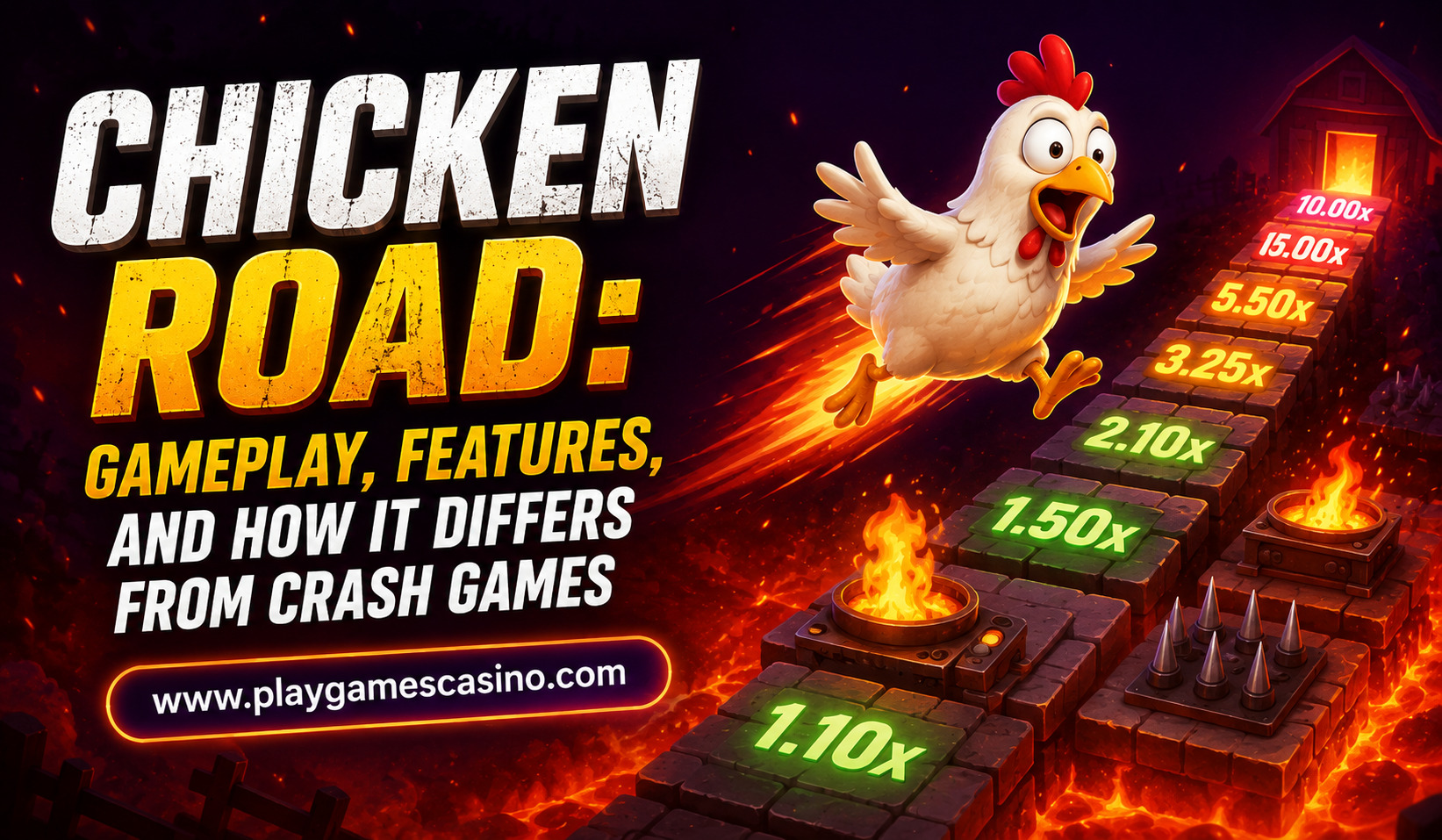
The online gaming market has seen a steady rise in fast-paced titles that borrow ideas from arcade games while adding multiplier-based betting mechanics. Chicken Road is one of the more distinctive examples. Instead of following the familiar format of a plane, rocket or astronaut moving upward until a crash, the game places a chicken in a hazardous journey where every successful step can increase the potential payout.
Developed by InOut Games, Chicken Road was released on April 4, 2024, according to the developer’s game information. The title offers four difficulty levels—Easy, Medium, Hard and Hardcore—with the risk increasing as players choose more demanding settings. InOut Games lists the game’s RTP at 98%.
At first glance, Chicken Road may appear to be another crash game. Its central idea is certainly related to the same risk-and-cash-out category, but the way the multiplier develops is different. Players do not simply watch an automatically rising number and wait for the right moment to exit. Instead, progress happens step by step, giving the player a decision after each successful move.
That difference makes Chicken Road worth examining separately from conventional crash titles such as Aviator, JetX and Spaceman.
What Is Chicken Road?
Chicken Road is an arcade-inspired, crash-style game in which a chicken moves forward through a sequence of increasingly risky steps. Every successful move can increase the multiplier, creating a larger potential payout. At any point, the player can choose to stop and cash out.
The game’s official developer page describes the objective as helping the chicken overcome dangers while progressing toward its goal. It also confirms that the game has four difficulty settings and that higher difficulty increases both potential winning odds and the risk of being “fried.”
This creates a simple but important choice. A player can stop after an early successful step and collect a smaller potential return, or continue moving forward in pursuit of a larger multiplier. Continuing, however, means exposing the wager to another uncertain step.
The game therefore combines three familiar concepts: an increasing multiplier, escalating risk and player-controlled cash-out.
How Chicken Road Gameplay Works
The gameplay begins when a player selects a wager and chooses a difficulty level. Once the round starts, the chicken begins its journey. Each successful step moves the character farther along the route and increases the multiplier.
Unlike a traditional continuous crash game, the multiplier does not simply climb automatically while the player waits. The next stage is reached through another player’s decision. This gives Chicken Road a slower, more deliberate rhythm even though individual rounds can still be completed quickly.
The basic sequence is straightforward:
- Select the wager and difficulty level.
- Start the chicken’s journey.
- Advance one step at a time.
- Cash out when the current multiplier is acceptable, or continue toward a higher potential payout.
If the chicken successfully completes another step, the potential return increases. If the round reaches an unsuccessful step before the player cashes out, the active wager is lost.
The exact interface and betting limits can vary depending on the operator offering the game, so players should always check the rules displayed on their particular platform.
Understanding the Step-Based Crash Mechanic
The step-based mechanic is the feature that most clearly separates Chicken Road from the traditional crash format.
In games such as Aviator, the multiplier typically increases continuously from the moment the round begins. Players watch the number rise and decide when to cash out before the crash. Chicken Road changes that relationship by making each step an individual decision.
Imagine a player starts with a 100-unit wager. The first successful move may produce a relatively small multiplier. After another successful move, the potential payout increases again. The player can then decide whether to bank the current amount or risk another step.
This means the pressure does not come primarily from watching a timer or rapidly climbing multiplier. Instead, it comes from the question of whether the next step is worth the additional risk.
That distinction can make the game feel more like an interactive path or crossing game than a conventional crash graph.
Four Difficulty Levels
InOut Games states that increasing the difficulty also increases the potential winning odds and the risk associated with each step.
This feature gives players more control over the level of volatility they experience. Someone who prefers a more conservative progression can choose a lower difficulty, while someone comfortable with greater uncertainty can select a harder mode.
However, difficulty should not be confused with skill level. Choosing Hardcore does not mean that a player is demonstrating greater gaming ability. It changes the risk profile of the game.
Similarly, choosing Easy does not guarantee that the chicken will successfully reach a particular stage. Each individual round remains uncertain.
The four settings are therefore best understood as different risk configurations rather than four levels that players can “master.”
RTP and What It Means
InOut Games lists Chicken Road with a 98% RTP, or Return to Player.
RTP is a theoretical long-term measurement. It does not mean that a player is guaranteed to receive 98% of their money back during a single session.
For example, if a game has a theoretical RTP of 98%, it would not mean that someone wagering ₹1,000 is guaranteed to receive ₹980. Individual results can vary significantly, particularly over short periods.
This distinction is important because the large multipliers associated with crash-style games can make individual outcomes highly variable. A player may have a profitable session, experience a losing session or see a combination of wins and losses.
RTP describes long-term mathematics rather than an individual player’s expected result from a particular afternoon or evening.
Chicken Road vs Traditional Crash Games
Chicken Road sits close to the crash-game category, but its gameplay structure differs from the best-known continuous-multiplier titles.
Aviator, for example, is based around a plane and a multiplier that rises automatically. Spaceman uses a similar continuous approach with its astronaut theme. JetX also uses an aircraft and an increasing multiplier. In each case, the player watches the multiplier climb and tries to cash out before the round ends.
Chicken Road introduces a different rhythm because the player determines when the next step happens.
| Feature | Chicken Road | Traditional Crash Games |
| Multiplier movement | Advances through individual steps | Usually rises continuously |
| Main decision | Continue or cash out after each step | Cash out before the crash |
| Risk control | Four difficulty settings | Usually a fixed game risk profile |
| Visual theme | Chicken and obstacle-based journey | Often plane, rocket or astronaut |
| Pacing | Largely player-controlled | Round develops automatically |
| Core risk | One unsuccessful step can end the round | Crash can occur while multiplier rises |
The distinction may seem small, but it changes the psychology of the game. Traditional crash titles create pressure because the multiplier keeps moving even if the player hesitates. Chicken Road gives the player another layer of control over when to take the next step.
Chicken Road and the Role of Player Decisions
The game may look more interactive than a conventional crash title because players actively decide when to progress. However, that should not be interpreted as meaning that players can control the underlying outcome.
The player’s meaningful choices involve risk management. They can decide the difficulty level, the size of the wager and when to cash out. They cannot guarantee that the next step will succeed.
This distinction is important for beginners. Having more decisions does not necessarily mean having more influence over the random outcome.
A player might decide to stop after three successful steps, for example. That decision controls whether the current potential return is collected. It does not mean the player knew that the fourth step would fail.
In other words, Chicken Road provides decision-making opportunities without turning the game into a guaranteed skill-based system.
Why the Game Has an Arcade Feel
One reason Chicken Road stands out is its visual identity. Instead of relying on a graph or a rising rocket, it uses a cartoon chicken and an obstacle-filled journey.
The theme gives the game an immediately recognizable personality. Players can understand the basic objective almost instantly: move forward, avoid danger and decide when to stop.
This arcade presentation also makes the game accessible to people who may find traditional casino interfaces complicated. There are no extensive card combinations to memorize or dozens of paylines to understand.
The simplicity is intentional. The game’s main decision remains visible throughout the round: take the current multiplier or risk another step.
Is Chicken Road Really a Crash Game?
The answer depends partly on how the term “crash game” is being used.
Chicken Road shares the defining characteristics of crash-style gaming: an increasing potential multiplier, escalating risk and a cash-out decision before an unsuccessful outcome. However, it does not use the classic continuously rising curve associated with titles such as Aviator.
Some descriptions therefore classify it as a step-based crash game or instant game rather than a traditional crash game. The developer itself presents Chicken Road as a game built around progressing through increasingly dangerous steps and managing risk.
From a player’s perspective, the distinction is useful because it explains why the game feels different even though the underlying risk-and-reward concept is familiar.
Chicken Road vs Aviator, JetX and Spaceman
The differences become clearer when the games are viewed side by side.
Aviator uses a plane and an automatically increasing multiplier. Players can cash out while the plane remains in flight. Its multiplayer presentation and real-time activity also contribute to its identity.
JetX similarly revolves around an aircraft and an increasing multiplier. The player watches the flight and decides when to cash out.
Spaceman uses an astronaut travelling upward and adds features such as partial cash-out options. Its gameplay is still based on the continuously rising multiplier and an unpredictable end point.
Chicken Road, by comparison, makes the player responsible for initiating the next step. The multiplier develops in stages rather than simply climbing continuously.
This makes Chicken Road particularly interesting for players who prefer making a sequence of smaller decisions rather than reacting to a continuously moving multiplier.
Does Chicken Road Have a Winning Strategy?
There is no strategy that can guarantee profits from Chicken Road.
Players can choose a lower difficulty, use smaller wagers and cash out earlier, but these choices do not remove the game’s underlying uncertainty. They can change the amount of money exposed to risk and the potential size of a return, but they cannot guarantee that the next step will succeed.
The idea that previous results can reveal the next safe step should also be treated carefully. A sequence of successful or unsuccessful outcomes does not create a reliable prediction for the next round.
For that reason, claims about guaranteed Chicken Road signals, prediction software or systems that supposedly identify the next losing step should be viewed skeptically.
Mobile and Browser Gameplay
Modern instant games are increasingly designed around mobile devices, and Chicken Road follows that broader trend. InOut Games’ own game information presents the title as a browser-based gaming experience, while third-party descriptions indicate mobile compatibility.
For players, mobile compatibility matters because the game’s controls are simple enough to work well with taps. There is no need for a complicated interface filled with multiple panels.
However, players should be careful when searching for unofficial APK files or apps. A browser-based version offered through an authorized platform is different from an unrelated third-party application using the same or a similar name.
Checking the developer and operator before entering payment details is an important safety step.
What Beginners Should Know Before Playing
The most important lesson for a newcomer is that Chicken Road is easy to learn but not necessarily easy to predict.
Understanding the four difficulty levels is a good starting point. Players should also understand that each additional step creates another opportunity for the round to end. The ability to cash out at any stage gives the player a risk-management decision, but it does not guarantee a profitable result.
It is equally important to understand RTP as a long-term mathematical figure rather than a promise of personal returns.
Before using real money, beginners should read the specific rules of the platform offering the game, check the displayed RTP and betting limits, and understand exactly how cash-out and failed steps are handled.
Final Thoughts
Chicken Road takes a familiar crash-game concept and gives it an arcade-style makeover. Instead of watching a plane, rocket or astronaut move continuously while a multiplier climbs, players guide a chicken forward one step at a time and decide whether to continue or cash out.
That step-based design is the game’s biggest difference from conventional crash titles. It gives players control over the pace and introduces four difficulty settings that change the risk profile. InOut Games lists the original Chicken Road at 98% RTP and identifies Easy, Medium, Hard and Hardcore as its four difficulty levels.
Despite its interactive presentation, the game should not be mistaken for a system in which skill can guarantee a winning outcome. The player controls decisions, not the uncertain result of the next step.
For beginners, the best approach is therefore to learn the mechanics, understand the difference between risk management and prediction, and treat real-money play as entertainment rather than a source of income. The bright theme may make Chicken Road look like a simple arcade adventure, but the financial decisions behind each step still deserve careful consideration.
Frequently Asked Questions
What is Chicken Road?
Chicken Road is an arcade-style crash game developed by InOut Games. Players guide a chicken through increasingly risky steps, with each successful step potentially increasing the multiplier.
How does Chicken Road differ from Aviator?
Aviator uses a continuously rising multiplier while the plane remains in flight. Chicken Road uses individual steps, meaning the player decides when to attempt the next stage.
What are the Chicken Road difficulty levels?
The game offers four difficulty settings: Easy, Medium, Hard and Hardcore. According to InOut Games, higher difficulty increases the potential winning odds while also increasing the risk at each step.
Can players cash out at any point?
The game’s core mechanic allows players to decide when to stop their progression and secure the current potential return. The exact cash-out process can depend on the operator’s implementation.